
Last updated March 2026
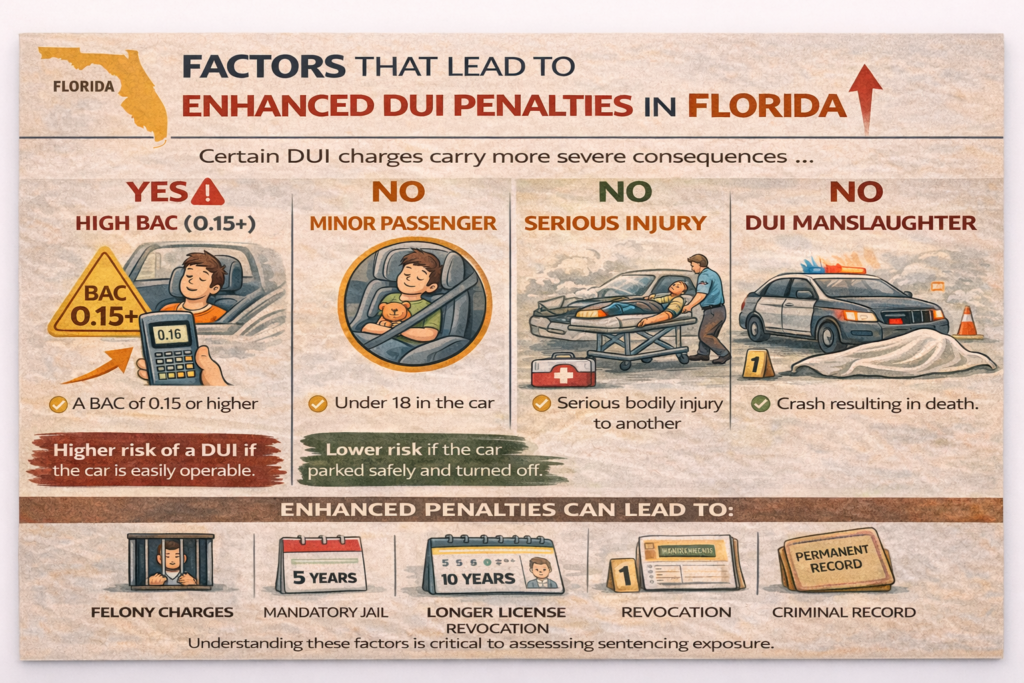
Certain DUI cases in Florida carry far more serious consequences than others. While some DUI charges remain misdemeanors, specific aggravating factors can dramatically increase penalties, trigger mandatory jail, or elevate a case to a felony.
This page explains the factors that lead to enhanced DUI penalties in Florida and how those enhancements affect sentencing exposure if a conviction occurs.
For a full breakdown of statutory penalties, see our guide to Florida DUI Penalties.
🎥 Video: How DUI Penalties Escalate in Florida
Attorney Michael White explains how aggravating factors can escalate DUI penalties in Florida.
⚖️ What Are DUI Penalty Enhancements in Florida?
A DUI enhancement refers to a specific aggravating factor that increases the severity of penalties after conviction. Enhancements may result in:
Higher fines
Longer license revocation periods
Mandatory ignition interlock requirements
Mandatory jail or prison sentences
Felony classification
Some enhancements apply even on a first DUI offense.
🔺 Common Factors That Lead to Enhanced DUI Penalties
1️⃣ High Blood Alcohol Content (BAC ≥ 0.15)
A BAC of 0.15 or higher increases penalties significantly, including:
Higher fines
Longer probation
Mandatory ignition interlock requirements
Increased jail exposure
These enhancements can apply even when no accident occurs.
2️⃣ Minor Passenger in the Vehicle
If a child under 18 was present at the time of the DUI:
Sentencing enhancements apply
Jail exposure increases
Ignition interlock requirements may be imposed
This factor applies regardless of whether an accident occurred.
3️⃣ Serious Bodily Injury (SBI)
If another person suffers serious bodily injury in a DUI-related crash:
The charge is elevated to a third-degree felony
Prison exposure increases significantly
License revocation is mandatory
These cases often carry sentencing consequences even for drivers with no prior record.
We break down how accident-based DUI charges are analyzed in our guide to DUI With an Accident in Florida.
4️⃣ DUI Manslaughter
If a DUI-related crash results in death:
The charge becomes DUI manslaughter
Mandatory minimum prison sentences apply
Long-term or permanent license revocation follows
DUI manslaughter cases are prosecuted aggressively and carry life-altering consequences.
🧠 Additional Factors That Can Increase DUI Penalties
Some factors may not independently create a felony but still increase sentencing exposure:
Prior DUI convictions (especially within 5 or 10 years)
Prior breath test refusals
Property damage resulting from the incident
Leaving the scene of a crash
These factors can eliminate eligibility for lenient sentencing or diversion options — and may significantly reduce the chances of avoiding incarceration, as discussed in our guide to How to Avoid Jail for DUI in Florida.
⚠️ Why DUI Enhancements Matter
Enhanced DUI penalties often:
Convert misdemeanors into felonies
Trigger mandatory jail or prison sentences
Extend license revocation periods
Create permanent criminal records
Understanding whether enhancement factors apply is critical when evaluating sentencing exposure.
We explain how these factors influence actual outcomes in our guide to DUI Sentencing in Florida.
💬 Frequently Asked Questions
Q: Can I still get a diversion program with an enhanced DUI?
A: Maybe. Some counties allow diversion for BAC ≥ 0.15, but not if there’s injury, a minor in the car, or repeat DUIs.
Q: Will I lose my license longer if I had a high BAC?
A: Yes. A high BAC may lead to a 12–18 month suspension and mandatory interlock.
Q: What if the other driver was partially at fault in a crash?
A: Your attorney can use this in negotiations or trial. DUI alone doesn’t automatically assign blame for a crash.
Q: Is DUI manslaughter a mandatory prison offense?
A: Yes. Florida law requires a minimum of 4 years in prison, even for first-time offenders.
📍 Facing DUI Charges With Aggravating Factors?
DUI enhancements can dramatically change the outcome of a case. Understanding how penalty exposure escalates is an essential first step after an arrest.