
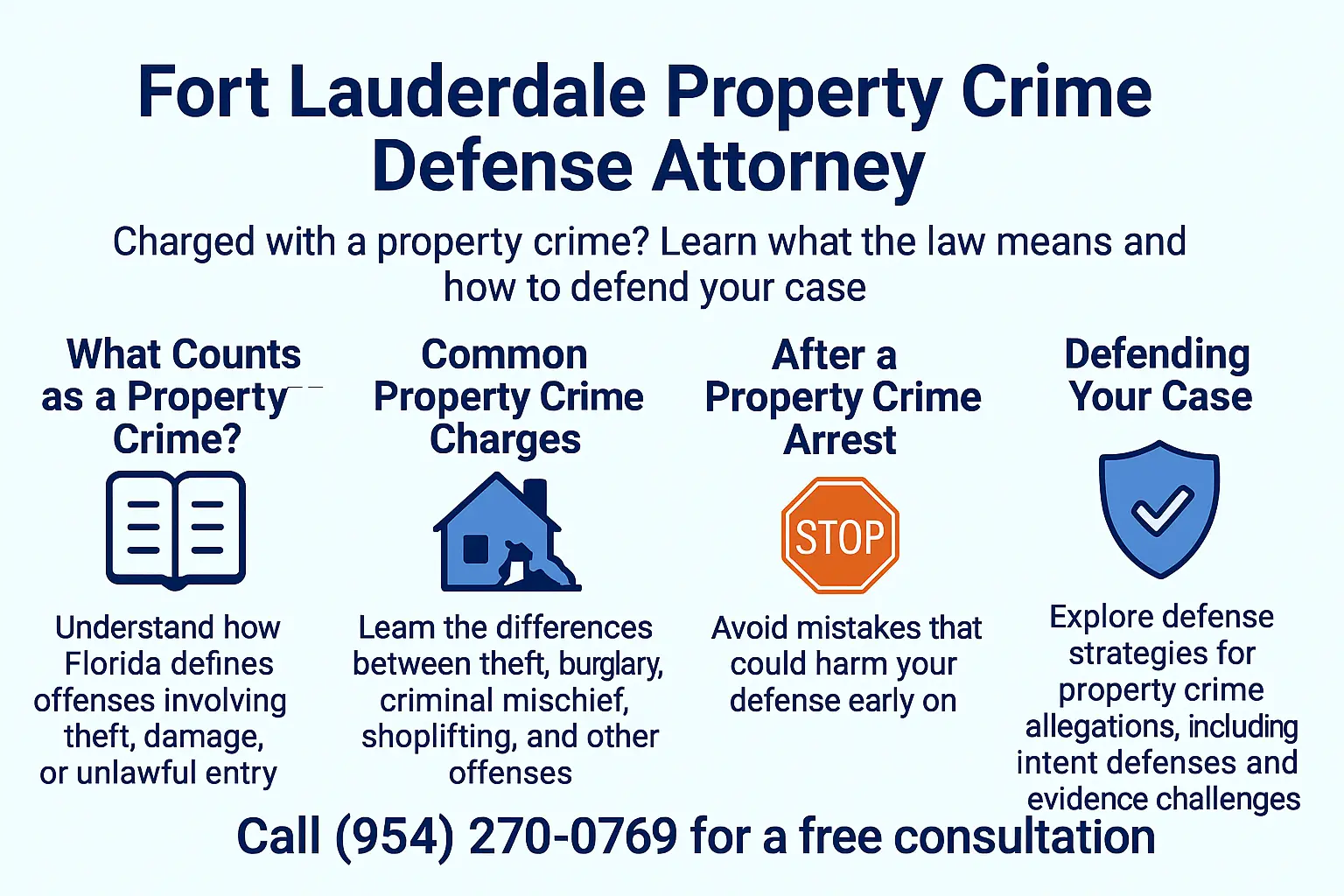
Horizontal infographic titled ‘Fort Lauderdale Property Crime Defense Attorney’ with four sections explaining what counts as a property crime, common property crime charges, what to do after a property crime arrest, and defense strategies. Includes icons of a book, a house with a burglar silhouette, a stop sign, and a shield, plus a call to call (954) 270-0769 for a free consultation.
You are here: Home > Property Crimes > 🏚️ Fort Lauderdale Property Crime Defense Attorney

🏚️ Fort Lauderdale Property Crime Defense Attorney

Last updated November 2025

Protecting Clients Charged With Burglary, Trespassing & Vandalism Across South Florida

If you’ve been arrested for a property crime in Fort Lauderdale or Broward County—whether it’s burglary, trespassing, or criminal mischief (vandalism)—you could be facing serious consequences. Florida law treats property crimes harshly, with penalties ranging from probation and restitution to felony convictions and mandatory prison time.

At Michael White, P.A., we understand how quickly these cases escalate and how aggressively prosecutors pursue them. As a former Broward County prosecutor, Michael White has handled hundreds of property crime cases on both sides of the courtroom. Today, he uses that insight to defend clients accused of burglary, trespass, vandalism, and related offenses throughout South Florida.

📞 Call (954) 270-0769 or book your free consultation to protect your future before speaking to law enforcement.

🧱 Property Crimes in Florida: Definitions and Penalties

Under Florida law, a property crime is any offense that involves unlawful entry, damage, or interference with another person’s property. These cases range from trespassing and vandalism (criminal mischief) to more serious charges like burglary of a dwelling, structure, or conveyance.

Whether you are charged in Fort Lauderdale, Broward County, or elsewhere in South Florida, the penalties can be severe. Misdemeanor trespass may carry up to 60 days in jail, while felony burglary can result in years of prison, restitution, and a permanent criminal record.

A knowledgeable Fort Lauderdale criminal defense attorney can explain your options,

⚖️ Penalties for Property Crimes in Florida

Florida law imposes strict penalties for property crimes, and the severity depends on the charge, the value of damage, and whether weapons or prior convictions are involved:

  • Trespassing (Fla. Stat. §§ 810.08 & 810.09)

    • Misdemeanor: Up to 60 days in jail and fines up to $500.

    • Felony: If the trespass occurs in a school, dwelling, or occupied structure, or if the defendant is armed → up to 5 years in prison and $5,000 in fines.

  • Criminal Mischief (Vandalism) – Fla. Stat. § 806.13

    • Damage under $200 → Misdemeanor, up to 60 days in jail.

    • Damage between $200 and $1,000 → First-degree misdemeanor, up to 1 year in jail.

    • Damage over $1,000 or to certain protected property (schools, places of worship, public utilities) → Third-degree felony, up to 5 years in prison and restitution.

  • Burglary – Fla. Stat. § 810.02

    • Burglary of a structure or conveyanceThird-degree felony, up to 5 years in prison.

    • Burglary of a dwellingSecond-degree felony, up to 15 years in prison.

    • Burglary with assault, battery, or a weaponFirst-degree felony, punishable by up to life in prison.

  • Possession of Burglary Tools – Fla. Stat. § 810.06

    • Third-degree felony, up to 5 years in prison.

Even first-time offenders face permanent criminal records, immigration issues, and lasting consequences. A skilled Fort Lauderdale property crime defense attorney can often negotiate alternatives such as diversion programs, withholds of adjudication, or dismissal through pretrial motions.

🗂️ Common Property Crimes We Handle

At Michael White, P.A., we routinely represent clients in Fort Lauderdale and across Broward County facing charges such as:

👉 Related reading:

Trespassing vs. Burglary in Florida

Sealing & Expungement in Florida

Fort Lauderdale Criminal Defense Lawyer

⚠️ Why Property Crimes Shouldn’t Be Taken Lightly

Even seemingly minor charges like trespassing or graffiti can carry:

  • Jail or prison time
  • Lengthy probation
  • Thousands in restitution or fines
  • Permanent criminal records that affect housing, jobs, and immigration

And for felony property crimes like burglary, sentencing enhancements may apply if weapons or prior offenses are involved.

👉 Trespassing vs. Burglary in Florida: Key Differences Explained

🛡️ Common Defenses to Property Crime Charges

Every property crime case is different, but there are several proven defenses that can protect your rights and help avoid a conviction:

❌ Lack of Intent

Most property crimes, including burglary (Fla. Stat. § 810.02) and criminal mischief (Fla. Stat. § 806.13), require proof of intent. If prosecutors cannot establish that you knowingly intended to trespass, damage, or commit a crime inside a structure, the charges may not hold. For example, simply being near damaged property or carrying tools does not automatically prove criminal intent. This is often a key angle in motions to dismiss.

🏷️ Permission or Lawful Presence

Trespass charges under Fla. Stat. § 810.08 can often be challenged if you had permission—or reasonably believed you had permission—to be on the property. These situations frequently arise in landlord-tenant disputes, domestic disagreements, or shared property arrangements. If your lawyer can show that you had lawful access, the State may be forced to drop or reduce the charges.

🚫 Mistaken Identity

Police and prosecutors often rely on shaky eyewitness testimony or poor-quality surveillance footage in property crime cases. Unfortunately, innocent people are misidentified, especially in nighttime incidents or chaotic environments. A defense attorney can cross-examine witnesses, challenge lineup procedures, and introduce alibi evidence to show you were not the person involved. Misidentification defenses are powerful in burglary and vandalism cases.

🧰 Burglary Tools Defense

Simply possessing a common tool—like a crowbar or screwdriver—does not prove burglary under Fla. Stat. § 810.06. The State must prove that you intended to use the tool for an unlawful purpose, which is often very difficult. Many people carry tools for work or everyday use, and that lawful explanation can defeat the prosecution’s case. Without clear evidence of criminal intent, a burglary tools charge may collapse in court.

Attorney Michael White has handled hundreds of property crime cases—on both sides of the courtroom. As a former prosecutor, he understands the strategy behind how these charges are filed and fought.

We take a proactive, aggressive approach to get charges dismissed, reduced, or resolved through diversion programs wherever possible.

📞 Call (954) 270-0769 or request a consultation online


👨‍⚖️ Former Prosecutor. Now Your Advocate.

❓ Frequently Asked Questions – Property Crimes in Florida

1. What is considered a property crime in Florida?

Property crimes in Florida include any unlawful entry, damage, or interference with another person’s property. Common examples are trespassing (Fla. Stat. §§ 810.08 & 810.09), burglary (Fla. Stat. § 810.02), criminal mischief (vandalism, Fla. Stat. § 806.13), and possession of burglary tools. In Fort Lauderdale and Broward County, even “minor” property crimes can carry jail, probation, and restitution.

2. Is trespassing a misdemeanor or felony in Florida?

Most trespass charges in Florida are misdemeanors punishable by up to 60 days in jail. However, trespass becomes a felony if it occurs in a school, dwelling, or occupied structure, or if the accused was armed at the time. In Broward County, prosecutors pursue these cases aggressively, so hiring a Fort Lauderdale trespassing defense lawyer quickly is critical.

3. Can I be charged with burglary for entering a car or garage?

Yes. Under Florida Statute § 810.02, burglary covers more than just homes — entering a vehicle, garage, shed, or other conveyance with intent to commit a crime can lead to burglary charges. In Fort Lauderdale, burglary of a conveyance is a common arrest, often tied to alleged theft from cars. Penalties can include felony convictions and prison time.

4. What if I had permission to be on the property?

If you had permission or reasonably believed you were allowed to enter, that can be a valid defense to trespass or burglary. For example, disputes often arise from landlord-tenant conflicts or shared property. A skilled defense lawyer can raise this defense early and may get the case reduced or dismissed. Learn more about Trespassing vs. Burglary in Florida.

5. Can a lawyer get my property crime charge dismissed or reduced?

Yes. A Fort Lauderdale property crime defense attorney can challenge whether the State proved intent, dispute eyewitness identification, or file motions to suppress evidence from unlawful searches. In many cases, attorneys also secure diversion programs or withholds of adjudication, especially for first-time offenders. These options can keep your record clean and make you eligible for sealing or expungement.

6. Will I go to jail for a property crime in Florida?

It depends on the charge and your record. Misdemeanor trespass may result in probation, while felony burglary carries the possibility of prison time. Factors like damage value, prior convictions, and whether a weapon was involved influence sentencing. In Broward County, we often negotiate outcomes that avoid jail through diversion or reduced charges.

7. Can property crime convictions be sealed or expunged in Florida?

You cannot seal or expunge a property crime conviction. However, if your case was dismissed, reduced, or resolved with a withhold of adjudication, you may qualify. For example, a dismissed criminal mischief charge may be eligible. Our firm regularly helps clients pursue record sealing and expungement in Fort Lauderdale.