
Last updated February 2026
Former Prosecutor. Strategic Firearm Defense. Immediate Action Required.
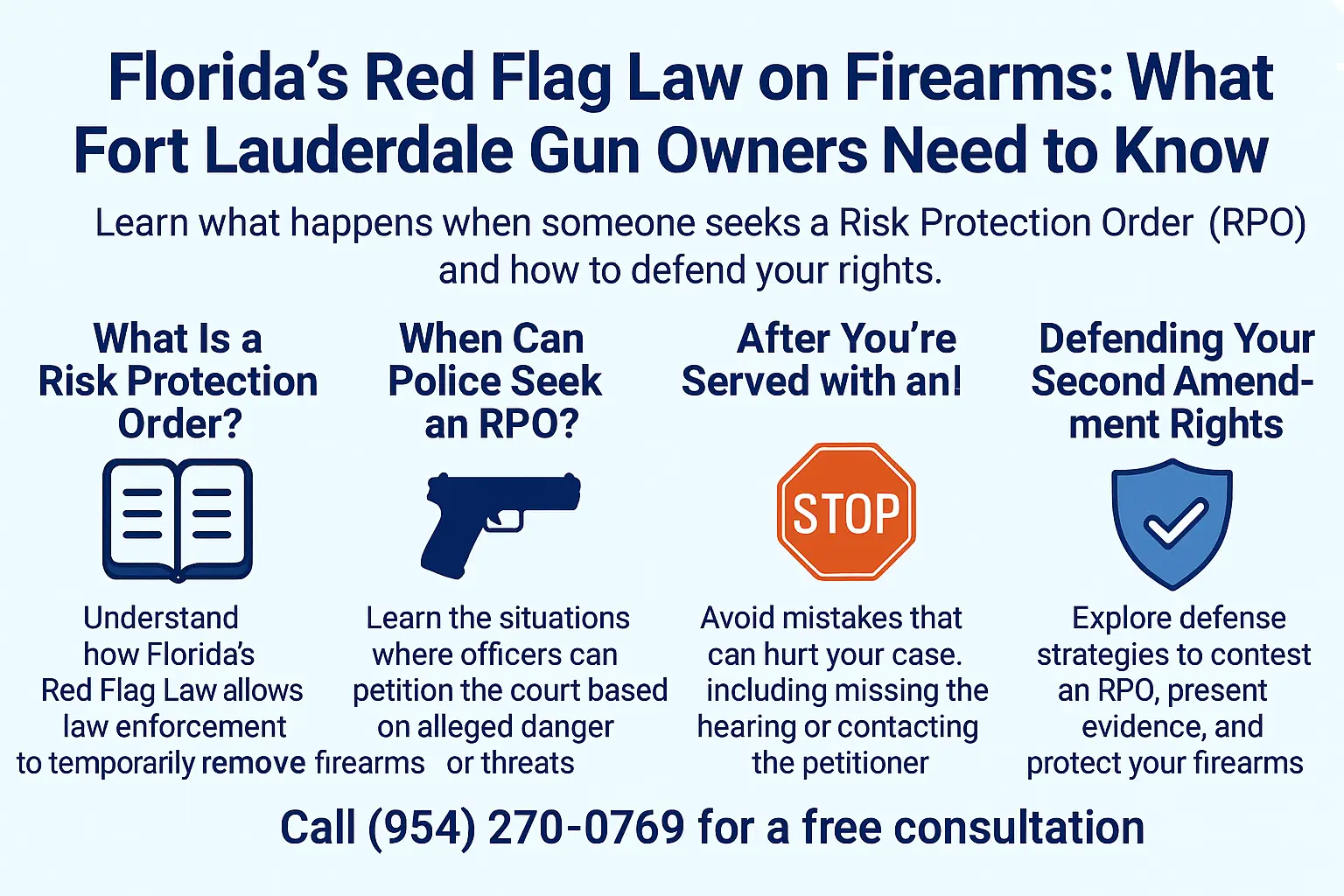
Florida’s Risk Protection Order (RPO) law—often called the “Red Flag Law”—allows law enforcement to seek a court order that temporarily restricts a person’s access to firearms and ammunition even when no criminal charges have been filed.
These cases move fast. A temporary order can be issued without warning. Firearms can be seized immediately. And if you do not appear at the final hearing, the court can enter an order by default that lasts up to 12 months—and may be extended.
If you’ve been served with an RPO in Fort Lauderdale or anywhere in Broward County, Miami-Dade, or Palm Beach, early defense strategy matters.
📞 Call (954) 270-0769 or request a confidential consultation before your hearing.
⚖️ What Is a Risk Protection Order in Florida?
Under Fla. Stat. § 790.401, only law enforcement may file a petition for a Risk Protection Order. Private individuals cannot file directly, but a report from a spouse, ex-partner, neighbor, co-worker, or family member often triggers police involvement.
An RPO can:
Require you to surrender firearms and ammunition immediately
Prevent you from purchasing or receiving firearms while the order is active
Trigger the surrender or suspension of your concealed weapons license
Place restrictions into background check systems during the order’s duration
Remain in effect for up to 12 months (with possible extension)
These orders are civil—not criminal—but they can carry serious real-world consequences for your rights, your reputation, and your career.
🏛️ How Risk Protection Orders Work in South Florida
1️⃣ Temporary (Ex Parte) Risk Protection Order
A judge may issue a temporary RPO without you present if law enforcement claims there is reasonable cause to believe you pose an immediate danger.
If a temporary order is granted, it typically involves:
Immediate surrender or seizure of firearms and ammunition
Service by law enforcement
A fast court date for the final hearing
2️⃣ Final Hearing (Usually Within 14 Days)
The final hearing is where these cases are won or lost.
At the hearing, law enforcement must generally prove the statutory requirements by clear and convincing evidence. You have the right to:
Appear with an attorney
Present evidence and witnesses
Cross-examine law enforcement witnesses
Challenge unreliable or exaggerated claims
Offer mental health or medical evidence when appropriate
⚠️ Many people lose RPO hearings simply because they do not appear. Showing up prepared—especially with counsel—dramatically improves your odds.
3️⃣ Final Order (Up to 12 Months)
If the court grants a final RPO, it can:
Prohibit firearm possession and new firearm purchases
Require ongoing compliance with surrender requirements
Continue reporting restrictions during the order’s duration
Be extended if law enforcement petitions for renewal
🔍 What Evidence Can Be Used Against You?
RPO petitions often rely on fast-moving allegations—sometimes based on limited investigation. Judges may consider:
Alleged threats (direct or indirect)
Domestic disputes or welfare checks
Claims involving mental health crises or suicide concerns
Prior arrests or alleged violent behavior
Substance abuse allegations
Witness statements and officer affidavits
Text messages, emails, and social media activity
Even when no crime occurred, vague statements and secondhand reports can be used to justify temporary firearm restrictions unless they are tested in court.
📱 Social Media, Texts, and “Out of Context” Evidence
In South Florida, RPO cases increasingly include digital evidence:
Old photos at a range
Group pictures where a firearm is visible
Posts taken out of context
Messages written during a heated argument
Comments interpreted as threats
Digital evidence should be evaluated for context, timeline, authenticity, and whether it actually shows access or control over a firearm. In many cases, careful review reveals that the evidence is exaggerated, stale, or misleading.
🚫 RPOs Can Turn Into Criminal Problems
Although an RPO is a civil court order, violations can become criminal.
If you are accused of possessing a firearm while an RPO is active—or attempting to buy one—law enforcement may pursue felony charges under Florida law. These situations can also trigger broader firearm investigations, especially where officers claim “access” or “constructive possession.”
If you believe law enforcement is looking for a violation, you should get counsel involved immediately—before a civil case turns into a criminal one.
👮 Veterans, First Responders, and Security Professionals
For veterans, law enforcement officers, military members, and security professionals, an RPO can create additional risks beyond firearm restrictions, including:
Employment and duty status issues
Clearance or credential impacts
Administrative investigations
Reassignment or leave pending the hearing outcome
RPO allegations in these cases often stem from stress-related events, misinterpretations, or stigma tied to PTSD or trauma. The court must evaluate actual legal risk—not assumptions.
🛡️ How a Fort Lauderdale Firearms Attorney Can Help
Risk Protection Order cases are not the place to “wait and see.” The petition is already framed against you—and the hearing date comes quickly.
At Michael White, P.A., we act fast to:
Challenge unsupported or exaggerated allegations
Cross-examine law enforcement witnesses
Attack hearsay-heavy affidavits and weak investigations
Present favorable evidence and witnesses
Introduce mental health evaluations when appropriate
Argue for denial, dismissal, or limited relief
Protect your concealed carry privileges and firearm rights
As a former prosecutor, Michael White understands how these petitions are built—and how to dismantle them in court.
🔄 Can a Risk Protection Order Be Terminated Early?
In many cases, yes. Florida law allows a person subject to a final RPO to petition the court for termination or modification under certain conditions.
But the burden is on you. Winning termination typically requires:
Evidence that circumstances have materially changed
Evidence that you do not pose a significant risk
A well-prepared hearing presentation
🔓 Getting Your Firearms Back After an RPO
If the RPO is dismissed, expires, or is terminated, you may be eligible to request the return of your firearms and ammunition. In practice, this process can involve:
Court filings or orders
Agency property procedures
Proof of eligibility to possess firearms
Avoiding delays and administrative pushback
An attorney can help ensure the return process is handled promptly and lawfully.
📍 Served With an RPO in Fort Lauderdale or South Florida?
If you’ve been served with a Risk Protection Order petition, do not ignore it—and do not assume the judge will “see through it” automatically. These hearings move quickly, and default outcomes are common when people fail to appear.
📞 Call (954) 270-0769 or request a confidential consultation online.