
Last updated April 2026
In a Florida criminal trial, the State must prove every element of the charge beyond a reasonable doubt. When the prosecution’s evidence is legally insufficient—even if you assume the judge believes all of it—the defense can ask the court to end the case immediately.
That request is called a Motion for Judgment of Acquittal (JOA).
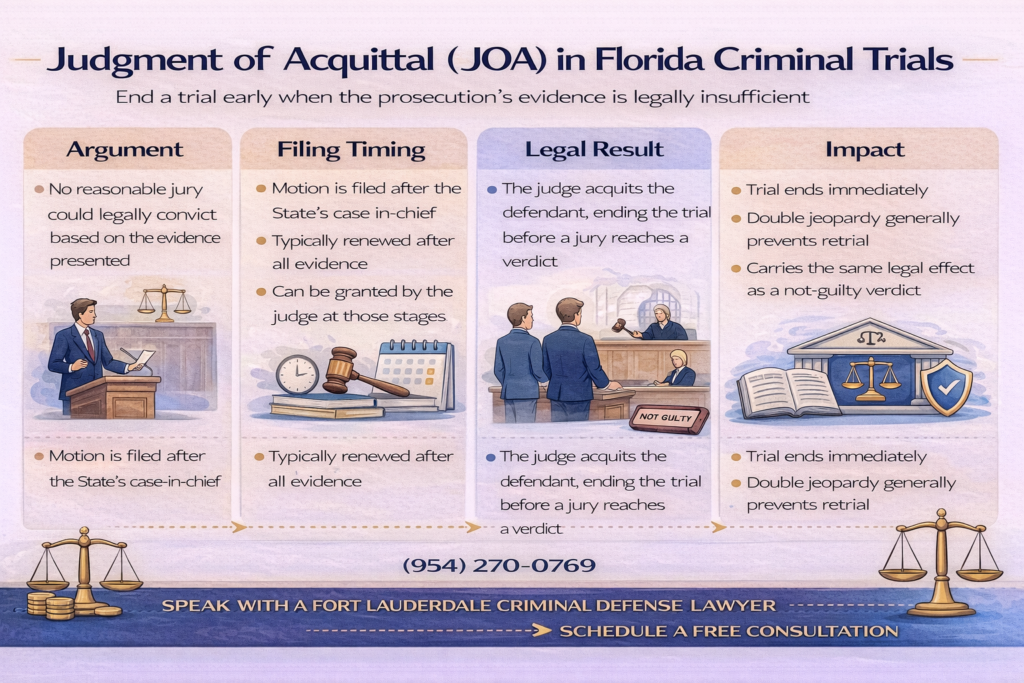
A granted JOA results in an acquittal and ends the trial before the case reaches a jury verdict.
For a broader overview of the other ways evidence is attacked—suppression motions, forensic challenges, and credibility issues—see our guide to challenging criminal evidence in Florida.
🔍 What Is a Motion for Judgment of Acquittal?
A Motion for Judgment of Acquittal argues that no reasonable jury could legally convict based on the evidence presented, even when the evidence is viewed in the light most favorable to the prosecution.
A JOA challenges legal sufficiency, not credibility.
That means a JOA is not about whether a witness is believable. It’s about whether the State’s evidence proves the required elements as a matter of law.
If the judge grants the motion, the court enters a judgment of acquittal and the case ends.
⚖️ Why a JOA Matters
A successful JOA can:
End a trial immediately
Prevent the case from going to the jury
Create a final acquittal that generally triggers double jeopardy protections
In other words, when the State’s proof doesn’t meet the legal minimum, a JOA can be the fastest route to a not guilty outcome.
📆 When Is a JOA Filed?
Most defense attorneys move for a JOA:
✅ At the close of the State’s case
✅ Again at the close of all evidence
Filing at both stages is critical. If the motion is not made (or not renewed) at the proper time, certain sufficiency arguments may be limited on appeal.
⚖️ The Legal Standard for a JOA in Florida
Florida courts evaluate a JOA by asking:
Could a rational jury find each element proven beyond a reasonable doubt based on the evidence presented—viewed in the light most favorable to the State?
If the answer is no, the judge should grant the motion.
On appeal, legal sufficiency issues are typically reviewed de novo, meaning the appellate court reviews the legal question without deferring to the trial judge’s conclusions.
🚫 What Happens If a JOA Is Granted?
If the judge grants a JOA:
The trial ends immediately
The court enters a judgment of acquittal
Double jeopardy protections generally prevent the State from retrying the defendant for the same offense after an acquittal
In rare circumstances, the State may pursue a limited appellate review of certain legal rulings, but an acquittal itself is ordinarily final.
A judge may also grant a JOA sua sponte (on the court’s own motion), though it is more common for the defense to request it.
🧠 JOA vs. Other Evidence Challenges
A JOA is only one tool in an evidence-focused defense.
Other common approaches include:
Motions to suppress (illegal searches, seizures, or statements)
Motions to exclude evidence (hearsay, relevance, authentication issues)
Forensic challenges (lab errors, contamination, weak methodology)
Cross-examination attacking reliability and inconsistencies
For the doctrinal foundation behind these arguments, see our breakdown of Florida standards of proof and evidentiary burdens.
📍 Judgment of Acquittal in Fort Lauderdale Criminal Defense Cases
JOA issues can arise in virtually any criminal trial, but they are especially common when the State’s proof depends on assumptions, weak identifications, missing elements, or questionable “constructive” theories.
Examples include:
Drug cases (possession, trafficking, constructive possession)
DUI trials (impairment or driving proof issues)
Assault and battery (identity, intent, lawful use of force)
Sex offense cases (credibility + corroboration issues)
White-collar and fraud cases (intent and reliance elements)
Firearm cases (possession/knowledge elements)
At Michael White, P.A., we prepare cases for trial early so we can immediately exploit gaps in the State’s proof if they appear at trial.
📞 Call (954) 270-0769 to schedule a consultation.
💬 Judgment of Acquittal FAQs
Is a JOA the same as a not-guilty verdict?
A granted JOA results in an acquittal entered by the judge and carries the same practical effect as a not-guilty verdict.
Can a judge grant a JOA without a motion?
Yes. A judge may grant a JOA on the court’s own motion if the evidence is legally insufficient, though defense counsel typically raises it.
Can the State appeal a judgment of acquittal?
An acquittal is generally final under double jeopardy principles, which typically prevents retrial after a judgment of acquittal.
What kinds of cases most commonly involve JOAs?
Any case where the evidence fails to prove an element. This often includes constructive possession drug cases, identification disputes, and intent-heavy offenses like fraud.
What happens if a JOA is denied?
The trial continues to verdict. Defense counsel typically renews the motion at the proper stages to preserve sufficiency issues for post-trial motions and appeal.