
Last updated May 2026
Florida probation allows someone to remain in the community instead of serving time in jail or prison—but it comes with strict conditions. When those conditions are violated, the consequences can escalate quickly, often leading to arrest, a no-bond warrant, and the possibility of serving the entire suspended sentence.
Whether you’re currently on probation or under investigation for a potential violation, understanding how probation works—and how violations are handled—is critical.
In Florida, most serious probation issues arise from alleged violations—commonly called Violations of Probation (VOPs)—where judges have wide discretion and cases move quickly.
The good news: many probation violations can be defended, mitigated, or resolved without jail or prison—especially when addressed early and strategically. This guide explains how probation works in practice, what happens when a violation is alleged, and the defense strategies that matter most.
⚖️ How Probation Works in Florida (Quick Overview)
In Florida, probation is a court-ordered alternative to incarceration that requires compliance with specific conditions set by the judge and enforced by a probation officer.
Common probation conditions include:
- Reporting regularly to a probation officer
- Completing community service hours
- Submitting to drug or alcohol testing
- Attending counseling, classes, or treatment programs
- Paying fines, court costs, or restitution
- Avoiding new arrests or criminal activity
- Following travel and residency restrictions
The exact terms depend on the underlying charge and the judge’s discretion. Some cases involve standard probation, while others include enhanced supervision or specialized conditions (such as DUI probation or drug offender probation).
While probation allows you to stay out of custody, it is not informal or flexible. Even minor issues—like missed appointments, incomplete classes, or payment problems—can trigger a violation proceeding.
🚨 Where Most Probation Cases Go Wrong
In practice, the most serious legal risk is not the original sentence—it’s the allegation that probation was violated.
A probation violation in Florida—commonly called a Violation of Probation (VOP)—can lead to:
- Immediate arrest
- A no-bond warrant in many cases
- A fast-moving court process with limited procedural protections
- The possibility of serving the full suspended sentence
Most violations are based on technical issues rather than new crimes, but judges have wide discretion in how these cases are handled.
👉 That’s why understanding how VOPs work—and how they are defended—matters.
🔗 Understanding Probation Violations in Florida
If you’re facing a violation of probation, different issues can affect how your case is handled:
- What happens at a VOP hearing in Florida
- Bond on a probation violation in Florida
- Being held without bond on a probation violation
- Technical vs. substantive probation violations
- What “willful and substantial” means
- When a probation violation can be dismissed
- New arrests while on probation
- VFO-SC probation violations explained
- Failure to Pay Fines And Or Restitution While on Probation in Florida
- Failure to pay fines or restitution on probation
📜 What Counts as a Probation Violation?
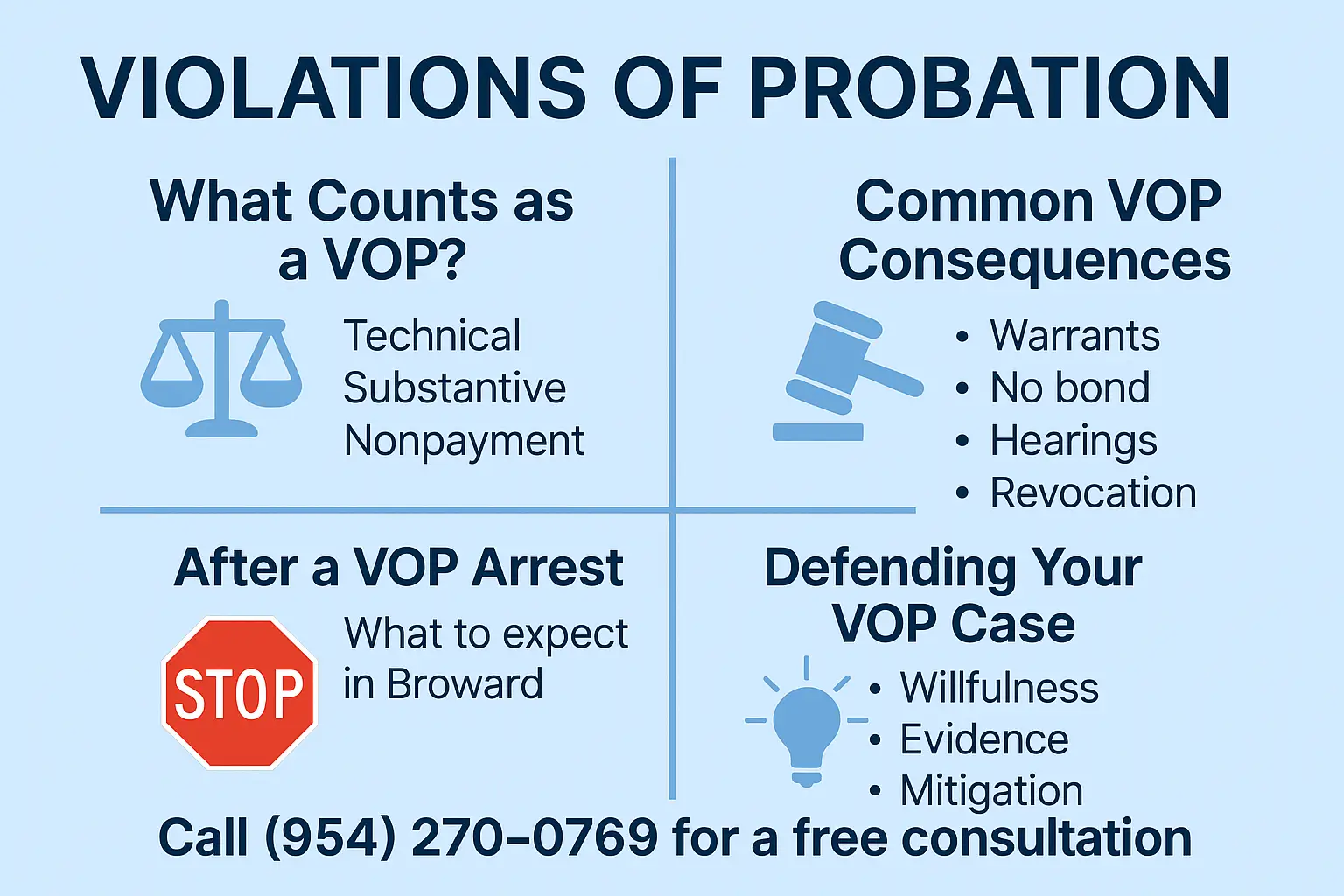
Under Florida Statute § 948.06, a probation officer may allege a violation for failing to comply with any condition of probation. Violations generally fall into three categories.
To see how courts evaluate these cases, see what happens at a VOP hearing in Florida.
1️⃣ Technical Violations (No New Crime)
A technical violation means you allegedly broke a condition of probation but did not commit a new offense.
Common examples include:
-
Missing a probation appointment
-
Late or missed drug or alcohol testing
-
Failure to complete required classes or counseling
-
Curfew violations
-
Failure to report address or employment changes
-
Incomplete community service hours
-
Failure to pay costs or restitution (only if willful)
To better understand how Florida courts distinguish between different types of violations, review our guide on Technical vs. Substantive Probation Violations in Florida.
For a deeper explanation of how courts evaluate these cases, see what happens at a VOP hearing in Florida.
Most probation violations in Florida are technical, and many are defensible with proper documentation and mitigation.
One of the most common technical violations involves missed or failed drug tests. Learn what happens next in missed drug test on probation in Florida.
If this your first alleged violation, see our guide on First-Time VOPs in Florida.
If your underlying case is DUI-related, review DUI Probation Terms in Florida to understand common conditions that trigger violations.
2️⃣ Substantive Violations (New Alleged Crime)
A substantive violation occurs when you are accused of committing a new criminal offense while on probation.
Important points:
-
A new arrest is not a conviction
-
The State does not need to prove guilt beyond a reasonable doubt
-
Judges may find a violation based on probable cause alone—unless challenged effectively
When a violation is based on a new arrest, the process differs significantly from a standard criminal case. Learn more in New Law Violations While on Probation in Florida.
This makes early legal intervention critical.
3️⃣ Failure to Pay Fines or Restitution
You cannot be violated for nonpayment unless the State proves the failure was willful.
If nonpayment resulted from:
-
Job loss
-
Medical hardship
-
Disability
-
Other legitimate financial barriers
Florida law prohibits revoking probation solely for inability to pay. For an in-depth explanation of how courts evaluate nonpayment, see failure to pay fines or restitution on probation in Florida.
Florida law requires the violation to be willful and substantial. For a more extensive explanation of this legal standard, see Willful and Substantial Probation Violations in Florida.
🚨 What Happens After a Probation Violation Is Alleged?
Once a probation officer files an affidavit of violation:
-
A VOP warrant is typically issued
-
Many VOP warrants are no bond
-
You are brought before the original sentencing judge
-
The court determines whether the violation was:
-
Technical or substantive
-
Willful or non-willful
-
Proven by competent, substantial evidence
-
The judge may:
-
-
Reinstate probation
-
Modify probation
-
Revoke probation and impose the original sentence
-
If you are being held without bond, review Held Without Bond on a Probation Violation in Florida to understand your options.
In some cases, the goal is to prevent the violation from being sustained at all. Learn more about when a probation violation can be dismissed in Florida.
You may also want to read Can You Bail Out of Jail on a Probation Violation in Florida? for a full explanation of bond eligibility.
⚖️ How a VOP Hearing Is Different From a Trial
Probation violation hearings are not criminal trials.
Key differences include:
-
No jury
-
Judge decides the outcome
-
Lower burden of proof (greater weight / preponderance standard)
-
Hearsay evidence may be admitted
-
Limited confrontation rights
Although the standard is reduced, the State must still present competent, substantial evidence.
Evidentiary objections and strategic cross-examination remain critical.
To better understand how these hearings are structured, see what happens at a VOP hearing in Florida?
🧠 What Judges Actually Look For in Probation Violation Cases
In practice, probation violation cases are not decided by technical rules alone. Judges have broad discretion, and outcomes often depend on how the situation is presented.
Key factors judges typically consider include:
- Whether the violation was truly willful (or the result of circumstances outside your control)
- Your compliance history — whether you were otherwise doing well on probation
- The seriousness of the alleged violation
- Whether there is a new arrest or underlying criminal conduct
- Your credibility in court
- Whether you’ve taken steps to correct the issue (treatment, payments, etc.)
In many cases, the difference between reinstatement and jail time comes down to how clearly these factors are presented and supported with evidence.
🛡️ How Probation Violations Are Defended in Florida
🟦 1. Lack of Willfulness
Judges may reinstate probation if the violation was not intentional.
Common defenses include:
-
Illness or medical emergencies
-
Transportation problems
-
Employment conflicts
-
Miscommunication with probation officers
-
Housing instability
-
Inability to pay
🟦 2. Insufficient or Unreliable Evidence
Even under a reduced burden, the State’s evidence must still be reliable.
Defense strategies often challenge:
-
Hearsay-based affidavits
-
Missing or incomplete drug-test documentation
-
Unverified probation officer assumptions
-
Inconsistent or missing records
⚠️ Why Probation Violations Happen in Real Cases
Most probation violations are not the result of someone intentionally ignoring court orders.
Instead, they often arise from:
- Miscommunication with probation officers
- Scheduling conflicts with work or family obligations
- Confusion about reporting requirements or deadlines
- Financial hardship affecting payments or program completion
- Transportation issues or unstable housing
- Administrative errors or incomplete documentation
Understanding this distinction is critical. Courts are far more receptive to violations that are explained and supported than those that appear to be ignored.
🟦 3. Challenging New Criminal Allegations
A pending charge does not automatically violate probation.
If the alleged new offense lacks reliable proof, the violation may fail as well.
🟦 4. Mitigation Judges Actually Care About
Strong mitigation frequently determines whether probation is revoked.
Effective mitigation includes:
-
Proof of employment
-
Treatment or counseling enrollment
-
Negative drug tests
-
Prior compliance history
-
Family responsibilities
-
Demonstrated rehabilitation
🟦 5. Early Intervention Before Formal Filing
In some cases, violations can be resolved before a warrant issues—avoiding arrest, jail, and collateral damage.
Many defense strategies focus on preventing revocation entirely. Learn more about when a probation violation can be dismissed in Florida.
🚨 Can a Probation Violation Be Stopped Before a Warrant?
In some cases, yes.
If the alleged violation has not yet resulted in a formal affidavit or warrant, early legal intervention may:
-
Clarify misunderstandings
-
Provide documentation before filing
-
Demonstrate compliance or treatment
-
Negotiate corrective action
In some cases, early legal action can prevent the violation from being formally filed. See How to Stop a Probation Violation Before a Warrant Is Issued.
Preventing a no-bond warrant is often the most important step in protecting freedom.
⚠️ Violent Felony Offender of Special Concern (VFO-SC)
Certain probation violations involve individuals classified as Violent Felony Offenders of Special Concern (VFO-SC) under Florida law.
When this designation applies:
-
Judges have significantly reduced discretion
-
Defendants may be held without release pending the violation hearing
-
Mandatory detention or prison exposure is more likely if the violation is sustained
VFO-SC cases follow special statutory procedures and are treated very differently from standard technical or first-time violations. Defense strategy, timing, and evidence presentation are critical in these cases.
If you are classified as a Violent Felony Offender of Special Concern, the rules change dramatically. Review VFO-SC Probation Violations in Florida Explained for a breakdown of the heightened standards.
📈 Consequences of a Probation Violation in Florida
Misdemeanor VOP
-
Up to the full suspended misdemeanor sentence
-
Additional probation conditions
-
Fines, classes, or limited jail exposure
Felony VOP
-
Up to the entire suspended prison sentence
-
Mandatory prison exposure in certain cases
-
Habitual offender consequences may apply
📍 Probation Violations in Fort Lauderdale & Broward County
Probation violations in Broward County are handled in the Seventeenth Judicial Circuit, with hearings typically held at the Broward County Courthouse in Fort Lauderdale.
While Florida law governs all probation violations statewide, local courtroom procedures, probation officer practices, and judicial discretion can significantly affect how a VOP case is resolved. Some judges are more inclined to modify probation. Others may impose jail or prison sentences if violations are not addressed properly and early.
In Fort Lauderdale probation violation cases, timing is often critical. Once an affidavit is filed, a warrant may issue quickly — and many violation warrants are no bond. Early intervention can sometimes:
-
Prevent a warrant from being issued
-
Clarify misunderstandings before formal filing
-
Present mitigation before a judge forms an initial impression
-
Position the case for reinstatement rather than revocation
If you are facing a probation violation in Fort Lauderdale or anywhere in Broward County, it is important to work with a defense attorney who understands local procedures and how these hearings are actually handled in practice — not just in theory.
📍 How Probation Violation Cases Are Actually Handled in Broward County
While the law is statewide, probation violation hearings in Broward County often move quickly and are heavily influenced by how the case is presented early.
In practice:
- Many VOP cases are set quickly after arrest
- Judges expect mitigation to be prepared immediately
- Probation officers’ reports often shape the initial perception of the case
- Early legal intervention can significantly affect whether a case is framed as a minor issue or a serious violation
Because these hearings are judge-driven and not jury trials, preparation, timing, and credibility often matter more than technical legal arguments alone.
Why Local Experience Matters in VOP Cases
Violation of probation hearings move quickly and are decided by judges — not juries. Because the burden of proof is lower than at trial, outcomes often depend on credibility, preparation, and strategic presentation of mitigation.
An experienced Fort Lauderdale probation violation lawyer can:
-
Review the probation file for procedural errors
-
Challenge unreliable or hearsay-based evidence
-
Demonstrate lack of willfulness where appropriate
-
Present employment, treatment, or rehabilitation evidence
-
Advocate for reinstatement or modification instead of incarceration
In many cases, the difference between continued probation and jail time comes down to how the violation is framed and defended at the hearing.
⚠️ If you are under investigation for a probation violation or believe a warrant may be issued, acting quickly can significantly affect the outcome.
⚠️ Facing a probation violation in Florida?
Early action can be the difference between continued probation and incarceration. Understanding how VOPs actually work—and how they are defended—matters.