
Last updated April 2026
When a death occurs and criminal charges follow, Florida law classifies the case as a form of homicide. But “homicide” itself is not a single charge. It is a category that includes multiple offenses — each with different elements, penalties, and defenses.
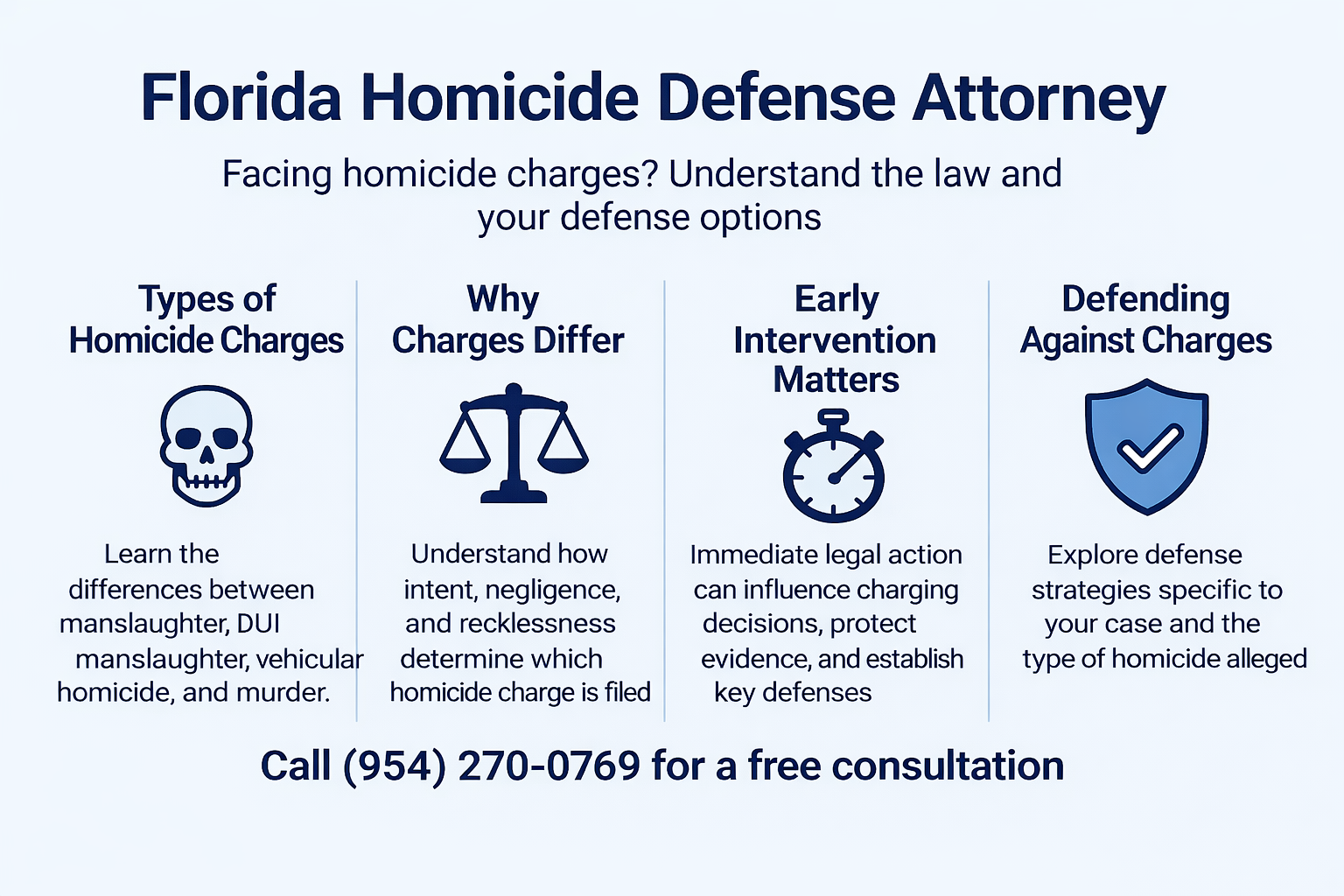
Understanding the differences between homicide charges is critical. The same incident can be charged very differently depending on intent, conduct, and surrounding circumstances.
This page explains how Florida homicide charges are structured, why prosecutors choose certain charges, and where each offense fits under Florida law.
🔍 What Does “Homicide” Mean Under Florida Law?
Homicide refers to the killing of one person by another. In Florida, homicide may be charged as:
Manslaughter
Vehicular homicide
DUI manslaughter
Second-degree murder
First-degree murder
The classification depends on intent, negligence, recklessness, use of force, and causation — not simply the fact that someone died.
Some homicides are criminally punishable. Others may be legally justified or accidental.
🧭 Why the Same Death Can Lead to Different Charges
Florida prosecutors evaluate homicide cases by asking:
Was the death intentional or unintentional?
Was force used?
Was the conduct reckless or negligent?
Was a vehicle or firearm involved?
Was the defendant impaired?
Did the defendant have a duty of care?
Small factual differences can mean the difference between probation exposure and decades in prison.
⚖️ Key Differences Between Homicide Charges in Florida
While all homicide charges involve the death of another person, the legal differences between them often come down to intent, recklessness, negligence, and surrounding circumstances.
Understanding these distinctions is critical because the potential penalties vary dramatically.
| Charge | Key Legal Element | Typical Penalty Exposure |
|---|---|---|
| Manslaughter | Reckless conduct or culpable negligence causing death | Up to 15 years prison |
| Aggravated Manslaughter | Death of a vulnerable victim (child, elderly person, disabled adult) caused by culpable negligence | Up to 30 years prison |
| Vehicular Homicide | Reckless driving causing death | Up to 15 years prison |
| DUI Manslaughter | Death caused while driving under the influence | Mandatory prison exposure |
| Second-Degree Murder | Act showing a depraved mind without regard for human life | Up to life imprisonment |
| First-Degree Murder | Premeditated killing or felony murder | Life imprisonment or death penalty |
Because these charges depend heavily on intent and surrounding circumstances, two cases involving similar facts may be prosecuted very differently.
🔗 Explore Individual Homicide Charges in Detail
Each type of homicide charge in Florida has unique elements, defenses, and legal standards. For a deeper breakdown of how these charges are investigated, prosecuted, and defended, explore the guides below:
• Manslaughter Charges in Florida
• Aggravated Manslaughter in Florida
• Vehicular Homicide in Florida
• Second-Degree Murder in Florida
• Attempted Murder in Florida
• First-Degree Murder in Florida
• The Felony Murder Rule in Florida
🧩 Types of Homicide Charges in Florida
⚖️ Manslaughter — § 782.07
Manslaughter generally involves the unlawful killing of another person without premeditation. It may arise from reckless conduct, culpable negligence, or acts not intended to cause death.
Florida law also recognizes aggravated manslaughter, which applies when a person’s conduct causes the death of particularly vulnerable victims such as children, elderly individuals, or disabled adults.
👉 See: Manslaughter Charges in Florida
👉 See: Aggravated Manslaughter in Florida
🚗 Vehicular Homicide — § 782.071
Vehicular homicide involves causing death through the operation of a motor vehicle in a reckless manner likely to cause death or great bodily harm.
👉 See: Vehicular Homicide in Florida
🍺 DUI Manslaughter — § 316.193
DUI manslaughter occurs when a death is caused while a driver is under the influence of alcohol or drugs. This offense carries mandatory prison exposure and severe sentencing consequences.
🔥 Second-Degree Murder — § 782.04
Second-degree murder involves an unlawful killing caused by an act that is imminently dangerous and demonstrates a depraved mind without regard for human life, but without proof of premeditation.
These cases often involve violent acts that prosecutors argue show extreme disregard for human life. Because the legal standard focuses on “depraved mind” conduct, disputes frequently arise over whether the evidence supports a murder charge or a lesser offense such as manslaughter.
👉 See: Second-Degree Murder in Florida
⚖️ Attempted Murder — § 777.04 / § 782.04
Attempted murder charges apply when prosecutors believe a person intended to cause another person’s death but the victim survived.
These cases often arise from shootings, stabbings, or other violent assaults where prosecutors argue the defendant acted with intent to kill. Because intent is a critical element, many attempted murder prosecutions involve disputes over whether the conduct actually demonstrates an intent to cause death.
👉 See: Attempted Murder in Florida
⚖️ First-Degree Murder — § 782.04
First-degree murder is the most serious homicide charge under Florida law. It typically applies when a killing is premeditated or occurs during the commission of certain dangerous felonies under the felony murder rule.
These cases often involve allegations of planned violence or deaths that occur during crimes such as robbery, burglary, or kidnapping. First-degree murder is classified as a capital felony and may carry life imprisonment or the death penalty.
👉 See: First-Degree Murder in Florida
⚖️ Felony Murder Rule — § 782.04
Florida’s felony murder rule allows prosecutors to charge murder when a death occurs during the commission of certain serious felonies — even if the defendant did not intend to kill anyone.
Under this doctrine, participants in crimes such as robbery, burglary, kidnapping, or carjacking may face murder charges if a death occurs during the felony. The rule can dramatically increase potential penalties and often becomes a central issue in homicide prosecutions.
⚠️ Prosecutorial Discretion in Homicide Cases
Homicide cases are among the most aggressively charged in Florida. Prosecutors often file the highest possible charge early and adjust downward only after reviewing evidence, medical findings, and witness credibility.
Early legal intervention can influence:
charging decisions
whether enhancements apply
bail and pretrial detention
preservation of critical evidence
🛡️ Common Defenses in Florida Homicide Cases
Homicide defenses vary widely depending on the charge, but may include:
Lack of intent
Accident or misadventure
Self-defense or justifiable use of force
Insufficient causation
Medical causation disputes
Constitutional violations during investigation
Each homicide charge has unique elements that must be proven beyond a reasonable doubt.
👉 Learn how self-defense and Stand Your Ground immunity can apply in homicide cases in our guide to Self-Defense and Stand Your Ground Immunity
📍 Facing a Homicide Investigation or Charge in Florida?
Homicide allegations demand immediate legal attention. Early decisions often determine the trajectory of the entire case.
Learn more about how an experienced violent crimes defense attorney in Fort Lauderdale approaches homicide cases, evaluates charging decisions, and protects defendants’ rights.
❓ Frequently Asked Questions About Homicide Charges in Florida
What does “homicide” mean under Florida law?
“Homicide” refers to the killing of one person by another. In Florida, homicide is a category that includes several different criminal charges—such as manslaughter, vehicular homicide, DUI manslaughter, and murder—each with its own legal elements and penalties.
Is homicide always a crime in Florida?
No. Not every homicide is criminal. Some deaths may be accidental, justified, or the result of lawful self-defense. Whether a homicide is criminal depends on intent, conduct, negligence, and the surrounding circumstances.
What is the difference between manslaughter and murder in Florida?
The primary difference is intent. Manslaughter generally involves an unlawful killing without premeditation, often based on reckless conduct or negligence. Murder charges involve intentional acts or a depraved mind showing disregard for human life, with first-degree murder requiring premeditation or specific felony circumstances.
Can homicide charges change after an arrest?
Yes. Homicide charges often change as evidence develops. Prosecutors may initially file the most serious charge and later reduce or amend it based on medical evidence, witness credibility, forensic analysis, or legal challenges raised by the defense.
Do homicide cases always result in prison time?
Not always. Outcomes depend on the specific charge, the defendant’s criminal history, sentencing guidelines, and whether defenses such as self-defense, accident, or lack of causation apply. Some cases are reduced or dismissed entirely.
What role does medical evidence play in homicide cases?
Medical and forensic evidence is critical. Prosecutors must prove causation—that the defendant’s actions actually caused the death. Disputes over timelines, injuries, or contributing medical conditions often become central defense issues.
Should I speak to police if I’m being investigated for a homicide?
No. Homicide investigations are extremely high-stakes. Anything you say can be used against you later. You should speak with a defense attorney immediately before making any statements to law enforcement.
Can self-defense apply in homicide cases?
Yes. Florida law allows justifiable use of force, including deadly force, in limited circumstances. Self-defense claims depend heavily on facts, evidence, and whether the force used was legally justified under the circumstances.
What should I do if I believe homicide charges may be filed?
Seek legal counsel immediately. Early intervention can influence charging decisions, preserve favorable evidence, and prevent mistakes that may later limit defense options.