
Last updated March 2026
🔫 Florida's 10-20-Life Law: What It Means and Who It Affects
Updated for 2025 — Understanding Florida’s Harsh Mandatory Minimum Gun Sentences
Florida’s “10-20-Life” law—codified under Fla. Stat. § 775.087—requires mandatory minimum prison sentences when a firearm is possessed, discharged, or used during certain serious felonies.
If you’re facing a firearm-related charge in Fort Lauderdale or South Florida, understanding this statute is critical — because it can force judges to impose decades in prison, even for first-time offenders.
For a broader overview of Florida firearm charges and how sentencing enhancements apply, see our guide to Gun Crime Charges in Florida.
📜 What Is the 10-20-Life Law?
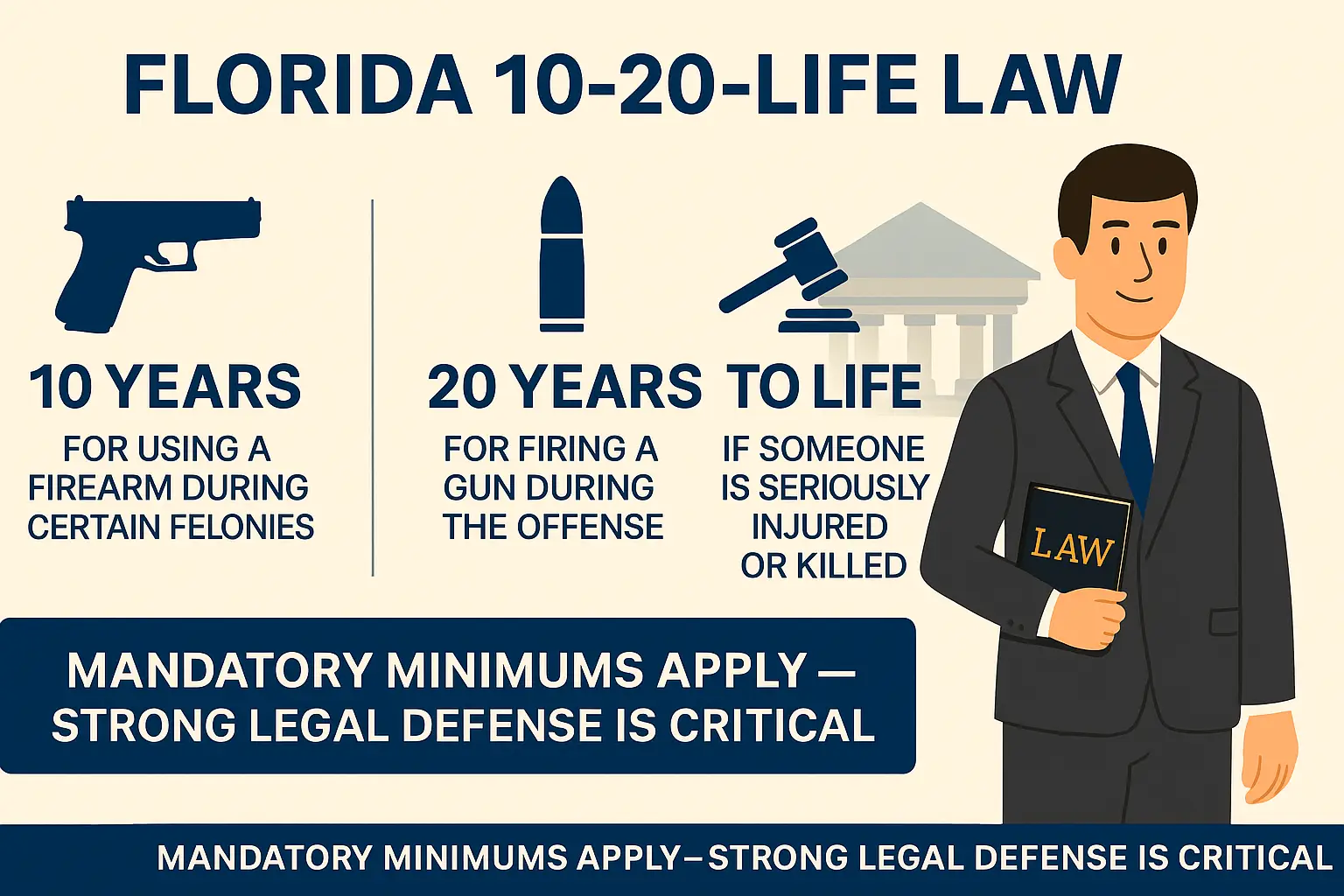
Under § 775.087, if you’re convicted of a qualifying felony and a firearm is involved, the minimum penalties are:
🔟 10 years
If you possessed a firearm during the crime. “Possession” can include actual possession, constructive possession, or liability under Florida’s principals theory — all of which are frequently challenged. To understand how constructive possession is proven in firearm cases, see our guide to Constructive Possession of a Firearm in Florida.
2️⃣0️⃣ 20 years
If you discharged a firearm (even if no one was injured).
2️⃣5️⃣–🔒 25 years to life
If you discharged a firearm and caused serious bodily injury or death.
💡 These mandatory minimums run consecutively to any sentence imposed for the underlying felony — not concurrently, meaning the firearm sentence is added on top of the sentence for the underlying felony — not served at the same time.
⚖️ Enhanced Penalties for Certain Weapons
If the firearm is:
an assault weapon,
a semiautomatic firearm with a high-capacity magazine, or
a machine gun,
…the minimums increase to:
15 years (possession)
20 years (discharge)
25 years to life (injury/death)
These enhancements are common in Broward trafficking, robbery, and violent crime cases.
🧨 Felonies That Trigger 10–20–Life
The statute applies to many serious felonies, including:
Murder — § 782.04
Sexual Battery — § 794.011
Robbery — § 812.13
Burglary — § 810.02
Arson — § 806.01
Aggravated Battery — § 784.045
Kidnapping — § 787.01
Escape — § 944.40
Aircraft Piracy — § 860.16
Aggravated Child Abuse — § 827.03
Elder/Disabled Adult Abuse — § 825.102
Discharging a Destructive Device — § 790.165
Carjacking — § 812.133
Home Invasion Robbery — § 812.135
Aggravated Stalking — § 784.048
Drug Trafficking — § 893.135
Capital Drug Importation — § 893.135
🛡️ Defending Against 10–20–Life Charges
When facing mandatory minimums, an experienced defense lawyer will examine:
🔍 Whether the firearm enhancement legally applies
Not all “gun cases” actually qualify under § 775.087.
🔍 Possession vs. discharge vs. injury
Small factual differences = massive sentencing differences.
🔍 Constructive possession & principals theory
The State must prove you actually possessed the firearm — or legally qualify the conduct under principals.
🔍 Chain of custody & firearm evidence challenges
In many cases, firearm evidence originates from traffic stops or vehicle searches that may not meet constitutional requirements. Learn how these cases are analyzed in Firearm Evidence Discovered During Traffic Stops.
🔍 Downward departure arguments
Rare, but powerful when available.
🔍 Negotiation for lesser-included offenses
A reduction to a non-10–20–Life offense can eliminate decades of mandatory prison.
In some cases, successfully challenging the underlying firearm charge can eliminate the mandatory minimum entirely. Learn more about how these cases are attacked in Can a Gun Charge Be Dropped in Florida?
📞 Accused of a Gun Crime in Florida?
The 10–20–Life statute can result in decades behind bars, even with no prior record.
At Michael White, P.A., we represent clients facing major firearm-related offenses across Fort Lauderdale, Broward, and South Florida.
📲 Call (954) 270-0769 or request a free consultation today.
❓ Frequently Asked Questions: Florida’s 10–20–Life Law
Q1: What is Florida’s 10–20–Life law?
A mandatory minimum sentencing law that imposes 10 years for possessing a firearm during certain felonies, 20 years for firing it, and 25 years to life if someone is injured or killed.
Q2: Does the law apply to all felony charges?
No. It applies only to serious felonies listed in § 775.087.
Q3: Can a judge reduce a 10–20–Life sentence?
Not usually. Judges lose discretion unless a valid legal basis for a downward departure applies.
Q4: What happens if I didn’t fire the gun?
Possession alone still brings a 10-year minimum.
Q5: Can I be charged under 10–20–Life if someone else had the gun?
Possibly. The State may argue constructive possession or principals theory; a lawyer can challenge this.