
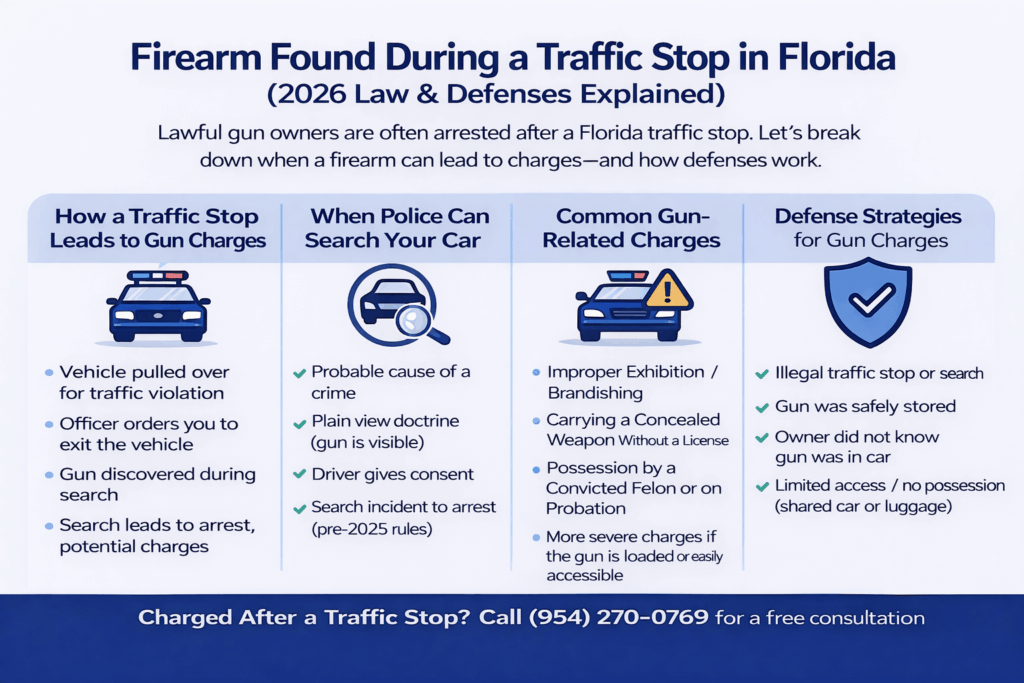
Last updated March 2026
Traffic stops are one of the most common ways firearm charges begin in Florida.
In many cases, the stop itself has nothing to do with a gun. A broken taillight, speeding, or a routine license check turns into a weapons arrest once an officer claims to see, discover, or learn about a firearm in the vehicle.
This page explains when police may lawfully search your car, when a firearm found during a traffic stop becomes a crime, and how these cases are defended under Florida law.
For a broader overview of Florida firearm offenses and penalties, see our guide to gun crime charges in Florida.
🚓 How Firearms Are Discovered During Traffic Stops
Most firearm cases arising from traffic stops fall into one of these scenarios:
An officer claims a firearm was visible in plain view
The driver or passenger is asked whether there is a weapon in the vehicle
Police conduct a vehicle search after alleging probable cause
A firearm is discovered during an inventory search after towing
The stop escalates into a detention or arrest for another offense
Whether the discovery was lawful matters just as much as whether the firearm itself was legal.
⚖️ When Police May Search a Vehicle in Florida
Police do not have automatic authority to search a vehicle simply because a traffic stop occurred.
Officers typically rely on one of the following justifications:
Consent (voluntary and informed)
Probable cause (claimed odor, contraband, or visible weapon)
Search incident to arrest
Inventory search after towing
Protective sweep based on officer-safety claims
If a search does not meet legal requirements, the firearm may be suppressed — even if possession would otherwise be illegal.
🚗 Florida Law on Carrying a Gun in Your Car
Florida law allows firearms in vehicles without a license if the firearm is:
Securely encased, or
Not readily accessible for immediate use
The law focuses on accessibility, not ownership or intent.
A firearm is considered securely encased when it is in a:
Glove compartment (locked or unlocked)
Snapped holster
Zippered case
Closed container
Closed center console
A firearm may be loaded inside a vehicle as long as it is properly stored. Problems arise when officers claim the gun was accessible — not because it was loaded.
🚫 When a Firearm Found During a Stop Becomes a Crime
Finding a gun in a vehicle does not automatically mean criminal charges apply.
Charges are commonly filed when police allege:
The firearm was loose under a seat or wedged between seats
The gun was within immediate reach without a barrier
The firearm was carried on the person without lawful authority
The driver or passenger was prohibited from possessing a firearm
The gun was possessed during another alleged offense
Officers claim constructive possession based on proximity. To understand how prosecutors try to prove knowledge and control in these situations, see our guide to Constructive Possession of a Firearm in Florida.
Small factual differences — placement, distance, control, and storage — often determine whether a case is legal or criminal.
🔍 Vehicle Carry vs. Unlawful Possession
Florida’s “private conveyance” exception allows lawful storage of firearms in the vehicle, not concealed carry on the body without authorization.
Vehicle-carry cases frequently turn on:
Where the firearm was located
Whether it was encased or accessible
Who exercised control over the weapon
Whether police misinterpreted lawful storage as concealment
These cases are decided on details, not assumptions.
🔫 Common Charges Filed After Traffic Stops
Depending on the facts, police may file charges such as:
Carrying a concealed firearm without lawful authority. Learn how Florida’s permitless carry laws affect these cases in Carrying a Concealed Weapon in Florida Without a License.
Improper exhibition of a firearm
Possession of a firearm by a convicted felon
Firearm possession during the commission of another offense
Sentencing enhancement allegations under Florida’s 10-20-Life law
In many cases, prosecutors overcharge early and sort out the facts later.
🛡️ How Firearm Traffic-Stop Cases Are Defended
Firearm arrests arising from traffic stops are often highly defensible.
Effective defense strategies commonly include:
Challenging the legality of the traffic stop
Suppressing the firearm due to an unlawful search
Disputing constructive possession (driver vs. passenger)
Establishing lawful vehicle carry under Florida law
Attacking officer credibility and report inconsistencies
Using body-cam or dash-cam footage
Many cases collapse once the search or seizure is examined closely.
In many cases, these issues lead to suppression of evidence or dismissal of charges. Learn more about how firearm cases are challenged in Can a Gun Charge Be Dropped in Florida?
⚠️ Why These Cases Escalate Quickly
Traffic-stop gun cases often escalate because:
Officers default to “officer safety” justifications
Passengers are wrongly assumed to possess the firearm
Proximity is confused with control
Lawful storage is mischaracterized as concealment
Firearms are automatically linked to unrelated allegations
Early legal intervention often prevents misdemeanor cases from becoming felony prosecutions.
👨⚖️ Firearm Defense After a Traffic Stop in Florida
A firearm discovered during a traffic stop can put your freedom, firearm rights, and future at risk — even when the stop began as a minor violation.
At Michael White, P.A., we defend clients charged after traffic stops involving:
Guns found in vehicles
Alleged unlawful searches
Constructive possession claims
Firearm-related sentencing enhancements
As a former prosecutor, Michael White understands how these cases are charged — and how to dismantle them.
📞 Call (954) 270-0769 or request a free consultation.
❓ Frequently Asked Questions
Can police search my car just because they stop me?
No. A traffic stop alone does not justify a search.
Do I have to tell police I have a gun in the car?
Florida law does not require voluntary disclosure during a routine stop unless specifically required by the circumstances.
What if the gun belongs to someone else?
Ownership is not the same as possession. The State must prove knowledge and control.
Can passengers be charged if a gun is found?
Yes — but constructive possession cases are often weak and defensible.
Can these charges be dismissed?
Yes. Many cases are dismissed or reduced due to illegal searches or lack of possession.