
Last updated April 2026
If you or a loved one has been arrested for a probation violation, the first question is usually immediate:
Will I be held without bond?
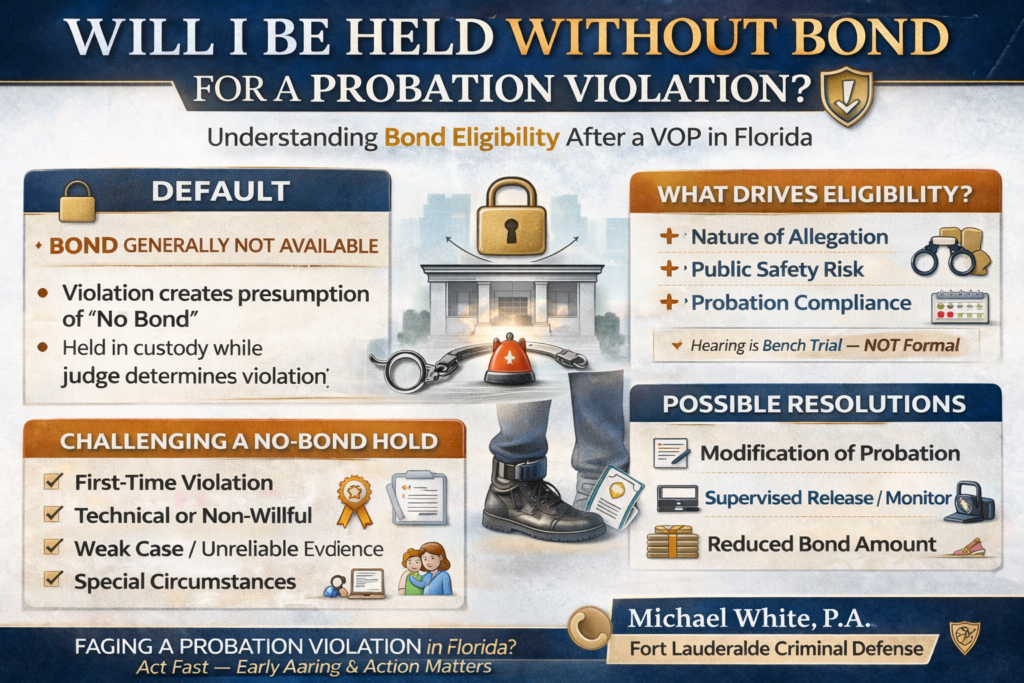
In Florida, the answer is often yes — at least initially.
Probation violation (VOP) arrests follow different rules than new criminal charges. Standard bond schedules do not apply, and many VOP warrants are issued with a no-bond hold.
But “no bond” does not always mean “no release.” Timing, judicial discretion, and strategy matter.
For a broader overview of how probation violations work, see our guide to probation violations in Florida.
Why Is There Often No Bond on a Probation Violation?
Probation is considered a conditional privilege. When someone is accused of violating probation, the court treats it as a breach of trust rather than a new offense.
Under Florida law:
Judges are not required to set bond
Bond schedules do not control
Release decisions are entirely discretionary
Many VOP warrants include a no-bond designation until the defendant appears before the original sentencing judge.
What Happens After a No-Bond Arrest?
After arrest, you are brought before a judge for first appearance.
At that stage, the court may:
Review probable cause
Confirm the warrant
Decide whether bond should be set
Schedule a final VOP hearing
In some cases, the judge maintains the no-bond hold until the final hearing.
Is Bond Ever Possible on a Probation Violation?
Yes — but it is not automatic.
Judges are more likely to consider bond when:
The violation is technical (no new crime)
The conduct was not willful
The underlying offense was non-violent
There is no history of absconding
The defendant has strong community ties
Bond becomes less likely when:
The violation involves a new arrest
The alleged conduct involves violence
There is a history of repeated violations
The person previously failed to appear
For more on how new arrests affect probation status, see our guide to new arrests while on probation.
Can I Be Held Without Bond Until the Final Hearing?
Yes.
In some cases, especially where the alleged violation is serious, the court may hold the defendant without bond until the violation hearing is resolved.
This can mean:
Days in custody
Weeks in custody
Longer delays if hearings are continued
Because VOP hearings move under a different procedural framework than standard criminal cases, detention periods may feel abrupt and accelerated.
What Does the Judge Consider When Deciding Bond?
Judges typically evaluate:
Nature of the alleged violation
Risk to public safety
Compliance history
Flight risk
Strength of the evidence
Underlying offense
Even if a violation is alleged, the State must ultimately prove it was willful and substantial at the hearing stage.
For a deeper explanation of that legal standard, see what “willful and substantial” means in a VOP case.
Can a Lawyer Help Secure Bond?
Yes.
Strategic intervention may include:
Requesting an expedited hearing
Presenting mitigation evidence
Challenging probable cause
Arguing lack of willfulness
Proposing supervision alternatives
In many cases, the earlier counsel becomes involved, the more options remain available.
What Happens If Bond Is Denied?
If bond is denied, the case proceeds toward a final VOP hearing.
At that hearing, the judge may:
Dismiss the violation
Reinstate probation
Modify supervision
Revoke probation and impose the suspended sentence
Unlike a new criminal case, sentencing can occur immediately if probation is revoked.
For a full breakdown of what happens inside a VOP hearing, review what happens at a violation of probation hearing in Florida.
FAQs: No-Bond Holds on Probation Violations
Is bond automatic for a probation violation in Florida?
No. Bond is discretionary, and many VOP warrants are issued with a no-bond designation.
Can a judge set bond after a probation violation arrest?
Yes. At first appearance or shortly thereafter, the judge may set bond depending on the circumstances.
How long can I be held without bond on a VOP?
It depends on how quickly the court schedules the hearing and whether bond is granted. Some individuals remain in custody until the final violation hearing.
Does a technical violation still mean no bond?
Sometimes. Even technical violations may result in a no-bond hold initially, though courts may be more receptive to release in those cases.
Can probation be revoked even if bond is denied?
Yes. Bond status is separate from whether the violation is ultimately proven.
Facing a No-Bond Hold for a Probation Violation?
Probation violation arrests move quickly, and custody decisions can happen fast.
Understanding the difference between an initial no-bond hold and the final violation hearing is critical.
Early strategy often determines whether detention continues — or whether release is secured.