
Last updated April 2026
If you believe you’re under investigation for theft in Florida, what you do right now matters more than anything you do later. Many theft cases are decided before an arrest ever occurs — often based on statements, records, and early cooperation (or mistakes).
Being “under investigation” can mean different things: a detective called you, loss prevention contacted you, your employer asked questions, or you learned police are reviewing video or financial records. No matter how it started, this is the most critical stage to protect yourself. We frequently see investigations begin quietly and escalate quickly based on early statements or assumptions.
Theft investigations are governed by Florida’s broader theft and fraud laws — and early mistakes can turn a quiet investigation into formal criminal charges.
If you believe you’re under investigation for theft, learn how a Florida theft and fraud defense lawyer can intervene early to stop charges before they’re filed.
Below is exactly what to do — and what not to do — if you’re under investigation for theft in Florida.
⚖️ How Theft Investigations Actually Turn Into Charges
Add:
In many Florida theft cases, charges are not filed immediately. Instead, investigators build a case over time using statements, records, and third-party information.
In practice, cases often move forward when:
Statements suggest intent
Financial or transaction records appear suspicious
A complaining witness pushes the investigation forward
Evidence is interpreted before all facts are known
This is why what you do early — before any arrest — can determine whether charges are ever filed.
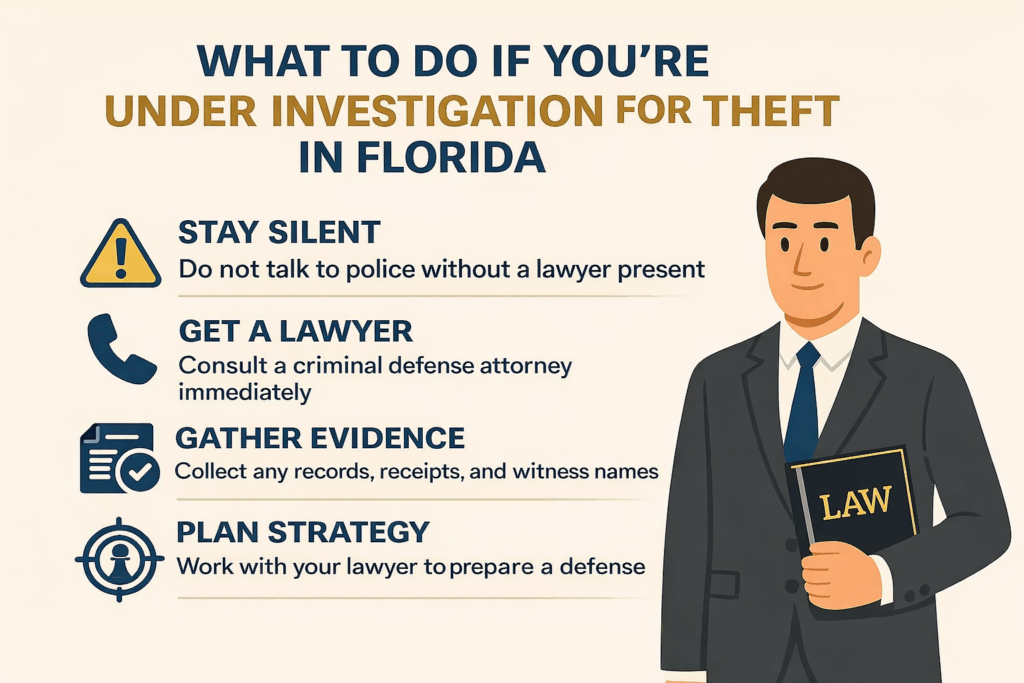
🔇 Step 1: Stay Silent — Even If You Haven’t Been Arrested
One of the biggest mistakes people make is thinking they can “clear things up” before charges are filed.
You cannot.
Police, detectives, store security, employers, and even insurance investigators are not neutral. Anything you say — even casually — can be:
-
Misinterpreted as intent
-
Used to establish value or control
-
Quoted later in an arrest affidavit
Statements like:
-
“I was going to return it”
-
“I forgot to pay”
-
“I didn’t think it mattered”
…are routinely used as proof of criminal intent. This is often one of the most important issues in theft cases—see how lack of intent defense in Florida theft cases applies.
👉 You have the right to remain silent — even before arrest. Use it. What happens during this stage often determines whether the case proceeds or stops entirely.
📞 Step 2: Contact a Theft Defense Lawyer Immediately
Early legal intervention is often the difference between:
-
No charges filed, or
-
A felony arrest with lifelong consequences
An experienced theft defense attorney can:
-
Contact detectives on your behalf
-
Control the flow of information
-
Present exculpatory evidence early
-
Push for diversion, civil resolution, or no filing
Once charges are filed, your leverage drops dramatically. Before arrest is the window where the most damage can be prevented.
In some cases, early intervention can prevent charges entirely—see when theft charges can be dropped in Florida.
🗂️ Step 3: Preserve Evidence — Quietly and Carefully
If you believe an investigation is underway, start preserving evidence without confronting anyone.
This may include:
-
Text messages or emails showing permission, confusion, or ownership
-
Receipts, invoices, or transaction records
-
Work schedules or access logs
-
Surveillance timestamps or locations
-
Witness names (do not contact them yet)
Disputes over value and ownership can also affect whether charges are filed—see how Florida treats grand theft over $750 and valuation issues.
⚠️ Do not alter records, delete messages, or attempt to “fix” anything. That can create new charges.
🎯 Step 4: Work With Your Lawyer to Control the Narrative
Once counsel is involved, strategy becomes everything.
Depending on the facts, your lawyer may:
-
Challenge intent (mistake, misunderstanding, lack of control)
-
Dispute value (especially near felony thresholds)
-
Argue civil resolution instead of criminal prosecution (In many situations, what appears to be theft is actually a dispute—see when a theft case is really a civil dispute in Florida.)
-
Identify illegal searches, detentions, or data access
-
Prevent statements from being taken at all
In many cases, the goal is not trial — it’s stopping the case from ever becoming one.
⚖️ Common Situations That Trigger Theft Investigations
People are often surprised to learn they’re under investigation for things like:
-
Retail loss prevention reviews
-
Workplace or employee theft allegations
-
Disputed ownership of property
-
Financial irregularities or audits
-
Alleged misuse of company resources
-
Borrowing property without clear permission
Not every investigation leads to charges — but how you respond determines whether it does.
🔗 Common Theft Investigation Scenarios in Florida
Depending on the situation, theft investigations often involve:
- Shoplifting cases in Broward County
- Credit card or financial theft allegations
- Disputes between roommates or family members
- Receiving stolen property investigations
In more complex cases, prosecutors may also pursue multiple charges based on the same conduct—see how grand theft charge combinations are handled in Florida.
❌ What Not to Do If You’re Under Investigation
Avoid these common mistakes:
-
❌ Talking to police “off the record”
-
❌ Calling the alleged victim to explain
-
❌ Paying restitution or civil demands without legal advice
-
❌ Posting about the situation online
-
❌ Assuming it’s “not serious” because no arrest happened
These actions frequently strengthen the prosecution’s case.
🧠 Why Early Defense Matters in Theft Cases
Theft cases often hinge on:
-
Intent
-
Control or possession
-
Value
-
Statements
All four are usually established before arrest.
Once law enforcement locks in their theory, it becomes much harder to undo. Early defense allows your lawyer to shape the record before it’s finalized.
📍 Under Investigation for Theft in Fort Lauderdale or South Florida?
In South Florida, many theft investigations begin with employers, retailers, or financial institutions before law enforcement becomes involved.
If you believe police, prosecutors, or private investigators are looking into a theft allegation, do not wait for an arrest.
At Michael White, P.A., we regularly intervene before charges are filed, using experience as a former prosecutor to identify weak cases early and shut them down when possible.
📞 Call (954) 270-0769 or request a confidential consultation today.
❓ Frequently Asked Questions — Theft Investigations in Florida
Can police investigate me without telling me?
Yes. Investigations often happen quietly through records, video, and third-party interviews.
Should I talk to a detective if I haven’t been arrested?
No. Anything you say can be used later — even if no charges are filed immediately.
Can charges be filed weeks or months later?
Yes. Theft investigations often take time, especially when value or intent is disputed.
Can a lawyer stop charges from being filed?
In some cases, yes — especially when evidence is weak or civil resolution is appropriate.
What if I already talked to someone?
You should still speak to a lawyer immediately. Early damage can sometimes be contained.