
Last updated April 2026
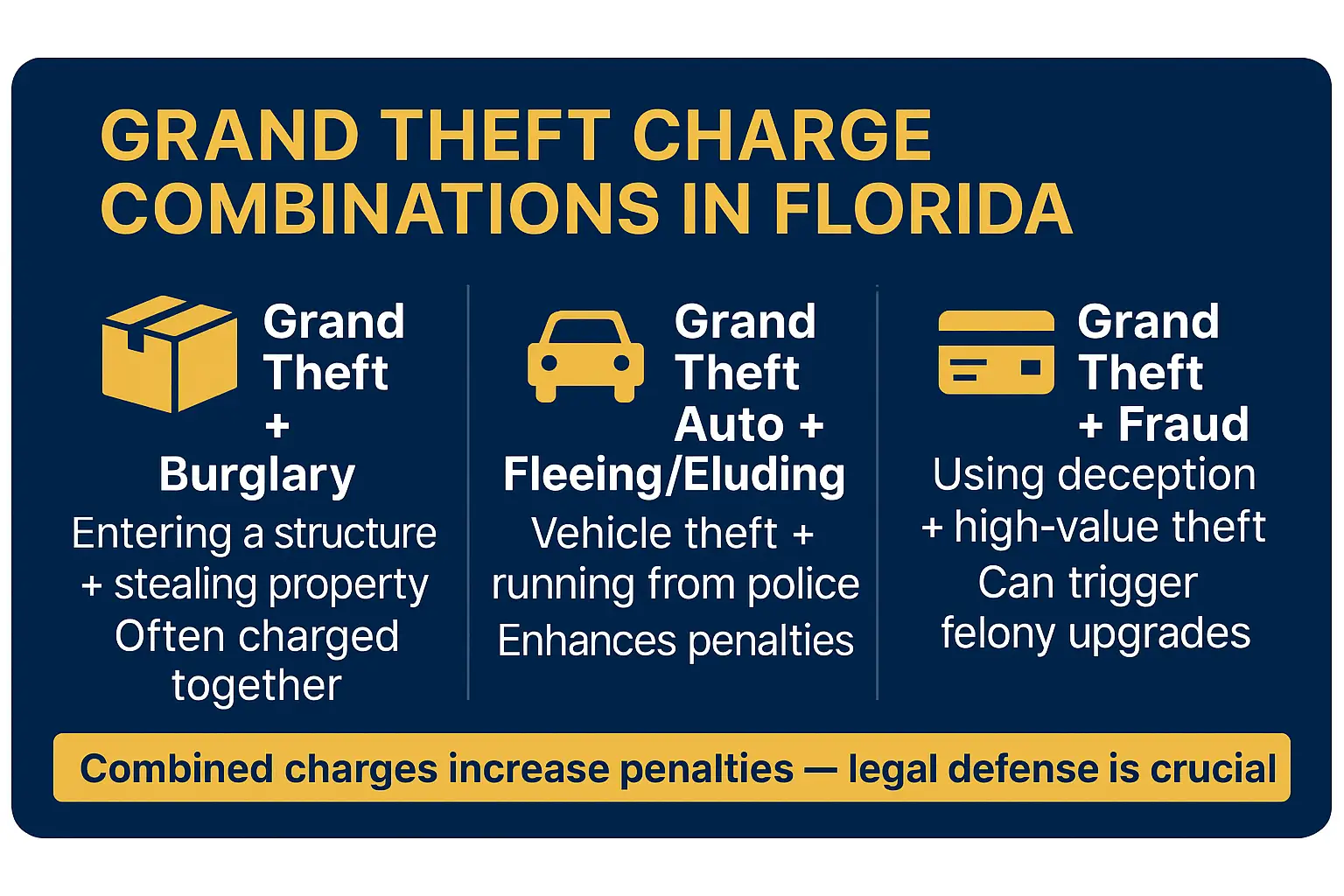
Grand theft in Florida is rarely charged alone. Prosecutors often stack additional offenses when a theft allegation overlaps with fraud, property damage, burglary, or possession of stolen items.
This stacking strategy increases sentencing exposure, creates leverage in plea negotiations, and pressures defendants into accepting harsher outcomes — even when the evidence is weak.
In Broward, Miami-Dade, and Palm Beach, “combination” theft cases are extremely common, especially in retail theft, online marketplace transactions, vehicle-related thefts, and residential property cases. We routinely see clients charged with multiple offenses arising from a single allegation, especially in property and financial cases. In South Florida, this charging strategy is frequently used in retail, vehicle, and online marketplace investigations.
When grand theft is charged alongside other offenses, overall sentencing exposure can increase significantly. For baseline felony ranges, see a full breakdown of grand theft felony penalties in Florida.
The best external legal authority for this topic is the theft statute itself: Fla. Stat. § 812.014.
Here are the combinations you’re most likely to see — and how we defend them.
⚖️ Why You’re Facing Multiple Charges for One Incident
In Florida theft cases, it is very common for a single incident to result in multiple criminal charges. This is not because multiple crimes necessarily occurred — but because prosecutors often charge different legal theories based on the same set of facts.
For example, a single allegation involving property can be charged as:
Grand theft (taking the property)
Dealing in stolen property (selling or transferring it)
Fraud or identity theft (if accounts or financial data are involved)
Burglary (if entry is alleged)
Understanding this helps explain why a case can look more serious on paper than it actually is.
⚠️ Charge Stacking Is a Prosecutorial Strategy
Multiple charges filed from a single theft incident are not accidental. Prosecutors often file overlapping counts to preserve leverage, survive motions to dismiss, and increase plea pressure — even when some charges are weak.
Theft charges in Florida are classified by value and conduct, but prosecutors often layer additional offenses to expand exposure. To understand how theft offenses are structured under Florida law, see theft charges in Florida.
⚖️ Common Charge Combinations Filed With Grand Theft
Florida prosecutors most often stack grand theft with:
1️⃣ Dealing in Stolen Property (F2)
This is one of the most common pairings.
If the State believes a person sold, trafficked, or distributed stolen property, they will charge grand theft and dealing in stolen property — even if the evidence is flimsy.
This often appears in online sales, pawnshop cases, and vehicle-part theft situations.
See how receiving stolen property charges in Florida are handled.
2️⃣ Scheme to Defraud / Organized Fraud
When theft involves:
-
multiple transactions,
-
multiple victims,
-
online activity, or
-
repeated conduct,
prosecutors often stack scheme to defraud charges — a serious felony frequently used in financial-crime cases.
This pairing significantly increases potential penalties.
3️⃣ Burglary
Grand theft is commonly added to burglary cases involving:
-
vehicles,
-
homes,
-
sheds,
-
storage units,
-
unlocked apartments.
Even if the burglary allegation is weak, the grand theft count remains as a fallback.
This is similar to how prosecutors “layer” counts in probable-cause-affidavit issues — using alternative theories to avoid dismissal.
4️⃣ Criminal Mischief
If property is damaged during the theft, the State may add a criminal mischief charge.
This combination is common in:
-
vehicle break-ins
-
home entry cases
-
domestic disputes involving property damage
5️⃣ Possession of Burglary Tools
If the police find:
-
screwdrivers,
-
pry bars,
-
window punches,
-
gloves,
-
flashlights, or
-
toolkits
…the State may add an additional third-degree felony, even if the tools are everyday items.
6️⃣ Identity Theft / Fraudulent Use of Personal Information
When theft includes:
-
stolen mail,
-
credit cards,
-
checks,
-
digital accounts, or
-
banking credentials,
the State can add identity-theft or intent-to-defraud charges.
These cases heavily overlap with digital-evidence issues and electronic-record inconsistencies.
🚨 Why Prosecutors Stack Charges
Charge stacking gives the State:
-
More leverage in plea negotiations
-
More sentencing options
-
A “backup” charge if the primary theft count weakens
-
The ability to apply restitution pressure
-
A stronger perception of criminal intent
We frequently see this in cases involving:
-
pawnshops
-
Facebook Marketplace
-
Craigslist
-
vehicle-part theft
-
apartment maintenance theft
-
employment-related theft
In many cases, once one or two stacked counts are dismissed, the remaining case collapses quickly. In many cases, early intervention can lead to dismissal of multiple counts—see when theft charges can be dropped in Florida.
What happens early in these cases often determines whether multiple charges survive or are reduced.
🧩 How Stacked Grand Theft Cases Break Down
Multiple charges do not automatically mean a stronger case.
At Michael White, P.A., common defenses include:
✔ Insufficient Evidence of Intent
Intent to permanently deprive is required — similar to lack-of-intent issues in fraud and property cases.
✔ No Knowledge Item Was Stolen
The State must prove knowledge — particularly in combined cases involving constructive possession.
✔ Mistaken Identity / Bad Video Footage
Surveillance is often poor quality or inconclusive.
✔ Overcharging
Dealing in stolen property or scheme-to-defraud is added aggressively — we often get these counts dropped.
✔ Inflated Value
Retail values are frequently exaggerated to reach felony thresholds.
✔ Illegal Search or Seizure
If the property was discovered during an unlawful search, everything is attackable through a motion to suppress.
✔ Ownership Issues
The property must be proven to belong to the alleged victim — not always clear.
These cases are often addressed as part of broader grand theft defense strategies in Florida.
🚨 Speak With a Fort Lauderdale Criminal Defense Lawyer Today
If you’re facing stacked grand theft charges, learn how our Fort Lauderdale theft and fraud defense team dismantles overcharged felony cases and protects your future.
Grand theft charge combinations often look overwhelming — but many are defensible once the facts, video, and legal elements are examined closely.
Contact Michael White, P.A. today to protect your rights and build a strong strategy from the start.
❓ FAQs — Grand Theft Charge Combinations
1. Why am I facing multiple charges for one theft?
Because prosecutors stack charges to increase leverage and cover multiple theories. This often results in cases appearing more serious than they actually are, particularly in early stages.
2. Is dealing in stolen property always charged with grand theft?
No, but it’s extremely common when items were sold or pawned.
3. Can grand theft be charged with fraud?
Yes — especially when digital or financial evidence is involved.
4. Can value inflation push a misdemeanor into a felony?
Yes. Retail values are often inflated and must be challenged.
5. Can these charges be dismissed?
Yes — especially when intent, knowledge, or the search is weak.