
Last updated April 2026
If you’ve been arrested for grand theft in Florida, you’re facing more than just accusations — you’re looking at a felony record, prison time, and long-term damage to your future.
But just because you were charged doesn’t mean you’ll be convicted.
In many cases, early intervention can result in dismissal—learn when theft charges can be dropped in Florida.
Grand theft cases are rarely as simple as police reports suggest. Prosecutors must prove value, intent, and lawful evidence — and weaknesses in any one of those areas can lead to dismissal or reduced charges.
To understand how these elements determine whether a case is charged as a misdemeanor or felony, see theft charges in Florida.
At Michael White, P.A., we’ve we’ve defended grand theft cases involving valuation disputes, intent challenges, and suppression issues throughout South Florida
In many Broward County cases, the initial police report tells only part of the story—and critical weaknesses often emerge early in the defense process.
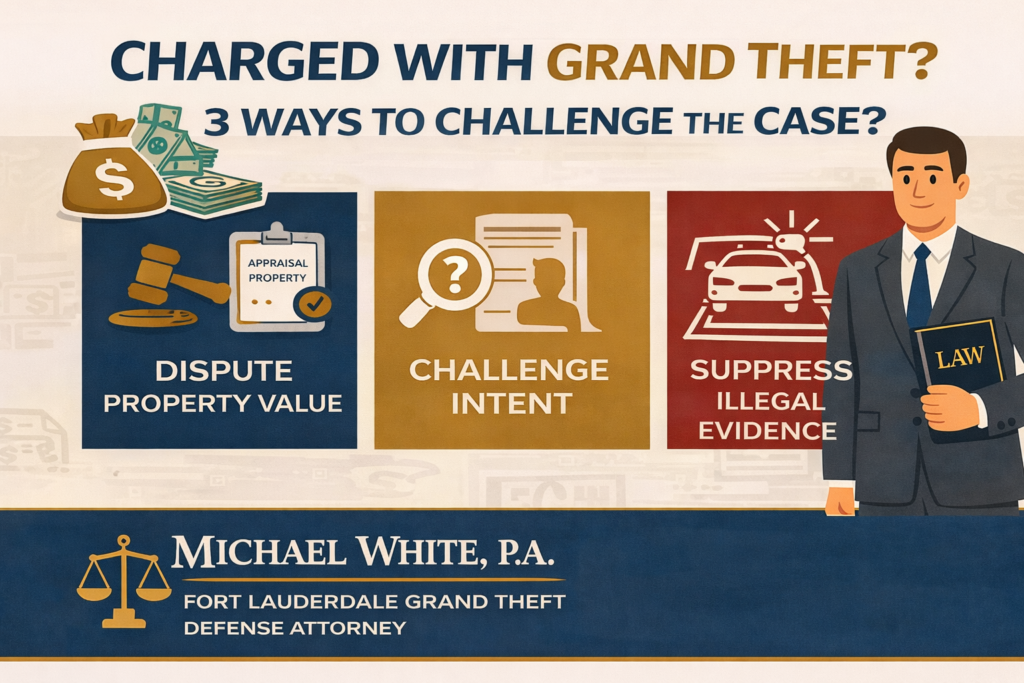
Here are three legal strategies that could change the outcome of your case.
⚖️ 1. Disputing the Value of the Property
Florida law defines grand theft based on the value of what was allegedly stolen:
-
Over $750 = 3rd-degree felony
-
Over $20,000 = 2nd-degree felony
-
Over $100,000 = 1st-degree felony
If prosecutors can’t prove the value meets those thresholds, you may be eligible for a reduction to petit theft — or even dismissal. We often bring in independent appraisals to challenge inflated estimates.
In practice, value is frequently estimated by store employees or, especially in non-retail theft cases, alleged victims rather than verified appraisals.
In many cases, reducing the alleged value below a felony threshold is the fastest path to avoiding a permanent felony conviction.
🕵️ 2. Challenging the Evidence of Intent
To convict you, the State must prove you intended to deprive the owner of their property — not that you borrowed it, mistakenly thought it was yours, or were simply present.
This is one of the most common and effective defenses—see how lack of intent defense in Florida theft cases is used.
We’ve defended grand theft cases where:
-
Two people had access to the same vehicle or account
-
Items were taken during a domestic or roommate dispute
-
Police relied on surveillance with unclear identity
Intent is not always obvious. And in many cases, it’s completely missing. We regularly see cases where intent is assumed based on circumstances rather than proven with actual evidence.
🚫 3. Suppressing Illegally Obtained Evidence
Police often cut corners — and we use that to your advantage. In theft investigations, these issues often arise during searches of vehicles, phones, or retail detentions.
We’ve had success suppressing evidence based on:
-
Illegal searches of homes, vehicles, or phones
-
Unlawful seizures of property without a warrant
-
Coerced or un-Mirandized statements
-
Overreach by loss prevention or store security
If your rights were violated, we file motions to suppress — and if successful, the prosecution may be forced to drop the case entirely.
The earlier a defense lawyer gets involved in a grand theft case, the more leverage exists to challenge value, intent, and evidence before positions harden.
Early intervention can mean the difference between a filed felony charge and a case that never formally proceeds.
📍 Fort Lauderdale Grand Theft Defense Lawyer
At Michael White, P.A., we don’t just plead cases out. We:
-
Investigate every detail
-
Challenge every piece of evidence
-
Fight to protect your future
We handle grand theft cases in Fort Lauderdale, Hollywood, Plantation, and across Broward County. Early action makes a huge difference.
📘 Grand Theft Defense FAQs
❓ Can I be charged with grand theft in Florida if I thought the property was mine?
You can be charged — but if you genuinely believed you had a right to the property, that may defeat the intent element of the crime.
❓ Is grand theft always a felony in Florida?
Yes. Grand theft starts at $750 in value and is always charged as a felony, with penalties based on value and circumstances.
❓ Can I avoid jail if I’m charged with grand theft?
Possibly. Diversion programs, probation, or charge reductions can help first-time offenders avoid incarceration.
❓ What happens if the police didn’t have a warrant to search me?
Your lawyer may be able to suppress that evidence — and if it’s key to the case, the charges could be dropped.
❓ Do I need a lawyer for a grand theft charge in Broward?
Absolutely. Grand theft is serious, and early legal help can lead to better outcomes — including dismissal or sealing eligibility later.