
Last updated March 2026
If you’ve been arrested for burglary in Florida, the stakes are high from the start. Burglary is always charged as a felony, and a conviction can carry prison exposure, probation, and a permanent criminal record.
But an arrest is not a conviction. Many burglary cases ultimately turn on a few key issues — whether prosecutors can actually prove intent, whether the entry was unlawful, and whether the identification evidence holds up.
Burglary is one of several serious property crimes prosecuted in Florida. For an overview of how burglary, trespassing, and property damage cases interact, see our Property Crimes Defense guide.
For an overview of how burglary, trespassing, and property damage charges are handled together, see our Property Crimes Defense guide.
📜 What Is Burglary in Florida?
Under Florida Statute § 810.02, burglary generally means:
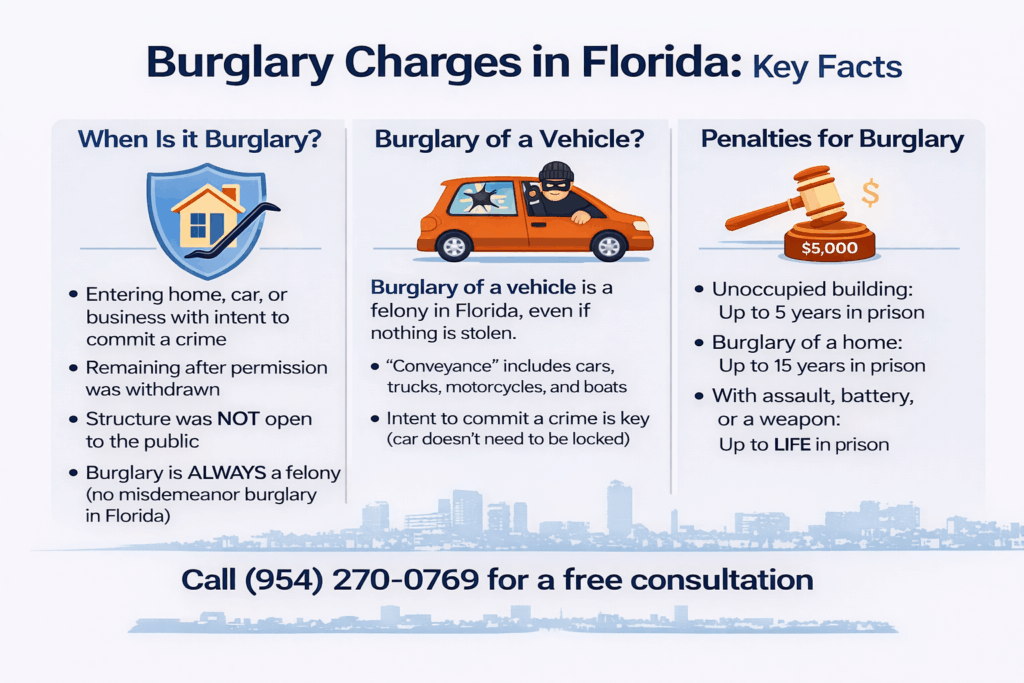
Entering a dwelling, structure, or conveyance with the intent to commit an offense inside — unless the premises are open to the public or the person is licensed or invited.
Burglary can also be charged when someone lawfully enters but remains after permission is withdrawn with alleged criminal intent.
If you’re looking for a detailed breakdown of how Florida law defines burglary — including technical issues like entry, remaining, and curtilage — see Florida Burglary Laws Explained.
Because intent is required, many burglary cases hinge on whether prosecutors can prove what the person intended at the time of entry. In some cases, charges are based almost entirely on circumstantial evidence. See Can Burglary Charges Be Based on Intent Alone in Florida?
Florida law does not require that property actually be taken. In other words, a person may still face burglary charges even where nothing was stolen if prosecutors claim the required intent existed at entry. For more on that issue, see Can You Be Charged with Burglary Without Stealing Anything in Florida?
🚗 What Is a Conveyance in Florida Burglary Cases?
Florida law treats vehicles and other transport-related spaces as a separate category called “conveyances.”
This includes:
- Cars and trucks
- Boats and watercraft
- Trailers and mobile units
Burglary of a conveyance typically involves allegations that someone entered a vehicle with intent to commit a crime inside. Importantly, the vehicle does not need to be locked — intent at entry is what matters.
For a full explanation of how vehicle-related cases are charged, see Burglary of a Conveyance in Florida.
🧾 Is Burglary a Felony in Florida?
Yes. All burglary charges in Florida are felonies. There is no misdemeanor burglary.
However, the severity of the charge depends on the location and surrounding circumstances.
Burglary Penalties in Florida
| Type of Burglary | Charge Level | Maximum Penalty |
|---|---|---|
| Unoccupied structure or conveyance | Third-degree felony | Up to 5 years |
| Dwelling | Second-degree felony | Up to 15 years |
| With assault, battery, or weapon | First-degree felony | Up to life |
The presence or absence of occupants can significantly affect how dwelling burglary cases are charged and evaluated. See Burglary of an Occupied vs. Unoccupied Dwelling in Florida.
The most serious cases — involving weapons, violence, or certain aggravating factors — can be prosecuted at the highest level. See What Makes Burglary a First-Degree Felony in Florida?
🔎 Types of Burglary Cases We Defend
Burglary charges vary significantly depending on the facts, location, and alleged conduct. We regularly defend cases involving:
- Burglary of a dwelling — see Burglary of an Occupied vs. Unoccupied Dwelling in Florida
- Burglary of a structure — see Burglary of a Structure vs. Dwelling in Florida
- Burglary of a conveyance — see Burglary of a Conveyance in Florida
- Armed burglary — see Armed Burglary in Florida
- Burglary with assault or battery — see Burglary With Assault or Battery in Florida
- Entry into garages, porches, or surrounding areas — see Entering a Garage, Porch, or Curtilage — Is It Burglary in Florida?
Each category carries different legal implications and strategic considerations.
🛡️ Common Legal Defenses to Burglary Charges
As a former prosecutor, Michael White understands how burglary cases are evaluated — and where they often break down.
🔹 Lack of Intent
Burglary requires intent at the time of entry. If that intent cannot be proven, the charge may fail. This is especially true in cases where the State relies on circumstantial evidence rather than direct proof. See Can Burglary Charges Be Based on Intent Alone in Florida?
🔹 Consent or Lawful Entry
If you were invited, licensed, or reasonably believed you had permission to enter, the burglary element may not be satisfied. In some cases, what is charged as burglary may more appropriately fall under trespass depending on the facts. See Burglary vs. Trespassing in Florida.
🔹 Mistaken Identity
Burglary cases often rely on surveillance footage or limited witness descriptions, which are frequently unreliable.
🔹 Reduction to Trespass
When intent is weak or unsupported, burglary charges are often reduced to trespass — avoiding a felony conviction. See Can Burglary Be Reduced to Trespass in Florida?
🔍 Additional Legal Issues in Burglary Cases
Burglary cases often involve additional legal questions beyond basic entry and intent.
For example:
- Whether damage during entry affects the charge — see Burglary with Property Damage in Florida
- Whether tools or equipment are used to support intent — see Possession of Burglary Tools in Florida
- Whether surrounding areas qualify as part of the protected space — see Entering a Garage, Porch, or Curtilage — Is It Burglary in Florida?
- Whether a case involves conduct that falls short of a completed burglary — see Attempted Burglary in Florida
🚨 Burglary With Assault or Battery
Burglary becomes dramatically more serious when prosecutors allege that an assault, battery, or weapon was involved.
These cases are often charged as first-degree felonies punishable by life and may involve immediate bond complications.
In many cases, the real dispute centers on:
- Whether an assault actually occurred
- Whether a weapon was involved
- Whether the alleged victim’s account is reliable
For a full breakdown of these high-exposure cases, see Burglary With Assault or Battery in Florida
👨⚖️ Burglary Defense Lawyer in Fort Lauderdale
At Michael White, P.A., we defend clients facing burglary charges throughout Fort Lauderdale and Broward County. Our approach focuses on early intervention, factual investigation, and aggressive pretrial advocacy aimed at dismissal, reduction, or diversion whenever possible.
📞 Burglary charges don’t automatically mean prison — but you must act fast.
Call (954) 270-0769 or request a free consultation to protect your future.
❓ Frequently Asked Questions
👨⚖️ Is burglary always a felony in Florida?
Yes. All burglary charges are felonies, though the level (third, second, or first-degree) depends on the circumstances.
🔐 What’s the difference between burglary and trespass?
Trespass involves entering or remaining without permission — but without criminal intent. Burglary requires intent to commit a crime inside.
📹 Can I be charged if I didn’t steal anything?
Yes. The law only requires intent to commit a crime, not that anything was actually taken.
🚓 What if the building wasn’t locked?
It doesn’t matter. Burglary charges can still apply even if no forced entry occurred — especially if it’s a home.
📂 Can burglary charges be reduced or dismissed?
Often, yes. We’ve helped many clients get burglary charges reduced to trespass or resolved through diversion.