
Last updated April 2026
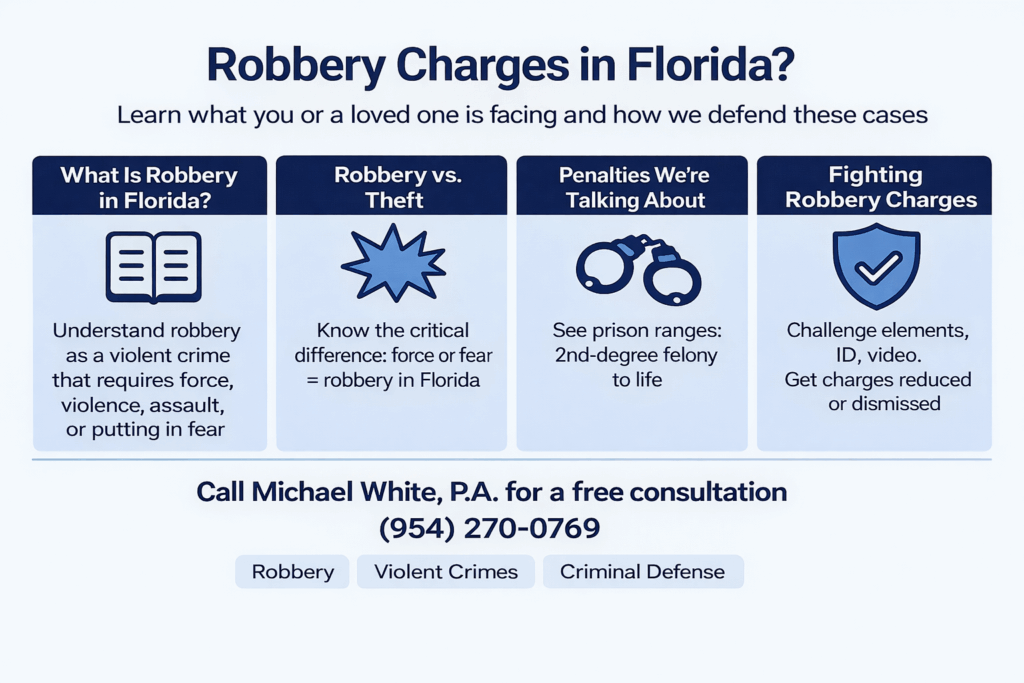
Robbery is not “just theft” in Florida. It’s treated as a violent felony because the State claims the property was taken using force, violence, assault, or putting someone in fear. That one allegation—force or fear—can turn a case from a theft investigation into a life-altering felony with prison exposure.
Robbery allegations can range from disputed shoplifting incidents to armed robbery charges involving alleged weapons. Below, we break down the legal distinctions between theft and robbery, strong-arm and armed robbery, sudden snatching, verbal threats, and cases built primarily on surveillance footage.
If you or a family member was arrested for robbery in Fort Lauderdale or anywhere in South Florida, your defense should start with a simple question:
Did the State really have force or fear—at the moment of the taking—and can they prove it beyond a reasonable doubt?
This page explains Florida’s robbery law, how robbery is different from theft, how penalties escalate (including “armed” robbery cases), and the defense strategies that commonly reduce or dismiss robbery charges.
If you’re facing a robbery accusation, speak with a defense lawyer early. Early intervention can shape bond, preserve evidence (especially video), and prevent “fear-based” allegations from hardening into an overcharged case.
Robbery charges are treated as serious violent felonies under Florida law and are prosecuted aggressively within the broader framework of Violent Crimes in Florida.
Talk to a Fort Lauderdale criminal defense attorney about your robbery case.
What Is Robbery in Florida? (Florida Statute § 812.13)
Under Florida Statute § 812.13, robbery is essentially theft plus force or fear.
A robbery charge usually alleges that a person:
Took money or property from another person (or from their custody/control), and
Intended to permanently or temporarily deprive the person of that property, and
Used force, violence, assault, or putting in fear in the course of the taking.
Key concept: Florida robbery is about the method of taking—how the State claims the property was taken—not just what was taken.
Robbery vs Theft in Florida (The Most Important Distinction)
In Florida, the difference between theft and robbery often comes down to one issue:
✅ Theft = taking property without force or fear
✅ Robbery = taking property with force or fear
That distinction matters because theft may be charged as a misdemeanor or non-violent felony, while robbery is typically prosecuted as a violent felony with far harsher sentencing exposure.
Overcharging happens here. In many cases, the defense hinges on whether the evidence truly supports force or a reasonable fear, or whether the incident is more accurately classified as theft.
For a side-by-side breakdown of how Florida law distinguishes robbery from theft — including force, fear, timing, and common overcharging scenarios — see our guide to Robbery vs. Theft in Florida
The “Force or Fear” Requirement: What Counts—and What Doesn’t
Florida robbery law allows the State to prove robbery in four ways:
Force
Violence
Assault
Putting in fear
But not every tense encounter is robbery.
When the State tries to stretch robbery:
The alleged “fear” is based on a vague feeling, not a reasonable threat
The alleged force happens after the taking, not during it
A verbal exchange is treated as an “assault” without a true imminent threat
The evidence is thin (no injuries, no weapon, unclear video)
A strong robbery defense often focuses on timing and proof: Was there force/fear at the moment of taking, and can the State prove it?
Florida courts apply specific standards when evaluating whether someone was truly placed in fear. We analyze how prosecutors attempt to stretch that element — and how it can fail — in our breakdown of Putting in Fear in Florida Robbery Cases.
In some cases, the allegation is based entirely on words rather than physical force. If that applies to your case, see our analysis of Robbery Based on Verbal Threats Only in Florida.
“In the Course of the Taking” Includes Flight
Florida’s robbery statute covers not only the moment property is taken, but also actions occurring during immediate flight after the taking.
That matters because prosecutors often argue:
A struggle during escape = robbery
Resistance while being stopped = robbery
A confrontation after the taking = robbery
The defense will often challenge whether the incident truly qualifies as immediate flight, whether the struggle was independent of the taking, or whether it was someone else on the video.
Types of Robbery Charges in Florida
Robbery cases are often charged based on how the State describes the incident:
1) Strong-Arm Robbery (Unarmed Robbery)
This usually means the State alleges robbery without a firearm or weapon. Strong-arm robbery commonly arises from:
A struggle over property
A “snatch-and-run” case where the State claims force was used
Allegations that the victim was put in fear through threats or intimidation
For a deeper breakdown of how Florida distinguishes strong-arm robbery from armed robbery — and how that difference impacts sentencing exposure — see our guide to Strong-Arm vs. Armed Robbery in Florida.
If the State alleges no weapon at all but still claims force or intimidation, review our deeper explanation of Robbery With No Weapon in Florida.
2) Armed Robbery (Firearm, Deadly Weapon, or Other Weapon)
“Armed robbery” typically refers to robbery where the State alleges a weapon was involved. This dramatically increases risk:
Higher felony degree
Prison-focused prosecution posture
Potential mandatory minimum exposure depending on firearm allegations and enhancements
3) Robbery by Sudden Snatching (Separate Statute)
Florida also has a separate crime called robbery by sudden snatching under § 812.131. People often confuse this with robbery under § 812.13.
We break down when purse-snatching or sudden grabbing qualifies as robbery — and when it does not — in our analysis of Is Snatching a Purse Robbery in Florida.
Important nuance: A sudden snatching is not automatically a “robbery” under § 812.13 unless the State can prove the required force/fear beyond what is inherent in the snatching itself.
Some cases also involve overlapping charges based on how the incident unfolded. For example, entering a structure and then confronting someone may lead to both burglary and robbery allegations. We break down that distinction in our guide to Robbery vs. Burglary in Florida.
When a vehicle is involved, prosecutors may instead pursue carjacking charges — a closely related but distinct offense with potentially harsher penalties — which we explain in our guide to Robbery vs. Carjacking in Florida.
Robbery Penalties in Florida (2nd-Degree Felony to Life)
Robbery sentencing exposure depends heavily on whether the State alleges a weapon.
Common penalty framework under § 812.13(2):
No weapon: typically charged as a second-degree felony (serious prison exposure)
Weapon (non-firearm/non-deadly): typically charged as a first-degree felony
Firearm or deadly weapon: typically charged as a first-degree felony punishable by life
Even when a case looks “minor” factually, the charge can still carry extreme consequences because robbery is prosecuted as a violent offense.
Bottom line: Robbery is a charge where early defense action matters—because prosecutors often decide how aggressively to pursue prison based on the first 30–60 days of the case.
What Prosecutors Must Prove in a Florida Robbery Case
To convict, the State typically must prove (beyond a reasonable doubt):
A taking of money or property
From the person or custody/control of the alleged victim
Intent to deprive (temporarily or permanently)
Force, violence, assault, or putting in fear
That it occurred in the course of the taking (including immediate flight)
A defense strategy often targets the weakest link—commonly:
Identity
Force/fear
Intent
Timing (“in the course of the taking”)
Reliability of witness/video evidence
In some cases, robbery charges can be reduced to theft if the State cannot prove force, violence, assault, or putting in fear beyond a reasonable doubt. We explain when that happens — and how defense strategy drives that result — in our guide to Can Robbery Charges Be Reduced in Florida?.
🔗 Key Issues in Florida Robbery Cases
Robbery cases often turn on specific legal issues that determine how a case is charged — and how it can be defended.
For deeper analysis of the most important issues, see:
• Robbery vs. Theft in Florida
• Strong-Arm vs. Armed Robbery in Florida
• What “Putting in Fear” Means in a Robbery Case
• Robbery With No Weapon in Florida
• Robbery and Surveillance Video Evidence
• Mistaken Identity in Robbery Cases
Common Robbery Scenarios We See in Real Cases
Robbery arrests in South Florida often arise from:
Convenience store / retail loss prevention incidents
Bar/club disputes that become “fear” allegations
Purse/phone snatching accusations
Ride-share or parking lot confrontations
“He said / she said” claims where fear is subjective
Cases built primarily on surveillance footage and quick ID procedures
Robbery cases are won by details: lighting, distance, the exact words used, the moment contact occurred, and what the video actually shows (not what a report claims it shows).
Because many robbery prosecutions now depend heavily on camera footage, we examine how video evidence can strengthen — or completely undermine — the State’s case in Robbery and Surveillance Video Evidence in Florida.
In many cases, the central issue is not what happened — but who was involved. We examine how misidentification occurs in robbery prosecutions, and how it can be challenged, in our guide to Mistaken Identity in Robbery Cases.
Defenses to Robbery Charges in Florida
Every case is different, but these are some of the most common robbery defenses:
1) No force or “putting in fear”
If the State cannot prove force/fear at the time of the taking, the case may be:
Reduced to theft, or
Dismissed / acquitted depending on evidence
2) Misidentification / mistaken identity
Robbery cases are frequently built on:
Stressful, fast events
Poor lighting
Cross-racial identification issues
Suggestive photo lineups or show-ups
Video that doesn’t clearly show the face
3) Lack of proof of intent
Robbery requires intent to deprive. Some cases involve:
Confusion over ownership
Intoxication-driven disputes
Claims that the property was returned immediately
“Borrowing” narratives (not always a complete defense, but relevant to proof)
4) Video evidence issues
Surveillance video can help or hurt—but it’s often:
Grainy
Missing the key moment
Taken from a bad angle
Edited clips that omit context
5) Illegal stop, search, or seizure
If police found evidence after an unlawful stop/search, suppression may change the entire case posture—especially when the State’s case depends on what was recovered.
6) Witness credibility problems
Robbery accusations sometimes come from:
Co-defendants trying to reduce exposure
Civil disputes turned criminal
Complainants with inconsistent statements
What to Do After a Robbery Arrest (Early Intervention Matters)
If you’re arrested or under investigation for robbery:
Do not try to “explain it away” in an interview
Preserve texts, app data, and location data (before it’s lost)
Identify and secure video sources immediately (stores overwrite footage)
Document injuries (or lack of injuries)
Get counsel involved early—bond conditions, no-contact orders, and discovery strategy can shape the entire case
Robbery cases move fast early—and early decisions can lock in a prosecutor’s theory.
✅ FAQs
1) Is robbery the same thing as theft in Florida?
No. Robbery is treated as a violent felony because the State alleges the property was taken using force, violence, assault, or putting the victim in fear.
2) Can you be charged with robbery if no weapon was used?
Yes. Florida allows robbery charges without a weapon if the State claims force or fear was used during the taking or immediate flight.
3) What does “putting in fear” mean in a robbery case?
It generally refers to a situation where the State claims the victim was placed in reasonable fear of harm at the time of the taking, even without physical contact.
4) Can robbery charges be reduced to theft?
Sometimes. If the defense can show the State cannot prove force, violence, assault, or “putting in fear,” robbery may be reduced to theft or otherwise resolved more favorably.
5) Does a struggle after the taking count as robbery?
It depends. Florida law can treat force used during “immediate flight” as part of the robbery, but the defense can challenge timing, causation, and whether the alleged force was truly connected to the taking.
6) How serious are robbery penalties in Florida?
Robbery is a felony, and penalties can be severe—ranging from major prison exposure for unarmed robbery to first-degree felony punishable by life when the State alleges a firearm or deadly weapon.
7) What are the best defenses in a robbery case?
Common defenses include lack of force/fear, mistaken identity, lack of intent, unreliable witness identification, weak video evidence, and suppression issues depending on how the evidence was obtained.
8) Should I talk to police if I’m accused of robbery?
In most cases, it’s safer to speak with a defense attorney first. Statements made early are often used to “fill gaps” in the State’s proof and can be hard to undo later.