
Last updated March 2026
People often assume robbery and theft are the same crime. Under Florida law, they are not—even though both involve taking property.
The difference between robbery and theft usually comes down to one critical factor:
Did the State allege force, violence, assault, or “putting in fear” at the time of the taking?
That single allegation can turn a case from a lower-level theft into a serious violent felony with decades of prison exposure.
Because robbery is classified as a violent felony in Florida, these cases are prosecuted aggressively under Florida’s robbery statutes rather than treated as ordinary theft offenses.
This page explains how Florida law distinguishes robbery from theft, why robbery charges are often over-filed, and how the defense challenges that distinction.
For a full breakdown of robbery elements and penalties, see our main guide on Robbery Charges in Florida.
What Is Theft in Florida?
Under Florida law, theft generally means knowingly obtaining or using another person’s property with the intent to deprive them of it—without using force or fear.
Key features of theft cases:
No violence or threats alleged
No intimidation or fear required
Usually charged as a misdemeanor or non-violent felony
Penalties depend primarily on the value of the property
Many theft cases involve:
Shoplifting
Employee theft
Property disputes
Alleged “grab and go” incidents without resistance
What Is Robbery in Florida?
Robbery, defined under Florida Statute § 812.13, is theft plus force or fear.
The State must claim the property was taken using:
Force
Violence
Assault
Or “putting the victim in fear”
Because of this added element, robbery is treated as a violent offense, even when:
No weapon was used
No one was injured
The incident happened very quickly
The Critical Difference: Force or “Putting in Fear”
This is where most robbery cases are won or lost. Florida courts apply specific standards to what qualifies as fear in these cases, which we break down in detail in our guide to what “putting in fear” means in a Florida robbery case.
Theft becomes robbery when prosecutors claim:
Physical force was used to take or keep the property
The victim reasonably feared harm at the time of the taking
Force was used during immediate flight after the taking
Common overcharging scenarios:
Sudden snatching cases with minimal contact
Verbal disputes later described as “threatening”even when no real imminent threat existed — an issue we examine in robbery cases based on verbal threats only.
Fear based on assumption, not an actual threat
Struggles occurring after the property was already taken
The defense often focuses on timing, context, and whether the alleged fear was reasonable and contemporaneous.
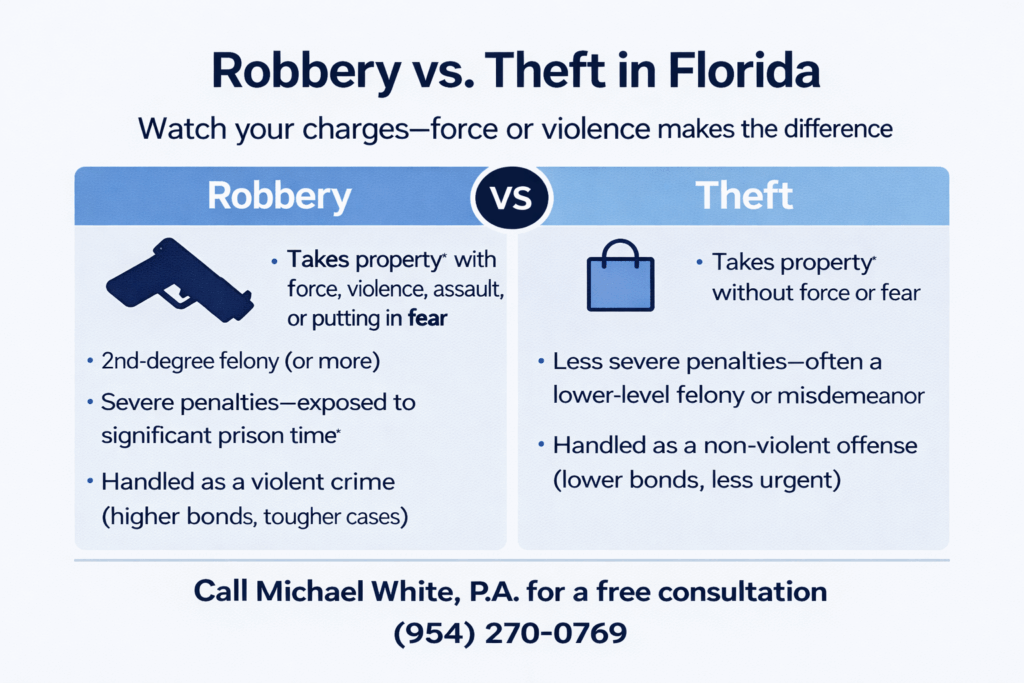
Side-by-Side Comparison: Robbery vs. Theft
Theft
Taking property without force or fear
Non-violent offense
Penalties based on property value
Lower bond exposure
Often eligible for diversion or early resolution
Robbery
Taking property with force, violence, assault, or fear
Classified as a violent felony
Minimum charge is typically a second-degree felony
Higher bonds and aggressive prosecution
Prison exposure can reach life if weapons are alleged
Why Robbery Charges Are Filed So Aggressively
Robbery charges give prosecutors leverage:
Higher sentencing exposure
Violent felony classification
Tougher plea posture
Greater bond restrictions
In many cases, robbery is charged before all evidence is reviewed—especially video, witness statements, or the exact sequence of events.
That’s why early defense involvement is critical.
Can Robbery Charges Be Reduced to Theft?
Yes—in the right case.
Robbery charges may be reduced when:
The State cannot prove force or fear
The alleged fear was subjective or unreasonable
Contact occurred after the taking, not during it
Video contradicts the arrest report
Identification evidence is weak or unreliable
A successful challenge often results in:
Reduction to theft
Dismissal
Suppression of evidence
More favorable plea options
We explain how and when that happens in our guide to whether robbery charges can be reduced in Florida.
Common Defenses in Robbery vs. Theft Cases
Defense strategies often focus on:
No force or fear at the time of the taking
Mistaken identity in fast-moving incidents — especially in cases involving brief encounters or unclear video, which we break down in our analysis of mistaken identity in robbery cases.
Surveillance video inconsistencies
Witness exaggeration or contradiction
Illegal detention or search
Self-defense or lawful resistance framing (when applicable)
Every detail matters—especially seconds on a video timeline.
What to Do If You’re Charged With Robbery or Theft
If you or a loved one is arrested:
Do not try to “explain” the situation to police
Preserve texts, messages, and location data
Identify surveillance cameras immediately
Avoid contact with alleged victims
Speak with counsel early—before the narrative hardens
Early defense action often determines whether a case stays a robbery—or gets reduced to theft.
✅ FAQs
Is robbery worse than theft in Florida?
Yes. Robbery is treated as a violent felony because it involves force or fear, while theft is a non-violent offense with significantly lower penalties.
Can you be charged with robbery without a weapon?
Yes. A weapon is not required. Robbery can be charged if the State alleges force or “putting in fear,” even without physical injury.
What does “putting in fear” mean in a robbery case?
It refers to a claim that the victim reasonably feared harm at the time of the taking. The fear must be more than speculation and must exist during the taking.
Can robbery charges be reduced to theft?
Sometimes. If the defense can show the State cannot prove force, violence, assault, or fear, robbery charges may be reduced or dismissed.
Does a struggle after the taking count as robbery?
It depends. Florida law may treat force during immediate flight as part of the robbery, but timing and context are often heavily contested.
Should I talk to police if accused of robbery or theft?
In most cases, no. Early statements are often used to strengthen robbery allegations. It’s usually safer to speak with an attorney first.