
Last updated March 2026
Yes — robbery charges in Florida can sometimes be reduced, but it depends entirely on the evidence, the strength of the State’s case, and how early a defense strategy is developed.
Under Florida law, robbery is defined in Florida Statutes § 812.13 as the taking of money or property with the use of force, violence, assault, or by “putting in fear.”
That definition creates leverage.
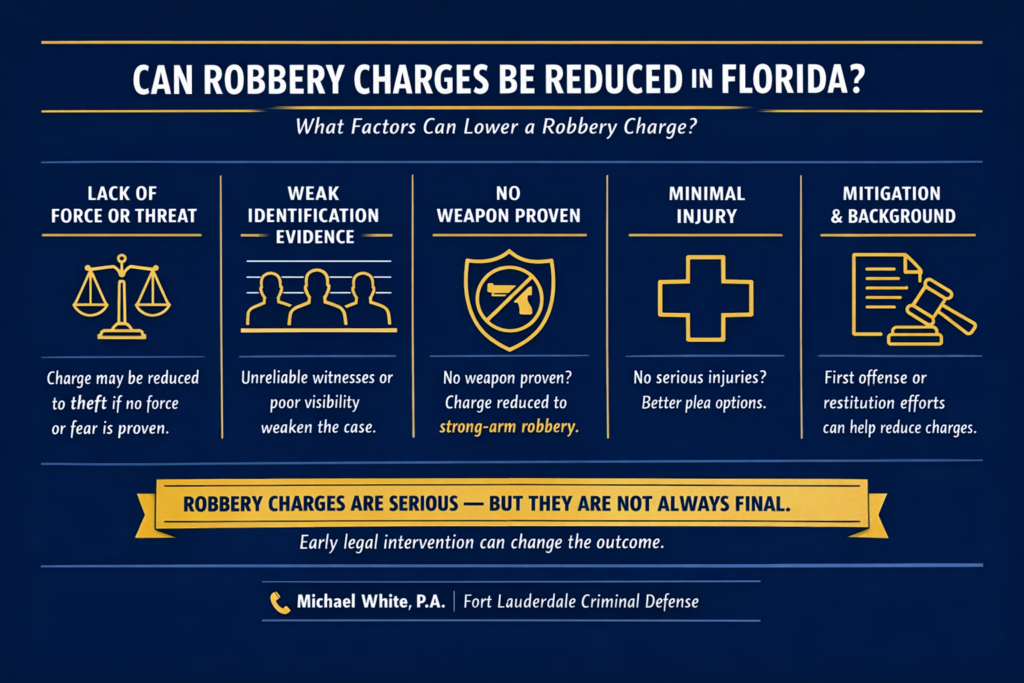
Because if the State cannot prove one of those required elements — especially force or fear — the charge may be reduced to a lesser offense such as theft.
If you are facing a robbery charge in Fort Lauderdale or Broward County, the outcome is not automatic. Many cases hinge on details that can significantly change the direction of the prosecution.
Because robbery is treated as a violent felony in Florida, understanding the full scope of penalties and defenses is essential. You can learn more about how robbery cases are prosecuted and defended on our guide to Robbery Charges in Florida.
When Robbery Charges Are Reduced to Theft
The most common reduction occurs when prosecutors cannot prove:
The use of force
A threat of violence
That the alleged victim was placed in reasonable fear
If property was taken but there is insufficient evidence of force or intimidation, the case may be reduced to:
Petit theft
Grand theft
This distinction matters. Robbery is a first-degree felony punishable by up to 30 years in prison. Theft offenses often carry dramatically lower exposure. We explain how that distinction drives charging decisions in our guide to robbery vs. theft in Florida.
The entire case often turns on whether the State can meet the “putting in fear” standard — which we break down in our guide to what “putting in fear” means in Florida robbery cases.
Weak Identification Evidence Can Change the Case
Robbery cases frequently depend on:
Eyewitness identification
Surveillance footage
Show-up identifications
Cross-racial or high-stress identifications
If identification is weak, unreliable, or suggestive, prosecutors may reconsider whether the evidence is strong enough to sustain a robbery conviction at trial. If identification is weak, unreliable, or suggestive — an issue we explore in our breakdown of mistaken identity in robbery cases — prosecutors may reconsider whether the evidence is strong enough to sustain a conviction.
When identity is questionable, leverage increases.
We analyze how video evidence can strengthen or undermine identification in our guide to robbery and surveillance video evidence in Florida.
Armed Robbery vs. Strong-Arm Robbery
Another major reduction issue involves weapons.
If prosecutors allege a firearm or deadly weapon, the charge escalates significantly. However, if the State cannot prove that:
A weapon was present
The weapon was real
The weapon was used during the taking
The case may be reduced from armed robbery to strong-arm robbery.
And in some cases, further negotiations may reduce the charge even more depending on mitigation and evidentiary weaknesses.
For a deeper breakdown of how weapon allegations impact charges and sentencing exposure, see our guide to strong-arm vs. armed robbery in Florida.
When no weapon is involved at all, we examine how those cases are charged in our guide to robbery with no weapon in Florida.
Minimal Force and No Injury
Not all robbery allegations involve serious violence.
Cases involving:
Brief physical contact
Minor scuffling
No visible injuries
No medical treatment
can sometimes present negotiation opportunities — particularly where the alleged force is minimal and the facts are disputed.
Severity affects bargaining power.
First-Time Offenders and Mitigation Matter
While robbery is a serious felony, prosecutors do evaluate:
Criminal history
Age
Employment background
Restitution efforts
Victim input
Case weaknesses
A clean record combined with evidentiary issues can significantly improve the chances of a reduced charge or favorable resolution.
Early intervention is critical.
Pretrial Motions Can Create Leverage
Reductions do not happen automatically. They are often the result of:
Motion to suppress identification
Challenging unlawful searches
Excluding unreliable statements
Contesting surveillance admissibility
When evidence is suppressed or weakened, the prosecution’s position changes.
Every Robbery Case Is Fact-Specific
There is no universal formula for reducing a robbery charge.
However, reductions become possible when:
The “force” element is weak
Fear is questionable
Identification is unreliable
A weapon cannot be proven
The evidence has constitutional issues
The earlier these weaknesses are identified, the stronger the negotiating position becomes.
FAQs
Can robbery be reduced to theft in Florida?
Yes. If prosecutors cannot prove force, violence, or that the victim was placed in fear, the charge may be reduced to a theft offense.
Can armed robbery be reduced to strong-arm robbery?
Potentially. If the State cannot prove a weapon was present or used, the armed enhancement may be removed.
Does a first-time offender have a better chance of a reduction?
First-time offenders with no criminal history may have stronger negotiation leverage, especially if the evidence is weak.
Robbery Charges Are Serious — But Not Always Final
A robbery arrest does not mean a robbery conviction.
Strategic defense analysis can:
Expose weaknesses
Challenge essential elements
Increase negotiation leverage
Create opportunities for reduction
If you are facing a robbery charge in Fort Lauderdale or anywhere in Broward County, early legal strategy can make a substantial difference in the outcome.