
Last updated April 2026
If you were arrested for DUI in Fort Lauderdale or anywhere in South Florida, the most important question isn’t just “What am I charged with?” — it’s:
Can the evidence against me be thrown out?
In many DUI cases, the answer is yes. The outcome is frequently determined not by what happened — but by whether the State’s evidence survives legal challenge.
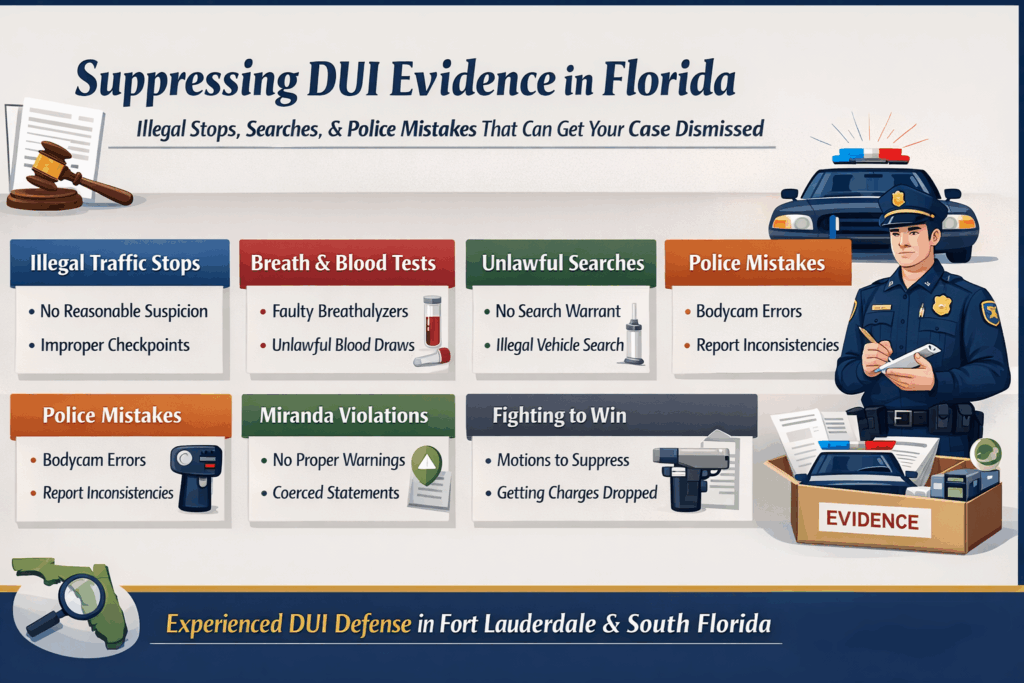
When police violate your constitutional rights during a DUI investigation, a skilled DUI defense attorney can file a motion to suppress — a legal challenge asking the court to exclude illegally obtained evidence. When key evidence is suppressed, DUI charges are often reduced or dismissed entirely.
Suppression issues are one part of a broader DUI defense strategy, which is explained in our overview of Florida DUI Cases.
🧠 What This Means for Your Case
DUI cases are evidence-driven — and when that evidence is excluded, the case often falls apart.
In many Broward County DUI cases:
- suppression leads to reduced charges
- key evidence becomes unusable
- prosecutors lose leverage
- dismissals become possible
👉 The issue is not just whether you were impaired.
👉 It’s whether the State can prove it using admissible evidence.
⚖️ What Is a Motion to Suppress in a Florida DUI Case?
A motion to suppress is a pretrial legal motion that challenges how evidence was obtained — not whether you were impaired.
In DUI cases, suppression focuses on constitutional violations, including:
• Illegal traffic stops
• Unlawful detention or searches
• Improper field sobriety testing
• Invalid breath or blood testing procedures
• Coerced or un-Mirandized statements
If the judge agrees that your rights were violated, any evidence obtained as a result cannot be used in court.
In practice, suppression is often the most powerful tool available in DUI defense.
📜 Constitutional Foundations of DUI Suppression
DUI suppression motions are grounded in fundamental constitutional protections, including:
• Fourth Amendment — unlawful stops, searches, and seizures
• Fifth Amendment — custodial interrogation and Miranda violations
• Florida Constitution, Article I, Section 12
If police violate these protections at any stage of a DUI investigation, evidence obtained afterward may be excluded — even if officers believed they were acting appropriately.
🚦 Illegal Traffic Stops (The Most Common Suppression Issue)
Most DUI cases begin with a traffic stop — and that stop must be lawful. In many cases, this is where DUI cases are won or lost — at the very first moment of police contact.
Police must have reasonable suspicion of a traffic violation or criminal activity to stop your vehicle. If the stop was unlawful, everything that followed may be suppressed, including:
• Field sobriety tests
• Breath or blood test results
• Officer observations
• Statements made after the stop
Common unlawful stop scenarios include:
• Vague lane drifting without corroboration
• Stops based on anonymous tips without verification
• “Fishing” stops in DUI enforcement zones
• Stops extended beyond their original purpose
An illegal stop can collapse the entire DUI case.
🛣️ Was Your DUI Stop Legal in Florida?
Every DUI case begins with a traffic stop — and that stop must be lawful. In Florida, an officer cannot pull you over based on a hunch, curiosity, or generalized suspicion. The law requires reasonable suspicion or probable cause supported by specific, articulable facts.
If the initial stop was illegal, everything that followed may be suppressed, including field sobriety exercises, breath or blood test results, officer observations, and post-stop statements.
Florida courts consistently suppress DUI evidence when the State cannot justify the legality of the stop.
⚖️ What Makes a DUI Stop Lawful in Florida?
A DUI stop is lawful only when an officer can point to a legitimate legal basis, such as:
• Observing a traffic violation (speeding, running a red light, failure to maintain lane with corroboration)
• Witnessing erratic driving that objectively suggests impairment
• Responding to a verified crash or emergency call
• Investigating a properly corroborated tip
The officer’s reason for the stop must exist before the vehicle is pulled over — not manufactured afterward.
🚫 Stops That Commonly Lead to Suppression
Courts frequently suppress DUI evidence when stops are based on:
• Minor or momentary lane drift without additional indicators
• Driving under the speed limit, alone
• Anonymous tips without independent police corroboration
• “Fishing” stops during DUI patrols or saturation details
• Vague claims of “weaving” not supported by video evidence
• Stops initiated to “check things out” or investigate lawful behavior
If the officer cannot articulate a valid legal basis for the stop, the detention is unconstitutional.
🛡️ How Illegal Stops Collapse DUI Cases
An unlawful stop taints all evidence obtained afterward under the “fruit of the poisonous tree” doctrine. When a stop is suppressed:
• Field sobriety exercises are excluded
• Breath or blood test results become inadmissible
• Officer observations lose legal foundation
• Statements made after the stop may be suppressed
Without admissible evidence, prosecutors are often forced to reduce or dismiss the DUI charge.
🔎 Key DUI Suppression Issues in Florida (Where Cases Are Won or Lost)
Not all suppression issues arise from the same type of evidence. Some of the most important challenges involve how statements, video, and statutory protections are handled in DUI investigations.
We break down these issues in more detail in:
- Accident report privilege in Florida DUI cases
- Bodycam footage in Florida DUI investigations
- Wheel witness doctrine in Florida criminal cases
🔗 How Suppression Fits Into DUI Defense Strategy
Suppression is one part of a broader DUI defense strategy. To understand how these issues connect across a case, see:
- DUI Traffic Stops & Investigations in Florida
- DUI Testing and Evidence Issues in Florida
- DUI Process & Defense Strategy in Florida
Each of these can determine whether critical evidence is admissible — and whether the State can proceed at all.
🎥 Video Evidence Is Often the Turning Point
Body-worn and dash-camera footage frequently contradicts an officer’s written justification for a DUI stop. Suppression issues commonly arise when video shows:
• Stable driving inconsistent with alleged weaving
• Delayed activation of emergency lights
• No observable traffic violation
• Inconsistent or evolving explanations for the stop
In many cases, video evidence is what exposes inconsistencies that lead directly to suppression.
When video undermines reasonable suspicion, suppression becomes a powerful defense tool.
We explore how video evidence can make or break DUI cases in our guide to Bodycam Footage in Florida DUI Investigations.
⚠️ Even a Lawful Stop Can Become Unlawful
A stop that begins legally can still violate constitutional protections if police:
• Prolong the detention without new reasonable suspicion
• Expand the investigation beyond its original purpose
• Conduct searches without consent or legal justification
Evidence obtained after an unlawful extension of the stop may still be suppressed — even if the initial stop was valid.
🔍 Why Stop Legality Must Be Examined First
Before breath results, field tests, or arrest decisions are evaluated, a DUI defense attorney must analyze the very first moment of police contact. Suppression arguments are strongest when raised early, before prosecutors lock in their case narrative.
Illegal stops are one of the most effective — and most overlooked — ways to dismantle a DUI prosecution.
🚓 Common Police Mistakes That Lead to Suppression in DUI Cases
Many DUI cases fall apart not because of what a driver did — but because of mistakes made by law enforcement during the investigation. Suppression issues often arise when officers fail to follow constitutional requirements or mandatory procedures.
Common errors that lead to suppressed evidence include:
🚫 Illegal or Unsupported Traffic Stops
Stops based on vague “weaving,” hunches, or uncorroborated tips frequently lack reasonable suspicion. When the stop itself is unlawful, all resulting evidence may be excluded.
🧍 Improper Field Sobriety Exercises
Field sobriety exercises must follow standardized protocols. Evidence may be suppressed or discredited when officers:
Give incorrect or incomplete instructions
Fail to demonstrate tests
Test on uneven or unsafe surfaces
Ignore medical or physical limitations
🗣️ Miranda Violations
Once a DUI investigation becomes custodial, police must advise you of your rights before interrogation. Statements obtained after custody without Miranda warnings may be suppressed entirely.
In crash-related DUI cases, additional protections may apply under Florida’s accident report privilege, which limits how certain statements can be used — an issue we explain in our guide to Accident Report Privilege in Florida DUI Cases.
⏱️ Breath Test Observation Violations
Florida requires a continuous 20-minute observation period before breath testing. Violations of this rule often result in exclusion of breath test results — the State’s most relied-upon evidence.
🧪 Chemical Testing and Evidence Handling Errors
Breath and blood evidence may be suppressed when:
Testing equipment is improperly calibrated
Operators lack valid certification
Blood draws occur without consent or a lawful warrant
Chain of custody is incomplete or unreliable
📄 Inaccurate or Contradictory Police Reports
Discrepancies between police reports and bodycam or dashcam footage frequently expose suppression issues and credibility problems that weaken the prosecution’s case.
Even minor procedural failures can have major consequences in DUI litigation. These are not rare mistakes — they occur in DUI cases every day.
In some cases, the State may attempt to rely on officers who did not personally observe the driving — raising issues under the “wheel witness” doctrine, which we explain in our guide to the Wheel Witness Rule in Florida criminal cases.
🚗 Unlawful Detention and Vehicle Searches
Even if a traffic stop begins lawfully, police cannot extend it without new legal justification.
Evidence may be suppressed when:
• The stop was prolonged without reasonable suspicion
• A vehicle search occurred without consent or a valid exception
• Probable cause was manufactured after the fact
Unlawful searches frequently lead to suppression of:
• Open containers
• Drugs or paraphernalia
• Evidence used to justify arrest
🧪 Suppressing Chemical Test Evidence in Florida DUI Cases
Chemical testing is one of the most litigated areas in DUI defense because it is highly procedural.
Breath or blood evidence may be suppressed when:
• The 20-minute observation rule was violated
• Calibration or maintenance records are missing or invalid
• The test operator lacked proper certification
• A blood draw lacked valid consent or a lawful warrant
• Chain of custody cannot be established
If chemical testing is excluded, the State often cannot prove impairment beyond a reasonable doubt.
🧪 Suppressing Breath Test Evidence in Florida DUI Cases
Breath test results are often the centerpiece of the State’s DUI case. But breath evidence is highly procedural and frequently suppressed when officers or agencies fail to follow Florida law.
Breath test evidence may be excluded when:
• The traffic stop was unlawful
• Police lacked probable cause to arrest
• Implied consent warnings were misstated or incomplete
• The breath-testing instrument was not properly calibrated or maintained
• The test operator lacked valid certification
• FDLE Rule 11D-8 requirements were not followed
When breath evidence is suppressed, prosecutors often lose their strongest proof of impairment — creating leverage for dismissal or reduction to reckless driving.
🩸 Suppressing Blood Test Evidence in Florida DUI Cases
Blood draws involve a physical intrusion into the body and generally require a warrant.
Florida courts allow warrantless blood draws only in narrow, fact-specific emergencies. There is no automatic exception for crashes, injuries, or DUI manslaughter allegations.
Courts evaluate:
• Whether a real emergency existed
• Whether a judge was reasonably available
• Whether obtaining a warrant would have caused a critical delay
If police had time to obtain a warrant but failed to do so, blood evidence may be suppressed entirely.
🗣️ Statements and Miranda Violations
Statements made during a DUI investigation may be suppressed when:
• You were in custody and not read Miranda rights
• Police continued questioning after you invoked your rights
• Statements were coerced, misleading, or improperly induced
Even casual admissions (“I had two drinks”) can be excluded if constitutional standards were violated.
⏱️ Timing, Trauma, and Suppression Opportunities
In DUI cases involving crashes, injuries, or medical treatment, testing often occurs well after driving.
Delays can create suppression or exclusion issues when:
• Alcohol absorption was still occurring
• Trauma or shock altered metabolism
• Medical treatment affected BAC readings
• Retrograde extrapolation relies on speculation
When timing and trauma undermine the reliability of testing, courts may exclude the evidence or reduce its weight.
🛡️ Why Suppression Is a Game-Changer in DUI Cases
DUI prosecutions are evidence-driven. When evidence is suppressed:
• Prosecutors lose leverage
• Charges are often reduced to reckless driving
• Dismissals become far more likely
• Trial risk increases for the State
This is why suppression issues must be identified early, before prosecutors lock in their case theory.
Even when a suppression motion is ultimately denied, the hearing itself can expose weaknesses in the State’s case, lock officers into testimony, and improve negotiation leverage. Many DUI cases resolve favorably after suppression issues are litigated — not because of trial, but because the evidence no longer supports the charge.
⏳ When Suppression Issues Must Be Identified
Suppression issues are strongest when identified early — before the State builds its case narrative.
In many cases:
- evidence is lost if not preserved quickly
- officers are not locked into testimony
- defense opportunities are missed
Early review of the stop, investigation, and testing process is critical.
👨⚖️ DUI Arrest in South Florida? Let’s Talk Suppression Strategy
At Michael White, P.A., we defend DUI cases throughout Fort Lauderdale, Broward County, Palm Beach, and Miami-Dade. As a former prosecutor, Attorney White understands how DUI cases are built — and exactly where constitutional violations occur.
In many cases, DUI charges are not defeated at trial — they are defeated when the evidence is no longer admissible.
📞 Call (954) 270-0769 or request a free consultation to evaluate whether evidence in your DUI case can be suppressed.
💬 Frequently Asked Questions
What is a motion to suppress in a DUI case?
A legal motion asking the court to exclude evidence obtained in violation of constitutional rights.
Can DUI charges be dismissed if evidence is suppressed?
Yes. When key evidence is excluded, prosecutors may be forced to reduce or dismiss charges.
What evidence can be suppressed in a DUI case?
Breath tests, blood tests, field sobriety results, statements, and evidence from illegal stops or searches.
Do I need a lawyer to file a motion to suppress?
Yes. Suppression motions are technical and require detailed legal and factual analysis.
How do I know if suppression applies to my case?
Your attorney must review the stop, arrest, testing procedures, video evidence, and paperwork to identify constitutional violations.