
Last updated April 2026
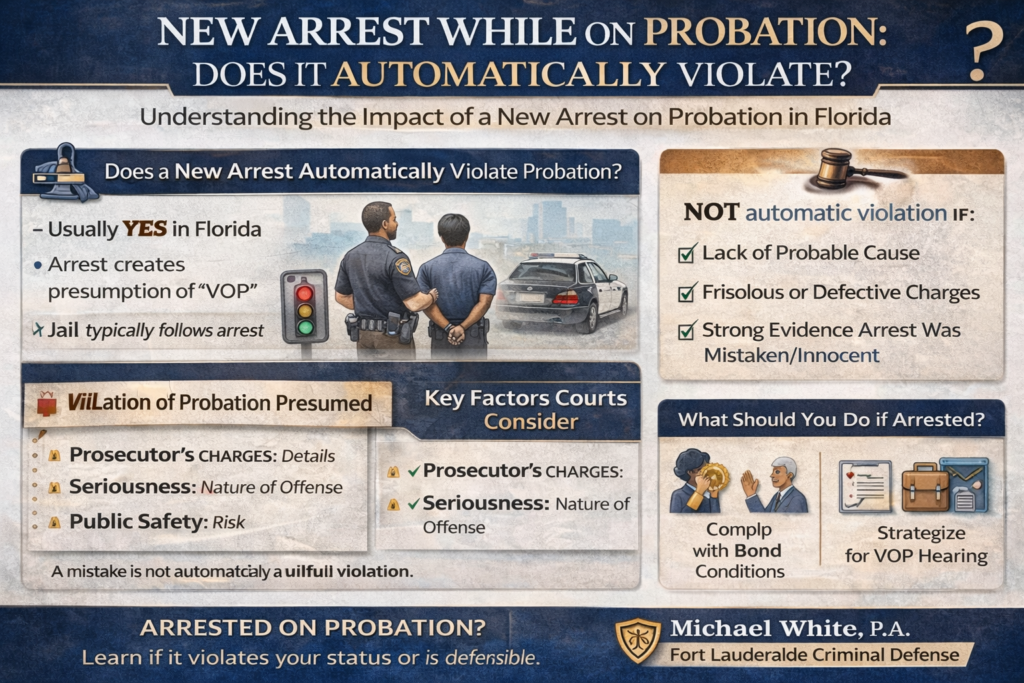
If you’re arrested while on probation, one question usually comes first:
Does this automatically violate my probation?
In Florida, the answer is no — not automatically.
But a new arrest almost always triggers a probation violation proceeding. And because probation violation hearings follow different rules than criminal trials, the consequences can move quickly.
For a broader explanation of how probation violations work in Florida, see our guide to probation violations in Florida.
Here’s what actually happens when a new arrest intersects with probation.
Does a New Arrest Automatically Violate Probation?
No.
A new arrest does not equal automatic revocation. A judge must still determine whether a violation occurred under the probation violation standard.
However:
-
A conviction is not required
-
The State does not have to prove guilt beyond a reasonable doubt
-
The judge decides the issue — not a jury
This makes the VOP process separate from the new criminal case.
How the Legal Standard Is Different
In a new criminal case, the State must prove guilt beyond a reasonable doubt.
In a probation violation hearing, the State must prove the violation by the greater weight of the evidence.
That is a lower burden.
Additionally:
-
Hearsay may be admitted
-
The judge evaluates credibility
-
The court determines whether the conduct was willful and substantial
For a deeper explanation of that standard, see what “willful and substantial” means in a VOP case.
What Happens After a New Arrest on Probation?
Typically:
-
The probation officer files an affidavit of violation.
-
A warrant may be issued.
-
A no-bond hold is often placed.
-
A VOP hearing is scheduled.
If you are arrested on the new charge, you may also be held on the probation violation.
For a broader explanation of how bond decisions work in these cases, see our guide to bond on a probation violation in Florida.
How Judges Evaluate a New Arrest in a VOP Case
Judges consider:
-
The seriousness of the alleged offense
-
Whether violence is involved
-
The strength of the evidence
-
Prior compliance history
-
Risk to public safety
-
Whether the conduct appears willful and substantial
A minor misdemeanor may be treated differently than a felony or violent allegation.
Can the Court Revoke Probation Before the New Case Is Resolved?
Yes.
The probation violation hearing does not have to wait for the new criminal case to conclude.
Because the burden of proof is lower, a judge may find a violation even if:
-
The new case is later dismissed
-
The charges are reduced
-
The defendant is ultimately acquitted
This is one of the most misunderstood aspects of probation law.
What If the New Charges Are Weak?
A new arrest does not automatically satisfy the probation violation standard.
Defense strategy may focus on:
-
Challenging the reliability of the police report
-
Cross-examining officers
-
Highlighting inconsistent witness statements
-
Demonstrating lack of probable cause
-
Presenting mitigation evidence
If the evidence is weak or unreliable, the court may decline to revoke probation.
For more on how VOP hearings work procedurally, review what happens at a violation of probation hearing in Florida.
Is Every New Arrest a “Substantive” Violation?
Generally, yes.
A new criminal allegation is classified as a substantive probation violation, which carries greater risk than a purely technical violation.
To understand the distinction, see technical vs. substantive probation violations in Florida.
Substantive violations often increase:
-
Bond risk
-
Revocation exposure
-
Jail or prison risk
But they are still defendable.
Can Probation Be Reinstated After a New Arrest?
Yes.
Even if a violation is found, judges retain discretion in many cases to:
-
Reinstate probation
-
Modify supervision
-
Add conditions (treatment, monitoring, classes)
-
Impose a short jail sanction rather than revoke
In some cases, the goal is to prevent the violation from being sustained at all. Learn more about when a probation violation can be dismissed in Florida.
The outcome often depends on preparation, evidence, and mitigation.
FAQs: New Arrest While on Probation in Florida
Does a new arrest automatically revoke probation?
No. A judge must still determine whether the probation violation standard is met.
Can I be held without bond after a new arrest on probation?
Yes. Many VOP warrants include a no-bond hold until a judge reviews the case.
Can probation be revoked even if I’m not convicted of the new charge?
Yes. The burden of proof is lower at a VOP hearing than in a criminal trial.
Can the VOP hearing happen before the new case is resolved?
Yes. The court does not have to wait for the new criminal case to conclude.
Is a new arrest considered a substantive violation?
Yes. A new criminal allegation is typically classified as a substantive probation violation.
Arrested While on Probation in Florida?
A new arrest does not automatically revoke probation — but it significantly increases risk.
Because probation violation hearings operate under a different legal framework than criminal trials, early strategy is critical.
Understanding the distinction between the new charge and the VOP proceeding can determine whether probation continues or is revoked.