
Last updated April 2026
If you’ve been accused of violating probation for the first time, one question usually dominates everything else:
Am I going to jail — or can this be fixed?
In Florida, a first-time violation of probation (VOP) is often the best opportunity to preserve your freedom. Judges have broad discretion on a first violation — especially when the allegation is technical or non-willful.
But probation violation hearings move quickly, and waiting to “explain it to the judge” can lead to unnecessary jail exposure.
For a full overview of how these cases are handled, see our guide to probation violations in Florida.
Here’s what matters — and what judges actually look at — when deciding a first-time VOP.
⚖️ What Is a Violation of Probation (VOP) in Florida?
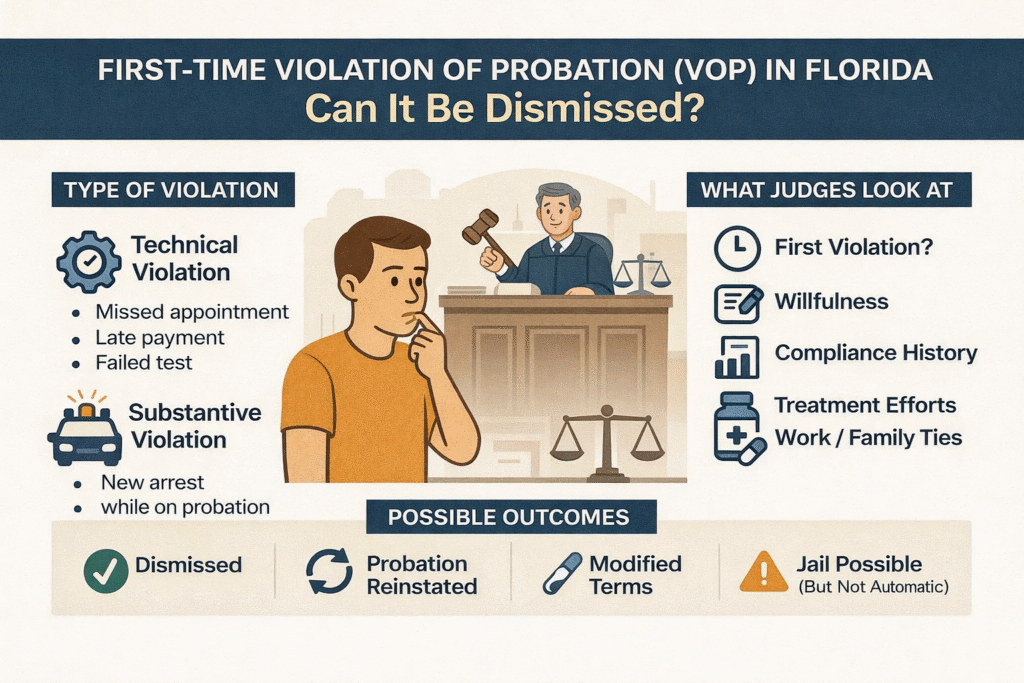
A violation of probation occurs when someone on probation allegedly fails to comply with one or more conditions of their sentence. Under Florida law, probation violations generally fall into two categories.
Technical Violations
A technical violation does not involve a new crime. Common examples include:
-
Missing a probation appointment
-
Late or missed payments
-
Failed or missed drug or alcohol tests
-
Failure to complete classes or treatment
-
Employment or reporting issues
Most first-time VOPs are technical, and these are often the most defensible.
For a deeper breakdown of how courts distinguish between types of violations, see our guide to technical vs. substantive violations in Florida.
Substantive Violations
A substantive violation involves an allegation that you committed a new criminal offense while on probation.
Important distinctions:
-
A new arrest is not a conviction
-
The State does not need to prove guilt beyond a reasonable doubt
-
Judges may rely on probable cause, unless the allegation is challenged
These violations are harder to resolve — but not impossible.
🛡️ Can a First-Time VOP Be Dismissed in Florida?
Yes — especially when the violation is technical or non-willful.
Florida judges retain broad discretion on a first violation, and dismissal or reinstatement is often possible with the right presentation.
Can a Probation Violation Be Dismissed If It Is Not Your First?
While first-time violations present the strongest opportunity for dismissal or reinstatement, a probation violation can still be dismissed even if it is not your first. Florida courts must find that a violation was both willful and substantial before revoking probation. If the alleged conduct was not intentional, if the State’s evidence is weak or unreliable, or if strong mitigation exists, a judge may decline to revoke probation and instead reinstate or modify supervision. That said, repeated violations significantly increase the risk of revocation, especially when prior warnings were ignored or when the alleged conduct involves new criminal behavior. The strategy in repeat-violation cases often shifts from seeking outright dismissal to preventing revocation and minimizing incarceration exposure.
⚠️ A First Violation Is Not Automatically Forgiven
While courts often show flexibility on a first violation, probation is considered a privilege. Judges may still revoke probation if they find the violation was willful and substantial.
Factors that increase risk include:
-
Repeated prior noncompliance not formally violated
-
Failure to respond to probation officer warnings
-
New criminal allegations involving violence or drugs
-
Ignoring the issue until arrest
Early legal intervention often determines whether the first violation is treated as a mistake — or as a pattern.
🔹 First-Time Technical Violations
Judges and probation officers frequently show leniency on a first violation when there is a reasonable explanation, such as:
-
Missed appointments with documentation
-
Job schedule conflicts
-
Financial hardship
-
Transportation or medical issues
-
Early engagement in treatment
Possible outcomes include:
-
Dismissal of the violation
-
Reinstatement of probation
-
Modification of conditions (classes, testing, treatment)
Jail is not automatic on a first technical VOP.
🔹 First-Time Substantive Violations
Substantive violations carry higher risk, but they are still defendable.
A court may decline to violate probation when:
-
The new charge is weak or dismissed
-
The evidence is unreliable
-
The conduct was not willful
-
Strong mitigation is presented
In many cases, defense strategy focuses on preventing revocation, even if the violation is sustained.
⚖️ What Judges Focus on in First-Time VOP Cases
When deciding how to handle a first violation, judges commonly consider:
-
Whether this is truly a first violation
-
Willfulness of the conduct
-
Prior compliance with probation terms
-
Efforts to correct the issue quickly
-
Participation in treatment or counseling
-
Employment and family responsibilities
Judges are often more receptive to solutions that salvage probation rather than revoke it.
🚨 What Happens at a First-Time VOP Hearing?
A VOP hearing is not a trial. There is no jury, and the judge decides whether a violation occurred under a lower burden of proof.
For a full breakdown of evidentiary standards and procedures, see our guide to probation violations in Florida.
In a first-time case, the focus often shifts from whether a violation technically occurred to whether probation should be reinstated.
To understand how these hearings actually unfold — including evidence rules and burden of proof — see our guide to
what happens at a VOP hearing in Florida.
📉 Can You Avoid Jail on a First-Time VOP?
Often, yes.
With early legal intervention, many first-time VOP cases are resolved through:
-
Dismissal
-
Reinstatement
-
Community-based sanctions
-
Treatment-focused modifications
Jail becomes more likely when violations are ignored, repeated, or involve serious new allegations.
📈 What Improves Your Odds on a First-Time VOP
Judges are more likely to reinstate probation when:
-
You address the issue before the hearing
-
You enroll in treatment voluntarily
-
You bring documentation (employment, classes, testing)
-
You demonstrate substantial compliance overall
-
You show immediate corrective action
The earlier the issue is addressed, the more options typically remain available.
For a full breakdown of legal strategies used to challenge alleged violations, see our guide to defenses to violation of probation in Florida.
❓ Frequently Asked Questions About First-Time VOPs in Florida
👨⚖️ Can a judge dismiss a violation of probation in Florida?
Yes. If the court finds the violation was not willful, not proven, or adequately addressed, the judge may dismiss it.
📄 What happens at a VOP hearing?
You appear before a judge, the State presents evidence of the alleged violation, and the judge decides whether to reinstate, modify, or revoke probation.
🧪 What if I failed a drug test but started treatment?
Courts often consider treatment as mitigation. On a first violation, this can support reinstatement instead of jail.
📉 Will I go to jail for my first probation violation?
Not necessarily. Many first-time violations are resolved without incarceration, especially technical violations.
📂 Does a first-time VOP go on my record?
Yes, but if the violation is dismissed or probation is reinstated, it may not change your original sentence or future eligibility for relief.
📄 What happens at a VOP hearing in Florida?
You appear before a judge, and the State tries to prove you violated probation. There is no jury, and the standard of proof is much lower than in a criminal trial.
⚠️ Accused of a first-time probation violation in Florida?
A first probation violation is often the best opportunity to fix the problem before probation is revoked.
Handled properly, many first-time VOPs result in reinstatement or modification rather than jail.
Handled poorly, they can lead to incarceration that could have been avoided.
Early action protects options.