
Last updated April 2026
Most people believe police must always read Miranda rights before asking questions.
That’s not true.
In Florida, Miranda warnings are required only in specific situations. Many arrests involve questioning without any Miranda warning at all. Understanding when Miranda applies — and when it doesn’t — can dramatically affect whether your statements are admissible in court.
Miranda violations are one category of constitutional violation that can result in suppressed evidence. For a broader overview of constitutional rights in Florida criminal cases, see our guide to Constitutional Violations in Florida Criminal Cases.
Here’s how Miranda works under Florida law, when statements may be excluded, and why invoking your rights clearly matters.
🧠 What Are Miranda Rights?
Miranda rights come from the U.S. Supreme Court decision Miranda v. Arizona, 384 U.S. 436 (1966).
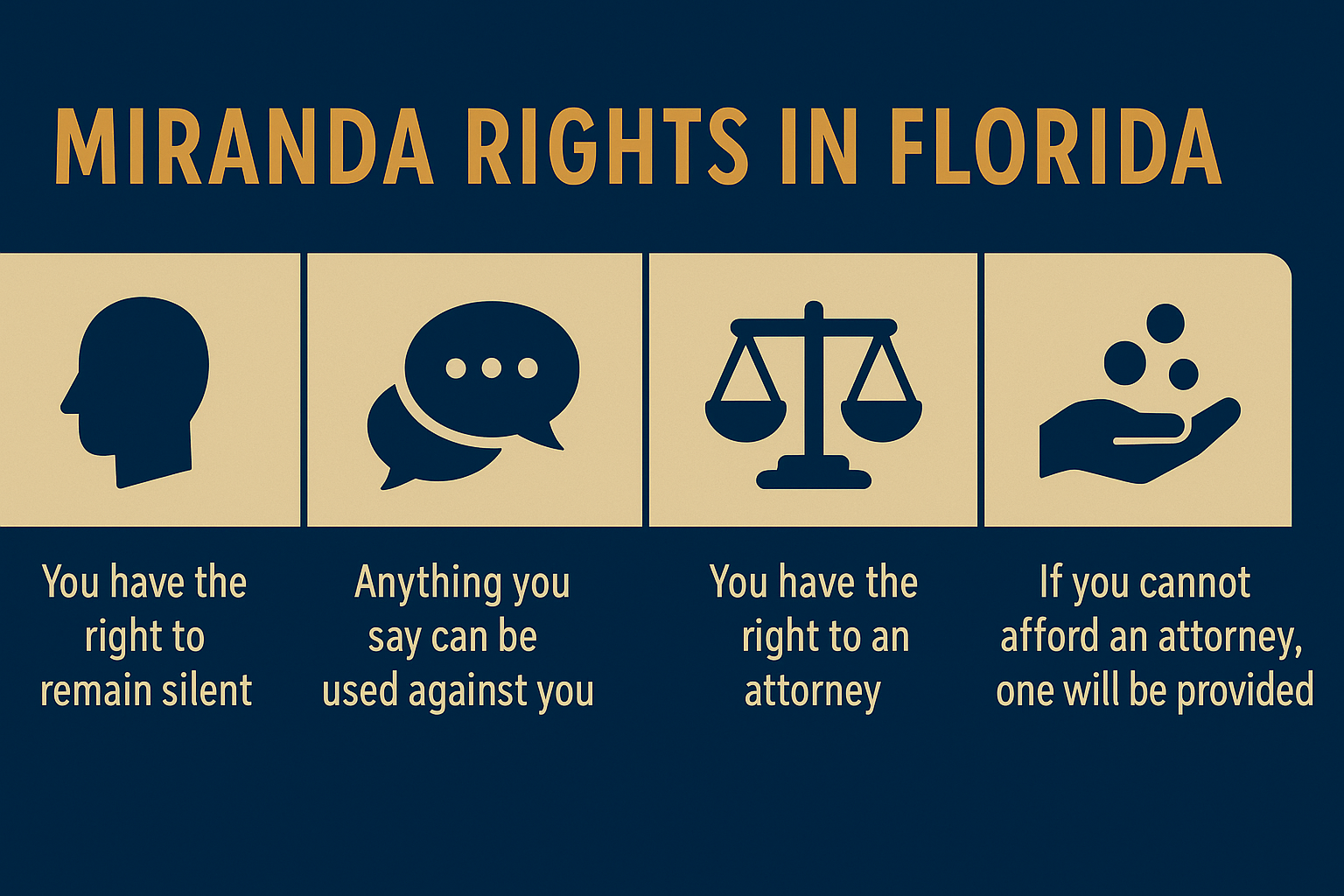
Before conducting custodial interrogation, police must advise a suspect of the following rights:
-
The right to remain silent
-
That anything said can be used against them
-
The right to an attorney
-
The right to have an attorney appointed if they cannot afford one
These warnings exist to protect the Fifth Amendment privilege against self-incrimination.
But Miranda is not triggered automatically by arrest — or even by questioning.
⚖️ When Police MUST Read Miranda Rights in Florida
Miranda warnings are required only when BOTH of the following are true:
✔ You are in custody
✔ Police are interrogating you
If either element is missing, Miranda does not apply.
This two-part requirement is frequently misunderstood — and often litigated in Florida courts.
Whether a situation qualifies as custody is often heavily contested, as explained in our guide to Miranda custody in Florida.
🚓 What “Custody” Actually Means
You are considered in custody when a reasonable person in your position would believe they are not free to leave.
Examples of custody may include:
-
Being formally arrested
-
Being handcuffed
-
Being placed in a patrol car
-
Being physically restrained during questioning
However, many police encounters do NOT qualify as custody, including:
-
Routine traffic stops
-
Street encounters
-
Voluntary interviews
-
Brief investigative detentions
Even if the interaction feels intimidating, courts focus on whether a reasonable person would feel free to leave under the circumstances.
These types of encounters also raise important questions about what police can require from you — including whether you must provide identification at all. In many cases, that obligation depends on whether you are actually detained, as explained in our guide to when you are required to identify yourself during a police encounter in Florida.
🗣️ What Counts as “Interrogation”
Interrogation includes:
-
Direct questioning designed to elicit incriminating responses
-
Words or actions police should know are reasonably likely to produce an incriminating answer
It does NOT include:
-
Routine booking questions
-
Requests for identification — While officers may request identification during an encounter, they cannot always require it.
-
Casual conversation
-
Voluntary statements you offer on your own
This distinction is especially important when deciding whether to speak at all, particularly when talking to police without a lawyer in Florida.
Police often rely on this distinction to gather statements before Miranda protections apply.
🚫 Common Miranda Misconceptions
❌ “If police didn’t read Miranda, the case gets dismissed.”
False. Only the statements may be excluded — not the entire prosecution.
❌ “Police must read Miranda at arrest.”
False. Miranda applies only during custodial interrogation.
❌ “Anything I say before Miranda can’t be used.”
False. Voluntary, non-custodial statements are often admissible.
These misconceptions frequently surface during pretrial suppression hearings.
🧠 Where Miranda Cases Often Turn
In many cases, the issue is not whether Miranda warnings were given — but whether they were required in the first place.
Common points of dispute include:
- whether the encounter had become custodial
- whether questioning amounted to interrogation
- whether a waiver was truly voluntary
- whether officers continued questioning after invocation
These issues often determine whether statements are admitted or suppressed.
🛑 When Statements May Be Suppressed
Statements may be excluded when:
-
You were in custody
-
Police interrogated you
-
Miranda warnings were not given
-
You did not knowingly and voluntarily waive your rights
In some situations, statements made before warnings are given may still be used, depending on how they were obtained, as discussed in statements made before Miranda in Florida.
Whether a waiver is legally valid is often the central issue, as explained in invalid Miranda waivers in Florida.
Even if warnings were given, statements may still be suppressed if:
-
The waiver was coerced
-
You clearly requested a lawyer and questioning continued
-
You invoked your right to remain silent and police ignored it
These issues are litigated through pretrial suppression motions.
For a detailed look at how Florida courts suppress statements after Miranda violations, see our guide to Miranda violations and suppression strategies in Florida.
🛡️ How to Protect Yourself During Police Questioning
The safest approach is simple:
Clearly and unequivocally invoke your rights.
Say:
“I am invoking my right to remain silent and I want a lawyer.”
Then stop talking.
Do not explain.
Do not argue.
Do not answer follow-up questions.
Once you clearly invoke your rights, police must stop questioning you.
⚖️ Miranda Issues Often Decide Cases
In many Florida prosecutions — including DUI, drug offenses, and violent felonies — a defendant’s statements become the strongest evidence in the State’s case.
When those statements are excluded:
-
The prosecution may lose critical admissions
-
Charges may be reduced
-
Some cases may be dismissed entirely
Miranda litigation is often one of the most powerful pretrial defense tools available.
📍 Fort Lauderdale Criminal Defense for Miranda Violations
At Michael White, P.A., we carefully analyze:
-
Whether custody existed
-
Whether interrogation occurred
-
Whether warnings were properly given
-
Whether any waiver was voluntary
-
Whether questioning continued after invocation
As a former prosecutor, Michael White understands how statements are used to build cases — and how constitutional errors can undermine them.
📞 Call (954) 270-0769 for a confidential consultation.
Serving Fort Lauderdale, Broward County, Miami-Dade, Palm Beach County, and South Florida.
🔗 Key Miranda Issues in Florida
Miranda challenges often arise in specific situations, including:
💬 FAQs: Miranda Rights in Florida
Do police have to read me my Miranda rights during a traffic stop?
Usually no. Miranda applies only if the stop escalates into custody and interrogation.
Can my case be dismissed if police violated Miranda?
Not automatically. However, your statements may be excluded, which can significantly weaken the prosecution’s case.
What if I started talking before police read Miranda?
Voluntary, non-custodial statements are often admissible.
How do I clearly invoke my rights?
Say: “I am invoking my right to remain silent and I want a lawyer.” Then stop speaking.
Can police question me again after I ask for a lawyer?
Generally, no. Continued interrogation after a clear request for counsel can lead to suppression.