
Last updated April 2026
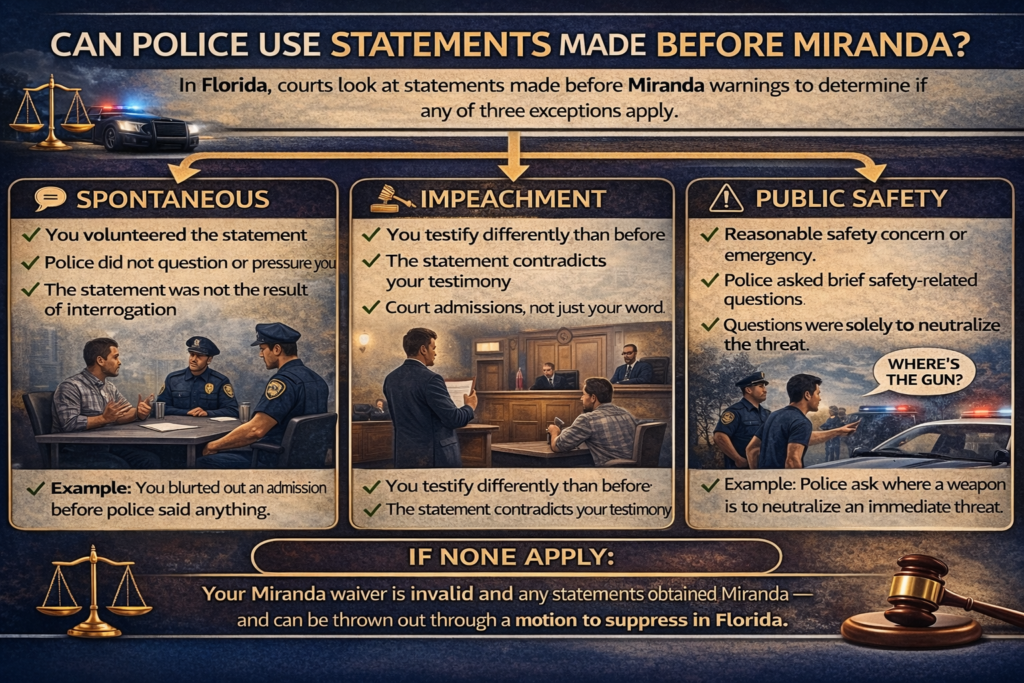
Many people believe that if police don’t read Miranda warnings, anything you say cannot be used against you.
That’s not always true.
In Florida, statements made before Miranda warnings may still be admissible depending on the circumstances. Understanding when those statements can be used — and when they can be challenged — is critical in many criminal cases.
For a broader overview of how these rules apply, see our guide to Miranda rights in Florida.
🧠 When Miranda Warnings Are Required
Miranda warnings are only required during custodial interrogation.
This means:
- you are in custody (not free to leave), and
- police are asking questions designed to elicit incriminating responses
If either element is missing, officers may not be required to give Miranda warnings at all.
Whether a situation qualifies as custody is often disputed, as explained in our guide to Miranda custody in Florida.
🚫 When Statements May Still Be Used Without Miranda
Even without warnings, certain statements may still be admissible.
1️⃣ Spontaneous or Volunteered Statements
If you speak without being prompted by police questioning, those statements are generally admissible.
Examples include:
- blurting something out during a stop
- making unsolicited comments
- speaking without being asked questions
Because these statements are not the product of interrogation, Miranda does not apply.
2️⃣ Statements Made Outside of Custody
If you are not in custody — even if police are asking questions — Miranda warnings are not required.
This often arises during:
- traffic stops
- consensual encounters
- early investigative questioning
The distinction between casual conversation and interrogation is not always clear, particularly when talking to police without a lawyer in Florida.
3️⃣ Public Safety Exception
Police may ask limited questions without Miranda warnings when there is an immediate threat to public safety.
Examples include:
- asking about the location of a weapon
- responding to an emergency situation
- addressing immediate danger to others
This exception is narrow and often challenged in court.
⚠️ When Pre-Miranda Statements May Be Suppressed
Even if statements were made before Miranda warnings, they may still be excluded if:
- the questioning was custodial and coercive
- the officer deliberately avoided giving warnings
- the statements were not truly voluntary
- the situation effectively became an interrogation
In many cases, the issue is not simply whether warnings were given — but whether the circumstances required them.
🔎 How Courts Analyze Pre-Miranda Statements
Courts examine:
- whether the person was in custody
- whether the officer’s questions were interrogative
- whether the statements were voluntary
- whether an exception applies
Timing is critical. A few moments can determine whether Miranda applies.
🧠 Where These Cases Often Break Down
In many cases, the issue is not whether statements were made — it’s whether police created a situation that required Miranda warnings.
Common problems include:
- questioning that becomes accusatory without warnings
- prolonged encounters that shift into custody
- pressure tactics that undermine voluntariness
- attempts to delay Miranda warnings intentionally
These details often determine whether statements are admitted or suppressed.
⚖️ How These Issues Are Challenged in Court
When statements are obtained improperly, the defense may challenge their admissibility through a motion to suppress in Florida.
Courts will evaluate:
- the nature of the questioning
- whether custody existed
- whether an exception applies
- whether the statements were voluntary
If the statements are excluded, the prosecution’s case may weaken significantly.
🔄 How This Relates to Miranda Waivers
Even when Miranda warnings are given, statements may still be challenged if the waiver itself was invalid.
👉 Learn how this works in invalid Miranda waivers in Florida
🛑 Can Police Use Your Statements Against You?
Sometimes — yes.
But only if:
- Miranda warnings were not required, or
- a valid exception applies, or
- the statements were truly voluntary
If not, the statements may be excluded.
❓ Frequently Asked Questions
Can police use statements made before Miranda warnings?
Yes, in some cases — particularly if the statements were voluntary or made outside of custody.
What is the public safety exception?
It allows police to ask limited questions without Miranda warnings when there is an immediate danger.
Are spontaneous statements admissible?
Yes. Statements not made in response to questioning are generally admissible.
Can pre-Miranda statements be suppressed?
Yes. If the situation required Miranda warnings and they were not given, statements may be excluded.