
Last updated May 2026
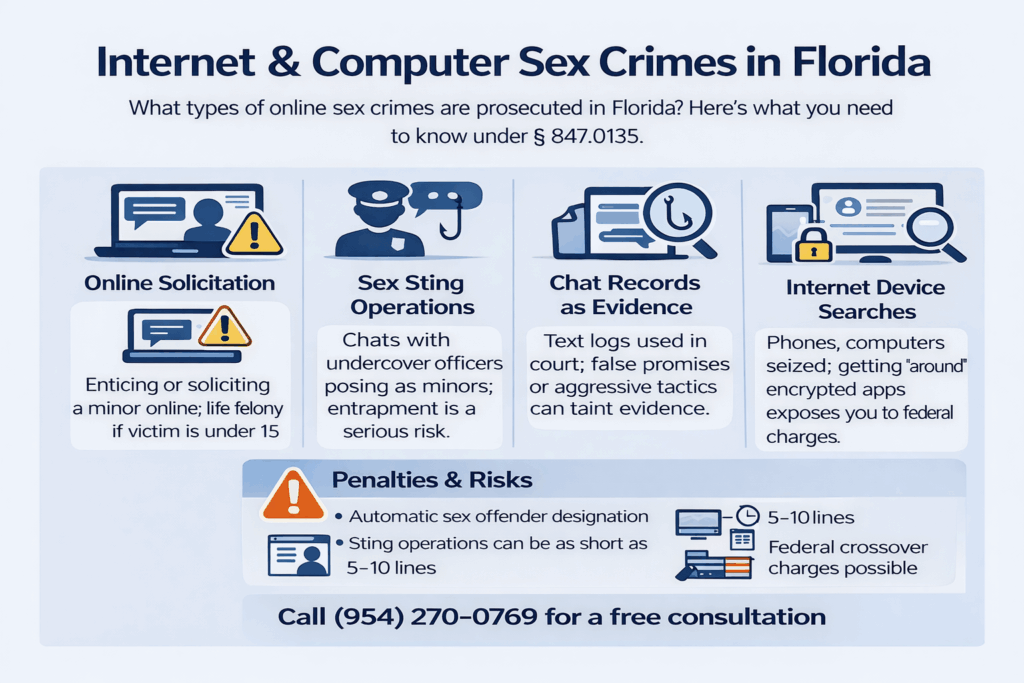
Internet and computer-based sex crime allegations are among the fastest-growing and most aggressively prosecuted offenses in Florida. These cases often involve undercover sting operations, digital communications, seized devices, and complex forensic analysis — long before formal charges are filed.
Unlike traditional sex crime allegations, internet sex crime cases frequently turn on intent, knowledge, and how digital evidence was obtained and interpreted. A single misstep early in an investigation can dramatically increase exposure.
If you are under investigation or have been arrested for an internet sex crime in Fort Lauderdale or South Florida, early legal intervention is critical.
Unlike traditional sex crime allegations, internet sex crime cases frequently turn on intent, knowledge, and how digital evidence was obtained and interpreted. A single misstep early in an investigation can dramatically increase exposure.
Internet sex crime cases are prosecuted under a different framework than traditional sex crime allegations, with heavy reliance on digital evidence, undercover operations, and forensic interpretation rather than eyewitness testimony.
If you are under investigation or have been arrested for an internet sex crime in Fort Lauderdale or South Florida, early legal intervention is critical.
For a broader overview of related offenses, see our guide to Sex Crimes in Florida.
🔍 What Are Internet Sex Crimes Under Florida Law?
Internet sex crimes involve alleged sexual offenses committed or facilitated through electronic means, including computers, smartphones, messaging apps, social media platforms, and file-sharing networks.
These cases are commonly charged under:
-
Florida statutes
-
Federal statutes
-
Multi-agency task-force investigations
⚖️ Common Internet & Computer Sex Crime Charges
Internet sex crime allegations can arise under several distinct charging theories, depending on the nature of the communication, the alleged conduct, and the agencies involved.
🔸 Online Solicitation of a Minor
Allegations involving electronic communication with someone believed to be a minor for unlawful purposes are commonly charged under Florida law.
These cases often begin with undercover law enforcement posing as a minor and may result in arrest before any in-person contact occurs.
👉 Read more: Online Solicitation of a Minor in Florida
🔸 Traveling to Meet a Minor
Charges may be filed when police allege someone traveled — or attempted to travel — to meet a minor after online communication.
These charges are frequently paired with solicitation counts and rely heavily on chat logs and proof of intent.
🔸 Sting Operations & Entrapment
Many internet sex crime cases originate from proactive sting operations conducted by:
-
Local law enforcement
-
Internet Crimes Against Children (ICAC) task forces
-
Federal authorities
These investigations frequently raise serious legal questions involving:
-
Inducement
-
Predisposition
-
Police overreach
👉 Learn more about how these operations work and when an entrapment defense may apply:
Entrapment in Internet Sex Crime Stings in Florida
🔸 Transmission of Harmful Material to a Minor
Florida law criminalizes the electronic transmission of explicit images, videos, or sexual communications to someone believed to be under 18. These charges are legally distinct from online solicitation and may be filed even when there is no plan to meet in person.
Allegations commonly involve:
-
Text messages
-
Social media platforms
-
Direct messaging applications
-
Image or video sharing
These cases are frequently referred to as “sexting” offenses, though the legal exposure can vary dramatically depending on age, intent, and the nature of the material.
👉 Learn more: Sexting a Minor in Florida
In some cases, individuals charged with sexting-related offenses face potential sex-offender registration consequences.
👉 Read more: Do You Have to Register as a Sex Offender for Sexting Charges in Florida?
🖥️ Possession or Distribution of CSAM (Sexual Performance by a Child)
Florida law refers to these offenses as sexual performance by a child under § 827.071, commonly searched online as “child pornography.”
These cases are aggressively prosecuted and typically involve:
-
Search warrants for electronic devices
-
Digital forensic examinations
-
Allegations of possession, viewing, saving, or sharing files
Each image or file may be charged separately, significantly increasing exposure.
👉 In-depth guide: CSAM Possession in Florida: What Prosecutors Must Prove
Recent changes in Florida law have expanded how certain internet-based offenses are charged, particularly in cases involving digital files and online investigations. For a detailed breakdown of these updates, see our guide to Florida CSAM law changes in 2026.
🔎 How Internet Sex Crime Investigations Begin in Florida
Most internet sex crime cases do not begin with a traditional police report. They begin online.
Law enforcement agencies routinely conduct proactive digital investigations, including:
-
Undercover chat operations
-
Social media monitoring
-
Online classified ad stings
-
Peer-to-peer file sharing investigations
-
Digital forensic reviews
In many cases, there is no actual minor involved. Instead, an officer poses as a minor and engages in conversation over days or weeks before arranging a meeting.
Arrests frequently occur at:
-
A pre-arranged meeting location
-
A residence following a search warrant
-
A workplace after digital evidence review
When devices are seized, forensic extraction becomes central to the case.
👉 Learn more about device searches and digital evidence challenges: Can Police Search Your Phone in a Sex Crime Investigation?
🔎 Digital Evidence, Devices, and Forensic Analysis
Internet sex crime cases often hinge on how digital evidence was obtained and analyzed.
Key issues include:
-
Legality of search warrants
-
Scope of device searches
-
Cloud storage and synced accounts
-
Metadata interpretation
-
Auto-downloads, caching, or background processes
-
Shared devices or accounts
🛡️ Common Defenses to Internet Sex Crime Allegations
Effective defense strategies depend on the specific charge but may include:
Lack of Intent or Knowledge
The State must prove knowing and intentional conduct — not accidental downloads or misunderstood communications.
Entrapment
In sting operations, prosecutors must prove predisposition rather than government inducement.
Unlawful Search and Seizure
Overbroad warrants or improper device seizures may result in suppression of key evidence.
Misinterpretation of Digital Evidence
Files may be corrupted, misidentified, automatically generated, or never intentionally accessed.
⚠️ What to Do If You’re Being Investigated
If you believe you are under investigation for an internet sex crime:
-
Do not speak to law enforcement without an attorney
-
Do not consent to device searches
-
Do not attempt to explain or “clear things up”
-
Preserve potentially exculpatory evidence
Early legal intervention can prevent charges from being filed or limit exposure.
📞 Internet Sex Crime Defense in Fort Lauderdale
At Michael White, P.A., we defend individuals accused of internet and computer sex crimes throughout Fort Lauderdale and South Florida.
These cases require an understanding of:
-
Digital forensic investigations
-
Sting-operation tactics
-
State and federal charging exposure
📞 Call (954) 270-0769 or request a confidential consultation today.