
Last updated May 2026
⚖️ Florida CSAM Law Changes (2026): New Charges, Mandatory Sentences, and What It Means
Last updated May 2026
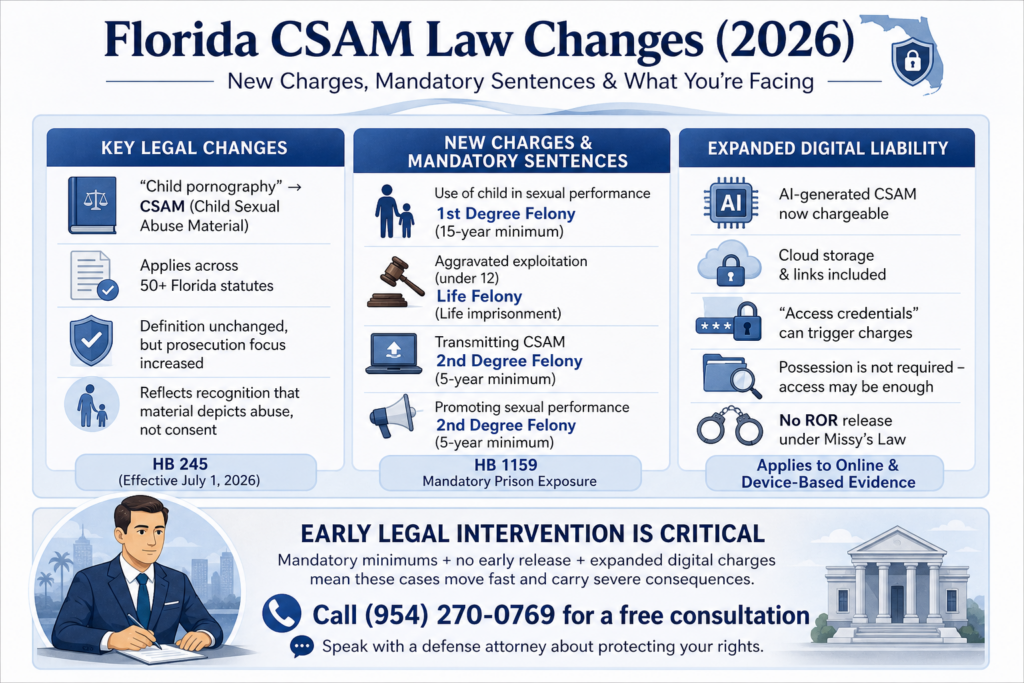
Florida has enacted sweeping changes to its laws involving child sexual abuse material (CSAM), with most provisions taking effect on July 1, 2026. These updates—passed through House Bill 245 and House Bill 1159—expand how these cases are charged, significantly increase penalties, and introduce mandatory prison sentences in situations where judges previously had discretion.
CSAM cases are prosecuted as part of broader internet-based offenses. For a complete overview of how these investigations work, see our guide to Internet Sex Crimes in Florida.
🔄 Florida CSAM Law Changes (Effective July 1, 2026)
Florida’s 2026 legislative update represents one of the most aggressive expansions of sex crime enforcement in recent years. The changes affect terminology, sentencing, digital evidence, and even pretrial release.
📘 Terminology Change: “Child Pornography” → “Child Sexual Abuse Material (CSAM)”
House Bill 245 replaces the term “child pornography” with “child sexual abuse material (CSAM)” across more than 50 sections of Florida law.
This change reflects the Legislature’s position that:
- The material documents abuse, not consensual conduct
- Minors cannot legally consent
- The terminology should reflect the harm involved
Important:
- The change is technical in nature
- It does not alter the elements of the offense
- It does not affect ongoing or prior prosecutions
However, it signals a broader shift toward more aggressive charging and sentencing practices.
⚖️ Enhanced Penalties and Mandatory Minimum Sentences
House Bill 1159 introduces substantial increases in penalties and imposes mandatory minimum prison sentences for several CSAM-related offenses.
Key Penalty Changes:
Using a Child in a Sexual Performance
- Upgraded from a 2nd-degree felony to a 1st-degree felony
- Now carries a 15-year mandatory minimum sentence
Aggravated Use of a Child (Under 12)
- Newly classified as a life felony
- Exposure includes life imprisonment
Transmitting CSAM
- Upgraded from a 3rd-degree felony to a 2nd-degree felony
- Now carries a 5-year mandatory minimum sentence
Promoting a Sexual Performance by a Child
- Classified as a 2nd-degree felony
- Now carries a 5-year mandatory minimum sentence
These changes significantly limit a judge’s ability to impose non-prison sentences and increase the likelihood of lengthy incarceration upon conviction.
🤖 AI-Generated CSAM and Digital Expansion
The 2026 law specifically addresses emerging technologies and digital conduct.
New provisions expand criminal liability to include:
- AI-generated or “generated” CSAM
- Digitally altered or synthetic depictions involving minors
- Expanded definitions of:
- “Access credential”
- “Cloud storage”
- “Link” or digital access pathway
This means that facilitating access to CSAM—even without physically possessing files—may now result in criminal charges.
To understand how prosecutors build these cases, see what prosecutors must prove in CSAM possession cases.
🚫 Missy’s Law: Pretrial Release Restrictions
Part of House Bill 1159 includes what is commonly referred to as Missy’s Law, which changes how defendants are handled immediately after arrest.
Under the new law:
- Individuals arrested for qualifying CSAM-related offenses are not eligible for nonmonetary pretrial release (ROR)
- Judges are restricted in granting release without bond
- Defendants may be held in custody pending further proceedings
Additionally:
- Individuals convicted of these offenses must often be remanded into custody immediately pending sentencing
This dramatically increases the pressure at the earliest stage of a case.
⚠️ Additional Restrictions and Related Provisions
The legislation also includes expanded restrictions beyond traditional CSAM charges.
For example:
- Individuals convicted of certain offenses involving animals may be prohibited from:
- Owning animals
- Working with animals
- Volunteering with animals
for a period of at least five years.
While separate from CSAM-specific charges, this reflects the Legislature’s broader trend toward expanded collateral consequences.
🚨 Why These Changes Make Early Defense Critical
The 2026 updates fundamentally change how these cases are handled from the moment an investigation begins.
With:
- Mandatory minimum sentences
- Expanded digital liability
- Increased detention risks
…the earliest stages of a case are now more important than ever.
In many situations:
- Charging decisions are influenced before formal filing
- Digital evidence is analyzed aggressively and often without full context
- Statements made early can significantly impact the outcome
Internet-based investigations frequently involve undercover operations. To understand how those cases are challenged, see Entrapment in Internet Sex Crime Sting Operations.
If you are under investigation or have been contacted by law enforcement, acting quickly can directly affect whether charges are filed—and how severe they are.
📱 Related Charges Often Filed Alongside CSAM
CSAM investigations often overlap with other internet-based charges, including:
• Online Solicitation of a Minor
• Sexting a Minor
• Sexting & Sex Offender Registration
These cases are frequently charged together, increasing overall exposure.
🎯 What To Do If You’re Under Investigation
If you believe you are being investigated for a CSAM-related offense:
- Do not consent to searches of your phone, computer, or accounts
- Do not attempt to delete files or access accounts
- Do not speak with law enforcement without legal counsel
- Contact a defense attorney immediately
Early intervention can influence how evidence is interpreted, how charges are structured, and in some cases, whether formal charges are filed at all.
📌 Bottom Line
Florida’s 2026 CSAM law changes dramatically increase the stakes in these cases. With harsher penalties, mandatory prison sentences, expanded digital liability, and stricter pretrial rules, these cases are now prosecuted more aggressively than ever.
Understanding how these laws work—and where they can be challenged—is critical to building an effective defense.
Florida replaced the term “child pornography” with “child sexual abuse material” (CSAM), increased penalties, added mandatory minimum sentences, expanded liability for AI-generated material, and restricted pretrial release.
Yes. CSAM possession is typically charged as a felony and can carry significant prison time depending on the facts of the case.
Under the 2026 law updates, certain AI-generated or digitally altered material involving minors can be prosecuted as CSAM.
In many cases, no. Under Missy’s Law, individuals arrested for certain CSAM-related offenses may not be eligible for nonmonetary pretrial release.