
Last updated March 2026
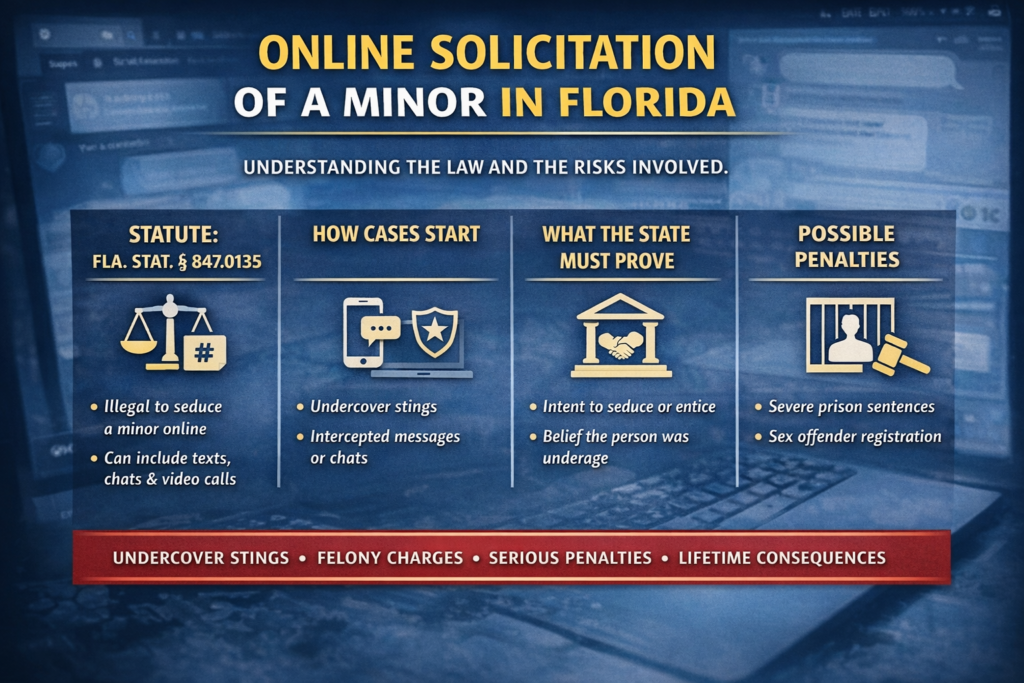
Online solicitation of a minor is one of the most aggressively prosecuted internet-based sex offenses in Florida.
These cases often begin not with a complaint from a real child — but with undercover law enforcement officers posing as minors online.
Text messages, social media chats, direct messages, and video calls can quickly escalate into felony charges.
For a broader overview of how digital investigations and sting operations work in Florida, see our guide to Internet Sex Crimes in Florida.
⚖️ The Governing Florida Statute
Online solicitation of a minor is generally prosecuted under Fla. Stat. § 847.0135.
The statute makes it illegal to:
Use a computer, online service, or electronic communication
To solicit, lure, entice, or seduce
A child (or someone believed to be a child)
To engage in unlawful sexual conduct
Importantly, the “minor” does not need to be real.
An undercover officer posing as a minor can be enough.
In some cases, similar communication-based conduct is charged under different statutes depending on age and content. See how these issues are handled in Sexting A Minor In Florida.
📋 What Prosecutors Must Prove
To convict, the State must establish several key elements beyond a reasonable doubt.
1️⃣ Use of Electronic Communication
The State must prove the defendant used:
Text messaging
Social media
Email
Messaging apps
Online gaming chat
Video platforms
The communication itself becomes primary evidence.
2️⃣ Intent to Solicit or Entice
This is often the central issue.
Prosecutors must show the defendant:
Intended to lure, entice, or solicit
Intended to engage in unlawful sexual conduct
Intent is typically inferred from:
Message content
Escalation in conversation
Requests for photos
Meeting arrangements
Travel plans
Context matters.
3️⃣ Knowledge or Belief About Age
The State must show the defendant knew or believed the other person was under 18.
In sting cases, officers often:
State an age clearly in early messages
Repeat it during conversation
Ask the suspect to acknowledge it
Whether that belief can be proven is often litigated.
4️⃣ Substantial Steps Toward Meeting (In Some Cases)
If the charge involves traveling to meet a minor, prosecutors may also need to show:
A planned meeting
Travel to a location
Possession of items consistent with the alleged plan
Travel-based charges often carry more severe penalties.
🎯 How These Cases Begin
Most online solicitation cases begin with:
Undercover sting operations
Task force investigations
Monitoring of online platforms
Decoy profiles posing as minors
In many cases, law enforcement initiates the conversation.
The tone, pressure, and escalation of communication can later become central to defense strategy.
🧠 The Role of Entrapment
Entrapment can become a defense issue in these cases, particularly when law enforcement initiates and drives the interaction. Learn how this defense works in Entrapment In Internet Sex Crime Stings In Florida.
Entrapment can become a defense issue when:
Law enforcement initiated the idea
Officers applied repeated pressure
The defendant showed reluctance
The conduct would not have occurred without police inducement
Entrapment is not simply “being tricked.”
It requires proof of government inducement and lack of predisposition.
📱 Digital Evidence Is the Case
Unlike other crimes, online solicitation cases are built almost entirely on:
Message logs
Screenshots
Metadata
IP tracing
Device extraction
Forensic downloads
Key defense issues often include:
Whether the full conversation is available
Whether messages were altered or truncated
Who controlled the account
Whether context changes interpretation
Whether the device was shared
Fragmented screenshots rarely tell the whole story.
🚨 Common Misconceptions
“If I never met the person, it’s not illegal.”
Incorrect. The crime can be completed through electronic communication alone.
“If it was just talk, it doesn’t count.”
Intent and content of communication are often enough.
“If the minor was actually an undercover officer, it’s not a crime.”
Florida law permits prosecution even when the “minor” is law enforcement.
“Deleting the messages protects me.”
Digital forensics often recovers deleted communications.
📉 Penalties for Online Solicitation
Online solicitation of a minor can carry:
Second-degree or third-degree felony charges
Significant prison exposure
Mandatory minimums in certain cases
Sex offender registration
Probation with strict internet restrictions
Lifetime collateral consequences
Travel-related charges may carry enhanced penalties.
🔐 Search & Seizure Issues
Many solicitation cases hinge on:
Whether a valid warrant supported device seizure
Whether the search exceeded scope
Whether statements were obtained lawfully
Whether consent was coerced
Suppression of digital evidence can significantly affect the prosecution’s case.
📞 If You Are Under Investigation
If you believe you are under investigation for online solicitation:
Do not continue communication
Do not attempt to delete data
Do not agree to a recorded call
Do not consent to device searches
Request counsel immediately
Early intervention can change the trajectory of the case.
❓ FAQs
1️⃣ Can someone be charged if no real minor existed?
Yes. Florida law allows prosecution even when the alleged minor was an undercover officer.
2️⃣ Is sending explicit photos automatically solicitation?
Not necessarily. Prosecutors must prove intent to lure or entice unlawful sexual conduct.
3️⃣ Can online role-play be used as evidence of intent?
Yes. Prosecutors may argue explicit communication shows intent, even if the defendant claims it was fantasy.
4️⃣ Can solicitation charges be reduced?
Case outcomes depend on evidence strength, prior record, and procedural issues.
5️⃣ Does online solicitation require sex offender registration?
In many cases, yes. Registration consequences can be long-term or lifetime.