
Last updated March 2026
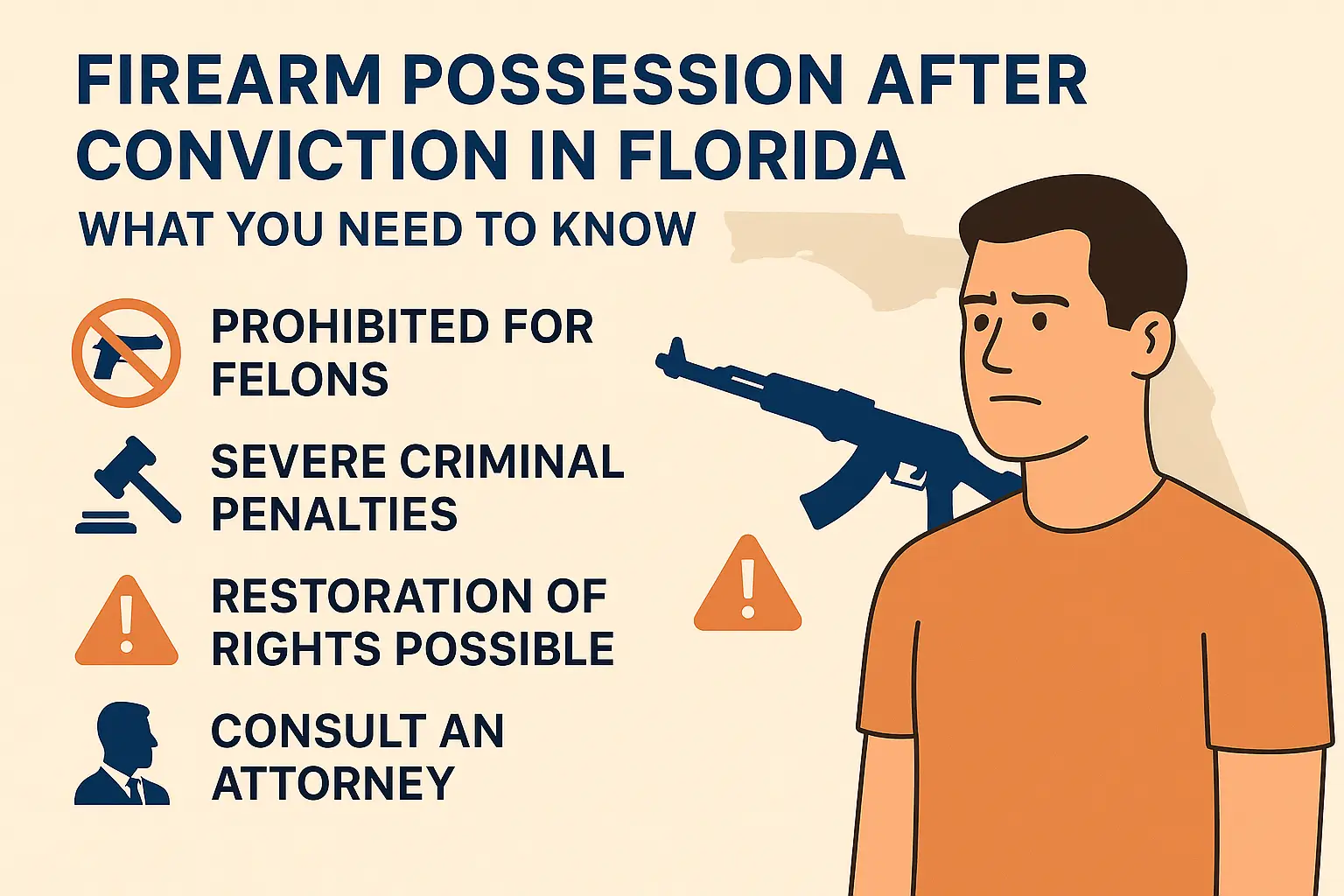
Florida imposes some of the strictest firearm restrictions in the country on people with prior felony convictions. Under Florida law, a single allegation of firearm possession after conviction can result in a second-degree felony and mandatory prison exposure, even when the firearm was never used.
This page explains when firearm possession is illegal after a conviction, what the State must prove, common arrest scenarios, and how these cases are defended.
For a broader overview of Florida firearm charges and penalties, see our guide to Gun Crime Charges in Florida.
A single possession charge can result in mandatory prison time, but several defenses may apply if your rights were violated or your conviction status is misclassified.
⚖️ Florida Law on Firearm Possession After Conviction
Under Florida law, it is illegal for a person to possess, own, or control:
A firearm
Ammunition
Certain weapons, including electric weapons
if they have been convicted of a felony or adjudicated delinquent for an offense that would be a felony if committed by an adult.
The State must prove all three of the following:
You were legally classified as a convicted felon at the time of the alleged possession
You knowingly possessed, owned, or controlled a firearm or ammunition
You were aware of your restricted status
Failure to prove any one element can result in dismissal or acquittal.
🔍 What “Possession” Means Under Florida Law
Firearm possession does not require the gun to be in your hands.
Prosecutors routinely rely on constructive possession, which may involve situations where a firearm is nearby but not in your physical possession. To better understand how this legal theory works, see our guide to Constructive Possession of a Firearm in Florida.
These cases often hinge on knowledge, access, and control, not mere presence.
🚨 Common Arrest Scenarios
Firearm possession after conviction charges frequently arise from:
Traffic stops and vehicle searches, where firearms are often discovered during roadside investigations. Learn how these cases develop in our guide to Firearm Evidence Discovered During Traffic Stops.
Searches of shared homes or apartments
Probation or pretrial release compliance checks
Allegations involving another person’s firearm
Law enforcement assumptions based on criminal history
Many arrests occur without direct evidence that the accused actually possessed or controlled the weapon.
💥 Penalties for Firearm Possession After a Conviction
Possession of a firearm by a convicted felon is a second-degree felony, punishable by:
Up to 15 years in Florida State Prison
Up to $10,000 in fines
Probation or community control
Permanent loss of firearm rights
If a firearm is alleged to have been used during another offense, mandatory minimum sentencing enhancements may apply.
A conviction may also trigger federal firearm disabilities and long-term collateral consequences.
🛡️ Defenses That Work in Firearm Possession Cases
These cases are often defensible, particularly when police overreach or misapply the law.
Common defense strategies include:
Lack of possession
The firearm belonged to someone else, or you had no knowledge or controlIllegal stop or search
The firearm was discovered through an unconstitutional traffic stop or search. In some cases, law enforcement may not have had the legal authority to take possession of the firearm in the first place. Learn more about these issues in Can Police Seize Your Firearm in Florida?Restoration of rights
Your civil rights, including firearm rights, were restored through clemency or pardonNo knowledge of restricted status
The State cannot prove you knew you were prohibited at the timeConstructive possession challenges
Proximity alone is not enough to establish possession
Because these cases are fact-specific, early legal review is critical.
👨⚖️ Florida Firearm Possession Defense
Firearm possession after conviction cases are aggressively prosecuted — but they are not automatic convictions.
At Michael White, P.A., we defend clients accused of:
Firearm possession by a convicted felon
Ammunition possession allegations
Firearms discovered during vehicle stops
Weapons found in shared residences
Possession allegations tied to probation or supervision
As a former prosecutor, Michael White understands how these cases are charged — and where they can be dismantled.
📞 Call (954) 270-0769 or request a free consultation.
❓ FAQs
1. Can I own a firearm after a felony conviction in Florida?
No, unless your rights have been formally restored through clemency or pardon.
2. What if I was found with a firearm that belongs to someone else?
If you had no control or knowledge of it, your lawyer can argue lack of possession.
3. Can I restore my gun rights in Florida?
Yes — through clemency, pardon, or other state-approved restoration processes.
4. What if my prior conviction was out of state?
Out-of-state felonies still apply unless your rights were restored in that jurisdiction.
5. What’s the penalty for firearm possession after conviction?
A second-degree felony: up to 15 years in prison, $10,000 fine, and permanent loss of firearm rights.