
Last updated March 2026
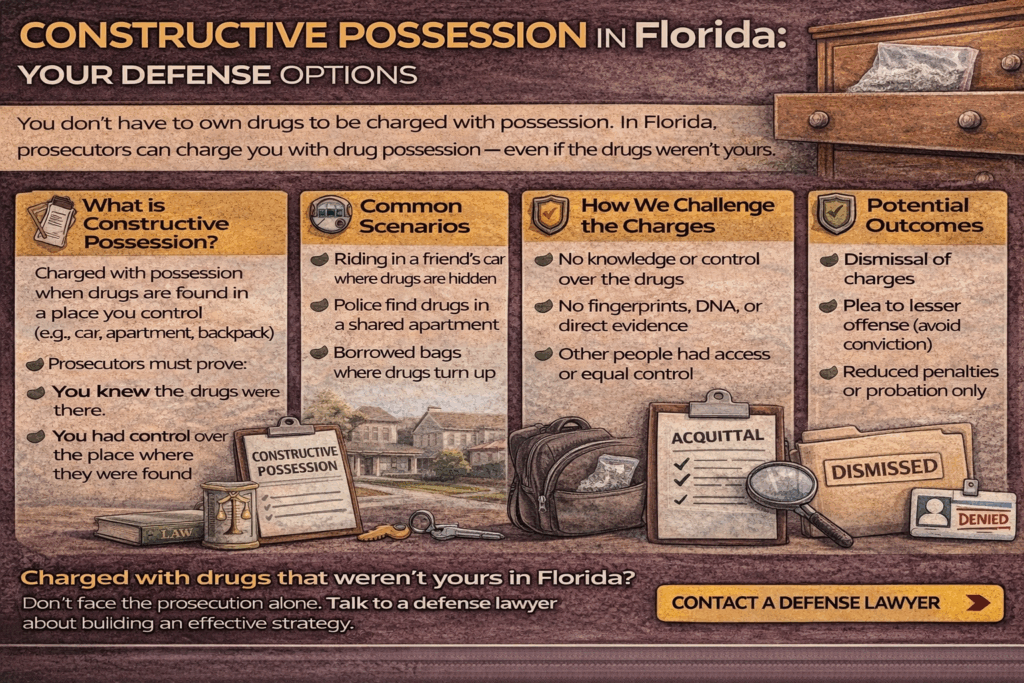
In many Florida drug cases, drugs are not found in a person’s hand or pocket. Instead, they are discovered in a car, home, backpack, or shared space. When that happens, prosecutors often rely on a legal theory called constructive possession.
Constructive possession is one of the most frequently litigated issues in Florida drug law. If you are facing possession charges in Broward County or anywhere in South Florida, understanding how constructive possession works can make the difference between conviction and dismissal.
For a broader explanation of how Florida drug possession charges are structured, see our overview of Florida Drug Possession Charges.
⚖️ What Is Constructive Possession Under Florida Law?
Under Florida Statute § 893.13, the State can prove possession in two ways:
Actual possession — the drugs are physically on you.
Constructive possession — the drugs are not on you, but the State claims you had knowledge of them and the ability to control them.
To prove constructive possession, prosecutors must establish beyond a reasonable doubt:
• You knew the drugs were present.
• You had the ability to exercise dominion and control over them.
If the drugs were found in a place shared by multiple people, the State must present independent evidence linking you specifically to the substance.
Mere proximity is not enough.
🚗 Common Constructive Possession Scenarios
Constructive possession frequently arises in:
• Traffic stops involving multiple passengers
• Drugs found under a seat or in a glove compartment
• Shared apartments or homes
• Hotel rooms with multiple occupants
• Vehicles that are not owned by the accused
In these cases, officers often arrest everyone present and allow the court to sort out responsibility later. But arrest does not equal proof.
In many of these situations, the immediate reaction is: “Those drugs weren’t mine.” That defense can be legally valid — but only if the State cannot prove knowledge and control. We explain how courts evaluate that claim in our guide to what happens when drugs weren’t yours in Florida.
If drugs were found in a vehicle you did not own, read more about drugs found in someone else’s car and how courts evaluate control.
🧠 The “Knowledge and Control” Requirement
Florida courts require proof of both knowledge and control. Without evidence of both elements, a conviction cannot stand.
Indicators prosecutors may rely on include:
• Statements allegedly made at the scene
• Nervous behavior or “furtive movements”
• Ownership or control of the vehicle
• Personal belongings found near the drugs
• Fingerprint or DNA evidence
But absence of fingerprints, lack of DNA, or shared access to the area often creates reasonable doubt.
We explore this further in our guide to knowledge and control in Florida drug cases.
🔬 Evidence Problems in Constructive Possession Cases
Because these cases rely on inference rather than direct proof, evidence weaknesses often lead to dismissal.
Key issues may include:
• No forensic evidence tying the accused to the drugs
• Chain of custody gaps
• Lost or contaminated evidence
• Conflicting statements between officers
If police lose drug evidence or fail to properly preserve it, the State’s case can collapse.
Likewise, problems with DNA evidence in drug cases often undermine the knowledge element.
🛡️ Defenses to Constructive Possession
Constructive possession is one of the most defensible drug charges in Florida.
Common defenses include:
Lack of knowledge — You were unaware the drugs were present.
No exclusive control — Multiple people had equal access.
Insufficient independent proof — No evidence linking you specifically.
Illegal search — Evidence obtained unlawfully may be suppressed.
Speculative inference — The State relies only on proximity.
Judges and juries are often skeptical when the prosecution cannot show concrete proof connecting a person to the drugs.
📍 Constructive Possession Defense in Broward County
In Fort Lauderdale and throughout Broward County, law enforcement often arrests all occupants in vehicle drug cases. However, prosecutors must still prove constructive possession beyond a reasonable doubt.
That burden is significant — especially in shared spaces.
Early intervention can mean the difference between felony conviction and case dismissal
❓ FAQs
Q1: What is the difference between actual and constructive possession?
Actual possession means drugs are on you. Constructive possession means they were nearby, but not directly on you.
Q2: Can multiple people be charged with constructive possession?
Yes. Police often charge everyone present if drugs are found in a shared space.
Q3: Is being near drugs enough for conviction?
No. Prosecutors must prove knowledge and control, not just proximity.
Q4: What if I didn’t know drugs were there?
Lack of knowledge is a valid defense, especially in shared spaces like cars or homes.
Q5: Can constructive possession charges be beaten in Florida?
Yes. Many cases collapse under scrutiny due to weak evidence and presumptions.