
Last updated April 2026
If you were arrested for resisting arrest or obstruction in Florida, you may be facing one of the most commonly charged — and most misunderstood — offenses arising from police encounters.
In Fort Lauderdale and throughout Broward County, these charges often begin with everyday situations: a traffic stop, a street encounter, or a police investigation. What starts as a simple interaction can escalate quickly when there is confusion, hesitation, or disagreement about what is happening.
But not every tense interaction is a crime.
Under Florida law, resisting or obstruction charges apply only when an officer is engaged in the lawful execution of a legal duty. If the stop was unlawful, the commands were unclear, or the situation escalated improperly, the charge may be challenged — and in many cases, dismissed.
⚖️ What “Resisting” and “Obstruction” Mean Under Florida Law
Florida law treats obstruction as a broad category of offenses involving alleged interference with law enforcement.
The most common charge is Resisting an Officer Without Violence under Florida Statute § 843.02.
To convict someone, the State must generally prove:
- the officer was engaged in the lawful execution of a legal duty
- the person knowingly and intentionally resisted, obstructed, or opposed that duty
If the officer was not acting lawfully, the charge often fails.
Many cases ultimately turn on what actually happened during the encounter — not just what is written in a police report.
🚔 How These Cases Commonly Begin
Most obstruction and resisting charges do not begin with serious criminal conduct.
They often arise from:
- traffic stops
- DUI investigations
- pedestrian encounters
- calls for service
- neighborhood complaints
In these situations, officers may interpret behavior such as hesitation, questioning, or noncompliance as interference.
But the law requires more than disagreement — it requires actual obstruction of a lawful duty.
⚠️ When Police Encounters Become Criminal Charges
Not every interaction with law enforcement leads to a valid criminal charge.
In many cases, the key issue is whether the officer’s actions were lawful and whether the conduct actually interfered with a legitimate police function.
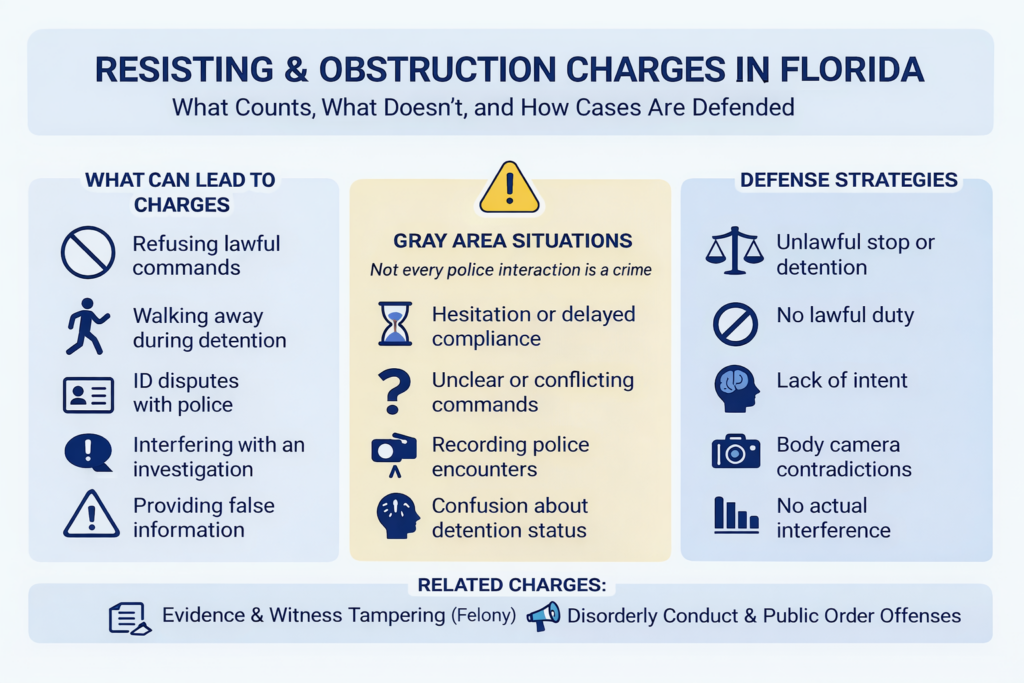
Situations that often fall into a gray area include:
- hesitation or delayed compliance
- unclear or conflicting commands
- attempts to leave a voluntary encounter
- questioning or recording police activity
In these situations, what may appear to be obstruction can actually be confusion, misunderstanding, or lawful conduct.
These distinctions are often central to defending the charge.
🔍 Common Resisting & Obstruction Scenarios
🪪 Identification Issues
Many obstruction arrests begin with a request for identification.
But not every encounter requires you to identify yourself. The rules depend on whether the interaction is a consensual encounter, a lawful detention, or a traffic stop.
- Do You Have to Show ID in Florida If You’re Not Driving?
- Can Police Run Your Name If You’re a Passenger?
- Refusing to Show ID in Florida
🚶 Walking Away From Police
Another common escalation point occurs when someone attempts to leave an encounter.
If the interaction is voluntary, you may have the right to walk away. If you are lawfully detained, you may not.
👉 See Walking Away from Police in Florida
📍 Refusing a Lawful Order
Police often claim a resisting charge resulted from someone refusing a lawful command.
But not every command is legally enforceable. The law depends on whether the officer had authority to issue the order.
👉 See Refusing a Lawful Order in Florida
📝 Providing False Information
Giving incorrect identifying information can also lead to obstruction charges — but only in certain circumstances.
👉 See Providing a False Name to Police in Florida
🚦 Traffic Stop Encounters
Traffic stops are one of the most common settings for obstruction allegations.
👉 See Obstruction During Traffic Stops in Florida
⚖️ Resisting With vs. Without Violence
Some cases escalate into felony charges when police allege physical force.
👉 See Resisting Without vs. With Violence in Florida
⚖️ Related Charges: Evidence & Witness Tampering
Some cases extend beyond resisting or obstruction and involve allegations that someone interfered with evidence or attempted to influence a witness.
These charges are legally distinct and often carry felony exposure.
👉 See Evidence & Witness Tampering in Florida
🧾 Related Offenses: Public Order Charges
In some situations, police may file separate public order offenses based on alleged disturbances or suspicious behavior.
These charges are distinct from resisting and depend on different legal standards.
🛡️ Common Defenses to Resisting & Obstruction Charges
Every case depends on the specific facts of the encounter.
Common defenses include:
- the officer was not performing a lawful duty
- commands were unclear or unlawful
- conduct was misunderstood or reflexive
- speech or recording was protected
- no actual interference occurred
- body camera footage contradicts the report
These cases often hinge on what actually happened, not just how it was described.
📉 Penalties for Resisting Without Violence
Resisting without violence under § 843.02 is a:
- First-degree misdemeanor
- Up to 1 year in jail
- Up to 12 months probation
- Up to $1,000 fine
- A permanent criminal record
Because these charges often arise from fast-moving encounters, early legal intervention can make a significant difference.
📞 Speak With a Fort Lauderdale Resisting & Obstruction Lawyer
If you were arrested for resisting or obstruction in Broward County, your case may depend on whether the police were acting lawfully — and whether your conduct actually met the legal standard for a crime.
Many of these cases are more defensible than they first appear.