
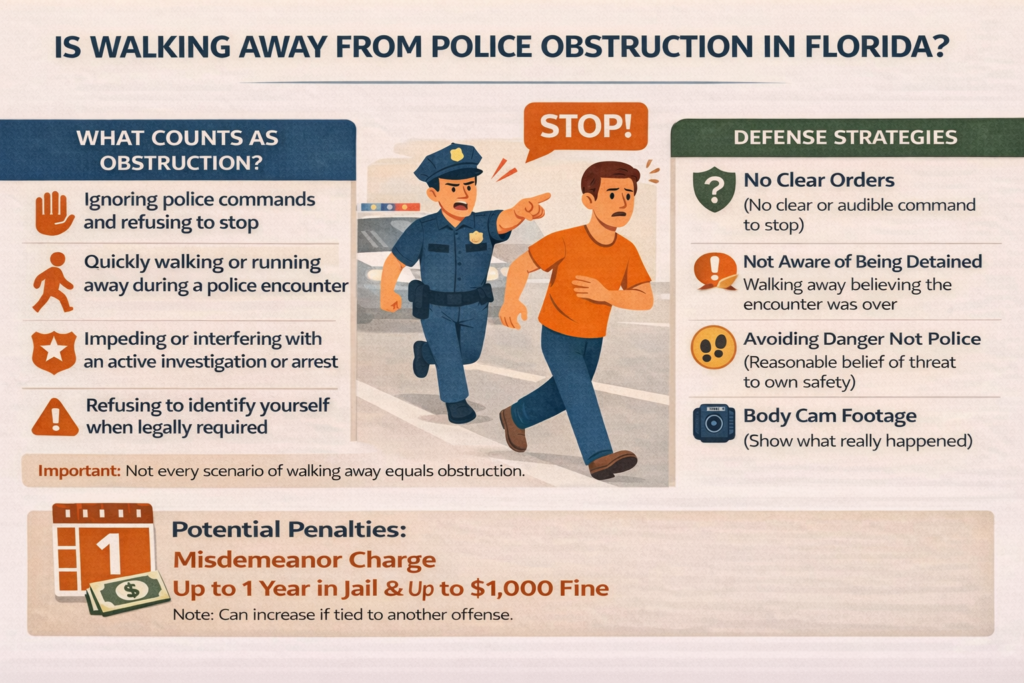
Last updated April 2026
If a police officer approaches you on the street and you simply walk away, can you be arrested for obstruction?
In Florida, the answer depends on one critical factor:
Were you lawfully detained?
Walking away from police is not automatically a crime. But in certain circumstances, it can lead to a charge for resisting an officer without violence.
For a broader overview of Florida’s resisting and obstruction laws, including how these charges are structured, visit our main guide to Resisting Arrest & Obstruction Charges in Florida.
Understanding the difference between a consensual encounter and a lawful detention is everything.
The Law: Resisting an Officer Without Violence
Most “walking away” cases are charged under § 843.02, Florida Statutes — Resisting an Officer Without Violence.
The statute makes it a crime to:
-
Obstruct
-
Resist
-
Oppose
An officer engaged in the lawful execution of a legal duty.
That phrase — lawful execution of a legal duty — is the foundation of every obstruction case. If the officer was not acting within the lawful execution of a legal duty, walking away cannot support a conviction for obstruction.
If the officer was not acting lawfully, the charge may fail.
Three Types of Police Encounters in Florida
Florida courts recognize three levels of encounters between police and civilians.
1️⃣ Consensual Encounter
This is a voluntary interaction. You are free to leave.
If you walk away during a consensual encounter, that alone is not obstruction.
Police may ask questions.
You are not required to stay.
2️⃣ Investigatory Detention (Terry Stop)
If an officer has reasonable suspicion that you are involved in criminal activity, they may temporarily detain you.
At this point, you are not free to leave.
Walking away after a lawful command to stop during an investigatory detention can support an obstruction charge.
Learn how these charges are applied in Resisting Without Violence in Florida.
3️⃣ Arrest
Once under arrest, refusal to comply with lawful commands may also support additional charges.
When Walking Away Becomes a Legal Issue
Not every decision to walk away from police is unlawful.
In many cases, the key issue is whether a reasonable person would believe they were being detained — not just whether an officer was present or asking questions.
Situations that often fall into a gray area include:
- officers asking questions without clearly stating you must stay
- unclear or indirect commands to stop
- hesitation before complying with instructions
- encounters that escalate quickly without explanation
In these scenarios, what may appear to be resistance can actually be a misunderstanding about whether the person was legally required to remain.
These distinctions are often central to whether an obstruction charge can be proven.
When Walking Away Is NOT Obstruction
You generally cannot be convicted of obstruction for walking away if:
-
The officer never ordered you to stop
-
The encounter was purely voluntary
-
There was no reasonable suspicion
-
The stop was unlawful
Florida courts have repeatedly held that merely ignoring police or refusing to cooperate during a consensual encounter is not obstruction.
Citizens are not required to engage in conversation with law enforcement when they are free to leave. See also Refusing to Show ID in Florida.
When Walking Away CAN Lead to Charges
You may face arrest if:
-
The officer clearly ordered you to stop
-
The officer had reasonable suspicion
-
You intentionally ignored a lawful command
-
Your conduct hindered the investigation
The State must prove that:
-
The officer was lawfully executing a legal duty
-
You knew the officer was performing that duty
-
You intentionally resisted, obstructed, or opposed
Simply being uncooperative is not enough. There must be actual obstruction.
What About Running?
Running away raises different issues.
Unprovoked flight in a high-crime area may contribute to reasonable suspicion.
But even then, courts look closely at whether the detention itself was lawful.
Each case turns on its specific facts.
Common Defense Strategies
Obstruction cases based on “walking away” are frequently defensible.
Challenging the Lawfulness of the Stop
If the officer lacked reasonable suspicion, the charge may collapse.
No Clear Command
If there was no direct order to stop, the State may struggle to prove obstruction.
Body Camera Review
Video evidence often reveals whether the encounter was consensual or coercive.
Suppression Motions
If the detention violated the Fourth Amendment, evidence may be excluded.
Why These Charges Are Frequently Over-Filed
Street-level encounters escalate quickly. What begins as a casual interaction can turn into an arrest based on perceived “noncompliance.”
These situations often overlap with broader identification issues. See Do You Have to Show ID in Florida If You’re Not Driving?
But the law does not require citizens to:
-
Answer questions
-
Engage in conversation
-
Remain present during a voluntary encounter
The dividing line is whether you were legally detained. In practice, these cases often turn on how the interaction is captured on body camera footage — and whether the officer clearly communicated that the person was not free to leave.
Facing an Obstruction Charge in Broward County?
If you were arrested in Fort Lauderdale or anywhere in South Florida for allegedly walking away from police, the legality of the stop is often the central issue.
At Michael White, P.A., we analyze:
-
Whether reasonable suspicion existed
-
Whether the command was lawful
-
Whether the conduct actually obstructed
-
Whether suppression or dismissal is available
Before accepting a plea, understand whether the detention itself was lawful.
📞 Confidential consultations available.