
Last updated April 2026
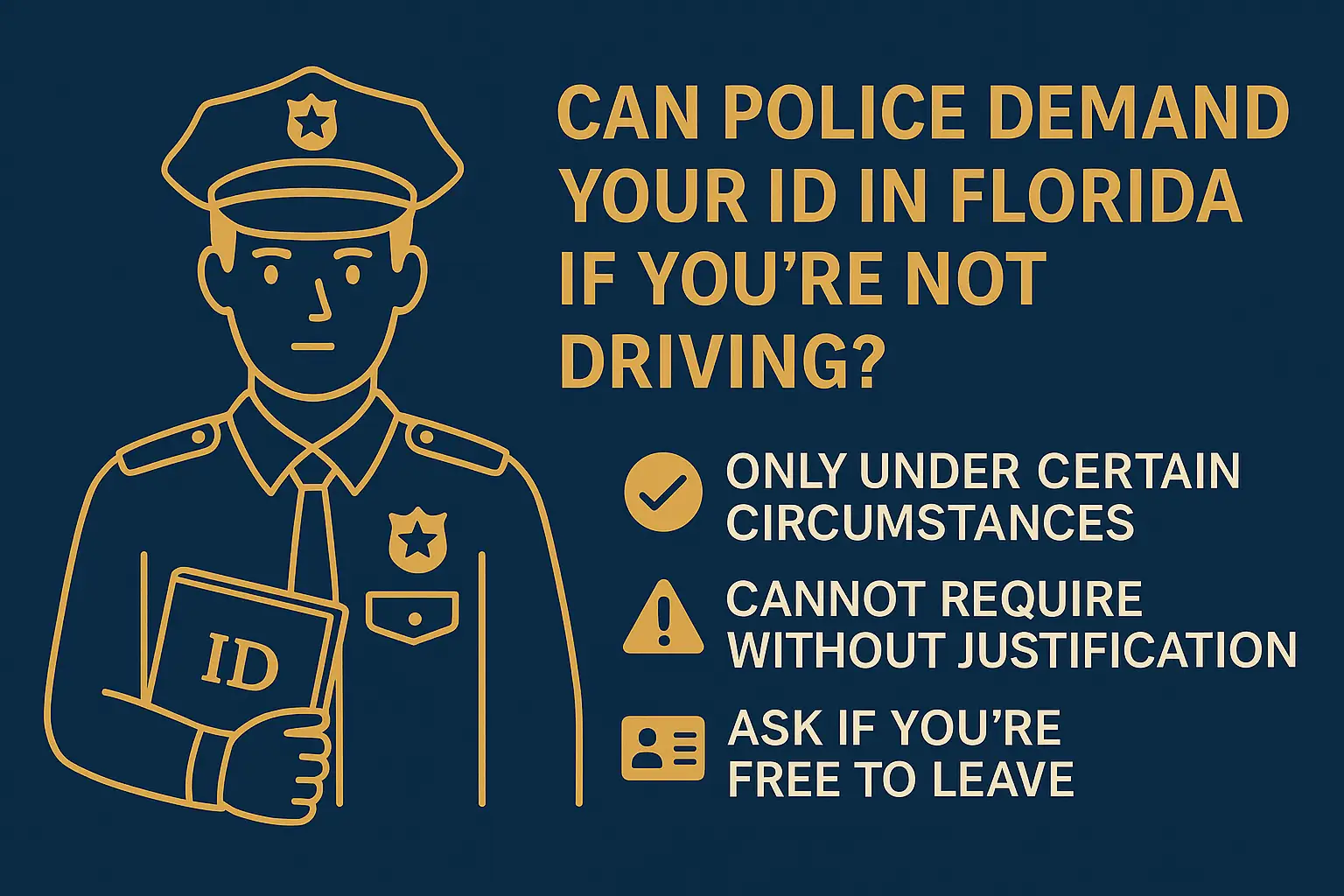
If you’re stopped by law enforcement in Fort Lauderdale or anywhere in Broward County, you may wonder: “Do I have to show them my ID if I’m not driving?” It’s one of the most common questions clients ask—especially during sidewalk stops, apartment-complex encounters, park detentions, and calls-for-service situations.
Florida is not a broad “stop and identify” state. That means police cannot demand your ID in most situations unless certain legal conditions are met. Understanding these limits can protect you from unlawful detention, unnecessary arrests, or escalating a simple encounter into something more serious.
For a broader overview of how these encounters can lead to charges, see our guide to Resisting Arrest & Obstruction Charges in Florida.
Below is a clear guide on when you must provide ID—and when refusing is within your rights.
⚖️ When You MUST Provide ID in Florida
Under Florida Statute § 901.151 (“Stop and Frisk Law”), officers may request your name and identification only when:
-
They have reasonable suspicion you committed, are committing, or are about to commit a crime; and
-
They have lawfully detained you.
If you are not detained (meaning you’re free to leave), you are not required to provide ID.
If you are detained but not driving, you generally must only state your name if lawfully asked. Florida courts have repeatedly held that refusing to identify yourself is not a crime unless:
-
You are lawfully detained and
-
You refuse to identify yourself and
-
Your refusal obstructs an officer’s lawful duty.
A critical part of this analysis is that the detention itself must be lawful. If officers lack reasonable suspicion, any demand for identification may be invalid — and refusal may not support a criminal charge.
🚗 When You’re Driving — Very Different Rules
If you’re operating a vehicle, Florida Statute § 322.15 requires you to present:
-
Your driver’s license
-
Upon demand by a law enforcement officer
This applies during:
-
Traffic stops
-
DUI investigations
-
Crash investigations
-
Checkpoints
If you’re not driving, the statute does not apply.
🚨 When Police Can’t Demand ID
If you are:
-
Walking down the street
-
Sitting in a park
-
Standing outside your apartment
-
Hanging out in a public place
-
A passenger in a car
…police cannot demand your ID unless they already have reasonable suspicion of a crime.
Learn more about your rights as a passenger in Can Police Run Your Name If You’re a Passenger in Florida?.
This is where police often overreach—especially during “field interviews” and “consensual encounters.” Law enforcement may ask, but you do not have to comply unless you are lawfully detained. These encounters often hinge on whether officers had legal grounds to demand identification in the first place — an issue that frequently determines whether an arrest or charge holds up under Florida law.
⚠️ When Does Refusing ID Become a Problem?
Not every refusal to provide identification leads to criminal charges.
In many cases, the key issue is whether the officer had legal authority to detain you in the first place — and whether your conduct actually interfered with that lawful duty.
Situations that often fall into a gray area include:
- uncertainty about whether you are being detained
- unclear or inconsistent instructions from officers
- hesitation or delayed responses
- encounters that escalate quickly without clear explanation
In these situations, what appears to be noncompliance may actually be a misunderstanding about whether you were legally required to identify yourself.
🛡️ How Refusing ID Can Lead to Arrest (Even When You’re Right)
If officers escalate an ID refusal into criminal charges, it is often framed as obstruction or resisting without violence — charges that can be challenged if the underlying detention was unlawful.
In practice, many of these cases turn on whether the officer can justify the stop — not simply whether a person refused to provide ID.
See how these charges are applied in Resisting Without Violence in Florida.
If officers think you’re obstructing, they may:
-
Escalate to an obstruction charge (§ 843.02)
-
Extend the detention
-
Try to build probable cause
This is why knowing your rights—and how to assert them calmly—is critical. A polite refusal is safer than a confrontational one.
If police escalate an ID refusal into criminal charges, it is often framed as obstruction— allegations that can be challenged if the underlying detention was unlawful.
These encounters can also overlap with broader refusal scenarios. See Refusing to Show ID in Florida.
⚖️ How a Fort Lauderdale Criminal Defense Lawyer Can Help
If you were detained or arrested after refusing to show ID, the legality of the officer’s actions is often the key defense. Our firm regularly handles:
-
Obstruction charges
-
Disorderly conduct cases
-
Unlawful detentions
-
Street-stop encounters
-
Probable cause challenges
We can examine body-worn camera footage, radio traffic, call logs, and reports to determine whether the officer lawfully detained you before demanding ID.
⚖️ Speak With a Fort Lauderdale Criminal Defense Lawyer Today
If a police encounter took an unexpected turn, don’t face it alone.
Call Michael White, P.A. today and get a former prosecutor on your side immediately.
❓ FAQs — Your Rights When Police Ask for ID (Florida)
1. Do I have to show ID to police in Florida if I’m not driving?
Usually no. Unless you’re lawfully detained based on reasonable suspicion, you’re not required to show ID when you’re not driving.
2. Can police detain me just for refusing to show ID?
Not legally. Refusal alone doesn’t create reasonable suspicion, but officers sometimes escalate—even when they shouldn’t.
3. What if I’m a passenger in a car?
Passengers are not required to show ID without independent reasonable suspicion, unless the officer is issuing a citation involving the passenger.
4. Can I get arrested if I politely refuse to identify myself?
Yes—officers may claim obstruction. Whether that arrest holds up depends on whether the detention was lawful in the first place.
5. What should I do if an officer insists I provide ID?
Ask:
“Am I being detained, or am I free to go?”
If detained, provide your name. If not detained, you can decline.