
Last updated April 2026
Giving police a false name might seem minor in the moment — especially during a stressful encounter — but in Florida, it can lead to a separate criminal charge.
However, not every police interaction requires you to identify yourself. And not every incorrect statement qualifies as a crime.
Understanding the difference between a casual encounter and a lawful detention is critical.
For a broader overview of Florida’s resisting and obstruction laws, including how these charges are structured, visit our main guide Resisting Arrest & Obstruction Charges in Florida.
If you are facing allegations of providing false identifying information during an investigation or traffic stop, the charge is often filed under Florida’s obstruction statute. These cases frequently turn on whether the officer had legal authority to demand identification in the first place.
What Law Makes It a Crime?
In Florida, providing false identifying information to a law enforcement officer is typically prosecuted under § 843.02, Florida Statutes — Resisting an Officer Without Violence.
This statute makes it a crime to:
-
Obstruct
-
Resist
-
Oppose
An officer in the lawful execution of a legal duty.
Giving a false name during a lawful detention can qualify as “obstruction.”
But the key word is lawful.
If the officer was not engaged in the lawful execution of a legal duty, the obstruction statute may not apply at all — even if incorrect information was given.
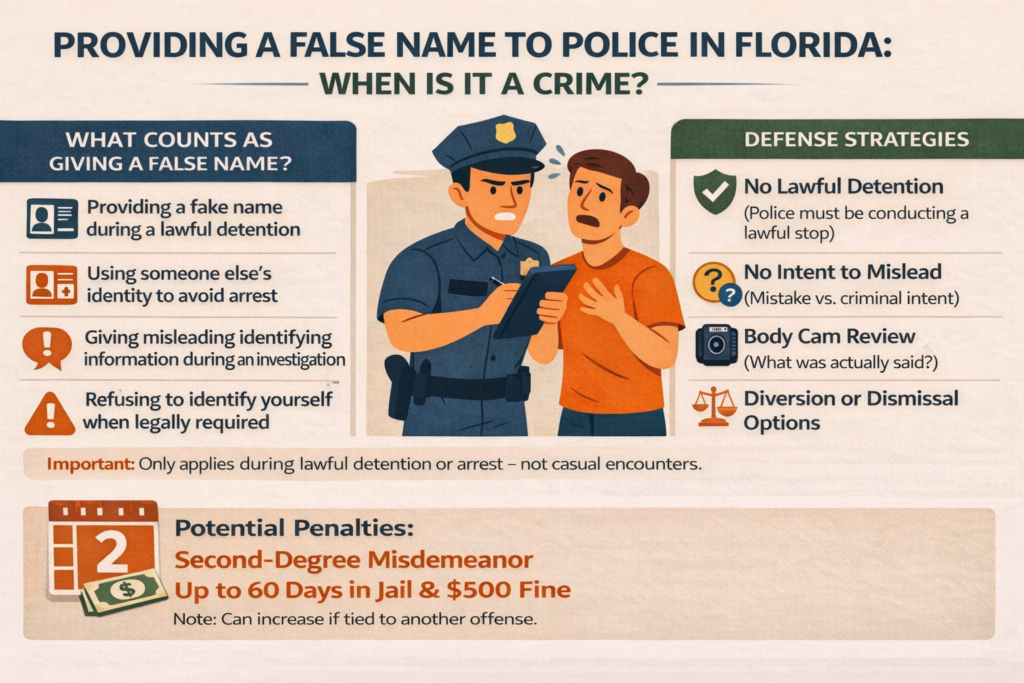
When Is Giving a False Name Actually a Crime?
It can become criminal when:
1. You Are Lawfully Detained or Arrested
If police have reasonable suspicion to detain you, and you intentionally provide false identifying information, that can support an obstruction charge.
Learn how these charges are applied in Resisting Without Violence in Florida.
2. You Intend to Mislead the Officer
Mistakes are not crimes. The State must prove you knowingly and intentionally gave false information.
3. The False Information Interferes With the Investigation
Courts look at whether the conduct actually obstructed the officer’s lawful duties.
When Does a False Name Become Obstruction?
Not every incorrect statement to police rises to the level of a criminal offense.
In many cases, the key issue is whether the information was intentionally false and whether it actually interfered with a lawful investigation.
Situations that often fall into a gray area include:
- misspeaking or providing incomplete information
- confusion during a stressful encounter
- giving a nickname or commonly used name
- unclear or rapidly escalating questioning
In these situations, what may appear to be deception can actually be misunderstanding, confusion, or lack of intent — all of which can be critical in defending the charge.
When It Is Not a Crime
There are important limits.
Casual Police Encounters
If an officer approaches you in a consensual encounter — meaning you are free to leave — you generally are not required to identify yourself. See Refusing to Show ID in Florida.
No Lawful Detention
If the stop was unlawful, the obstruction charge may fail.
Honest Mistake
Misspeaking, providing incorrect spelling, or confusion about your legal name does not automatically establish criminal intent.
What About Refusing to Show ID?
Florida does not have a broad “stop and identify” law for every encounter.
Identification may be required:
-
During a lawful detention
-
During a traffic stop (drivers must present license and registration)
-
When specific statutes require identification
But refusing to answer questions during a consensual encounter is not automatically obstruction.
If you want a deeper breakdown, see Do You Have to Show ID in Florida If You’re Not Driving?
Penalties for Providing a False Name
When charged under § 843.02, the offense is typically a:
First-Degree Misdemeanor
Maximum penalties can include:
-
Up to 1 year in jail
-
Up to $1,000 fine
-
12 months of probation
-
Permanent criminal record
If the allegation is tied to another offense, prosecutors may use the false-name charge as leverage in plea negotiations.
Common Defense Strategies
These cases are often defensible. Successful defenses frequently involve:
Challenging the Lawfulness of the Stop
If there was no legal basis for detention, the obstruction charge may collapse.
Lack of Intent
The State must prove intent to mislead — not confusion, fear, or mistake.
Body Camera Review
Video evidence often reveals what was actually said and how the encounter unfolded.
Suppression Motions
If the stop or detention violated the Fourth Amendment, evidence may be excluded.
In practice, these cases often turn on body camera footage and whether the officer can show that the alleged false information actually interfered with a lawful investigation.
Why These Charges Matter
Many people underestimate obstruction-related offenses because they are misdemeanors. But a conviction can:
-
Appear on background checks
-
Affect professional licenses
-
Impact immigration status
-
Increase exposure in future cases
And because these charges often arise during traffic stops or street encounters, they are frequently over-filed.
Early legal review matters.
Charged With Providing a False Name?
If you were arrested in Fort Lauderdale, Broward County, or anywhere in South Florida for allegedly giving false identifying information, the facts of the stop are everything.
At Michael White, P.A., we analyze:
-
Whether the detention was lawful
-
Whether the officer had authority to demand identification
-
Whether the evidence shows actual intent
-
Whether suppression or dismissal is possible
Before making statements or accepting a plea, understand your options.
📞 Confidential consultations available.