
Last updated April 2026
🚨 Arrested for Theft in Florida? Classification Comes First.
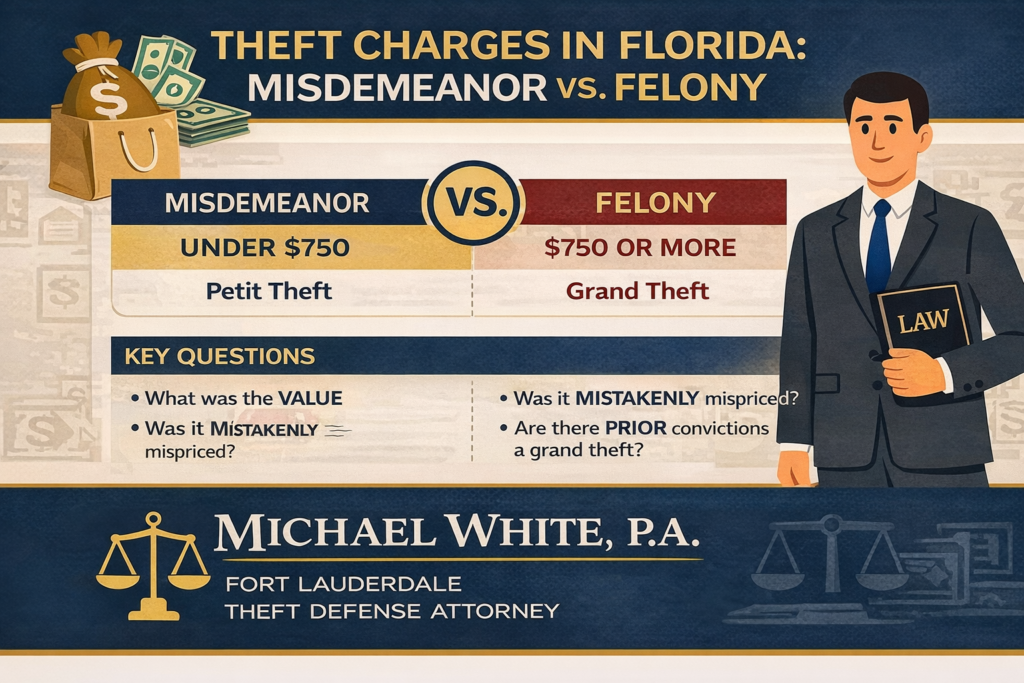
In Florida, theft charges are classified primarily by the value of the property involved. That single number often determines whether a case is charged as a misdemeanor or a felony — and the difference can mean anything from probation to decades in prison. In practice, that number is often disputed — and many cases turn on how value is calculated.
For a broader overview of theft and fraud charges, defenses, and how these cases are handled across South Florida, see our guide to Theft & Fraud in Florida.
Before penalties or defenses even come into play, the first question in any theft case is: Is this charged as petit theft or grand theft?
What happens in the early stages of a theft case often determines how it is ultimately classified. In some cases, the issue is not classification but whether the State can prove the charge at all—learn more about grand theft defense strategies in Florida.This page explains how Florida law makes that determination.
⚖️ How Theft Charges Are Actually Decided in Real Cases
In real cases, theft charges are not determined by value alone. Prosecutors also consider how the allegation is reported, the available evidence, and whether intent can be proven.
In many cases, the initial charge does not reflect how the case ultimately resolves once value, intent, and ownership issues are challenged.
This is why early legal strategy often determines whether a case stays a misdemeanor, escalates to a felony, or is reduced or dismissed.
⚖️ Theft Charges in Florida (Fla. Stat. § 812.014)
Under Florida law, and as applied in real cases, theft is defined as knowingly obtaining or using another person’s property with the intent to deprive the owner of it, either temporarily or permanently.
Because intent is a required element, many cases turn on whether prosecutors can prove it—see how lack of intent defense in Florida theft cases can impact the outcome.
The classification of the charge depends on the fair market value of the property at the time of the alleged theft.
🔹 Misdemeanor Theft (Petit Theft)
Petit theft applies when the value of the property is less than $750.
🔸 Petit Theft Charge Levels
| Charge Level | Property Value | Maximum Penalty |
|---|---|---|
| Second-Degree Misdemeanor | Under $100 | Up to 60 days jail or 6 months probation |
| First-Degree Misdemeanor | $100–$749 | Up to 1 year in jail or probation |
If your charge falls below the felony threshold, learn more about petit theft misdemeanor charges in Florida, including penalties and defense considerations.
🔸 Felony Theft (Grand Theft)
Grand theft applies when the value of the property is $750 or more. All grand theft charges are felonies under Florida law.
🔴 Grand Theft Charge Levels
| Charge Level | Property Value | Maximum Penalty |
|---|---|---|
| Third-Degree Felony | $750–$19,999 | Up to 5 years in prison |
| Second-Degree Felony | $20,000–$99,999 | Up to 15 years in prison |
| First-Degree Felony | $100,000+ or cargo theft | Up to 30 years in prison |
For a detailed breakdown of felony degrees, sentencing exposure, and penalty ranges, see our guide to grand theft felony penalties in Florida.
To understand how specific felony levels are applied, see grand theft third degree in Florida.
🔫 Theft Offenses That Bypass Value Thresholds
Some theft offenses are treated differently under Florida law. For example, theft of a firearm is always charged as grand theft, regardless of the weapon’s value.
To understand how these exceptions work, see our overview of grand theft firearm charges in Florida.
Financial instrument cases are also treated differently under Florida law, including credit card theft charges in Florida.
Vehicle-related cases follow their own rules as well—see how grand theft auto charges are handled in Florida.
⚠️ Why Classification Matters
Whether a theft charge is classified as a misdemeanor or felony affects:
-
Jail or prison exposure
-
Eligibility for diversion programs
-
Long-term criminal record consequences
-
Future sentence enhancements
-
Firearm and civil rights
In many cases, disputes over value determine whether a charge stays a misdemeanor or escalates to a felony.
When value is close to the threshold, understanding how Florida law treats valuation disputes is critical. For a side-by-side explanation, see petit theft vs. grand theft in Florida.
These cases often turn on how value is calculated—see how Florida treats grand theft over $750 and valuation disputes.
Some cases involve possession rather than taking property directly, which can lead to separate charges—see how receiving stolen property charges in Florida are prosecuted.
🔗 Related Theft Charges & Defenses in Florida
Depending on the facts, theft cases often involve additional issues beyond classification.
For example:
- Grand theft third degree in Florida (felony threshold cases)
- Grand theft auto charges in Florida (vehicle-related cases)
- Credit card theft charges in Florida (financial crimes)
- Receiving stolen property charges in Florida (possession cases)
⚖️ When Theft Charges Become More Complex
Some theft cases involve additional allegations beyond simple taking of property.
For example:
- Multiple charges filed from a single incident
- Financial or fraud-based allegations
- Disputes involving contracts or shared property
To understand how these situations are charged and defended, see:
👉 Grand theft charge combinations in Florida
👉 When a theft case is really a civil dispute in Florida
❓ Frequently Asked Questions About Theft Charges in Florida
⚖️ What’s the difference between misdemeanor and felony theft in Florida?
The difference is primarily the value of the property. Theft under $750 is generally charged as petit theft (misdemeanor). Theft of $750 or more is charged as grand theft (felony), unless a statutory exception applies.
🧾 Can a first-time theft charge be dismissed?
Possibly. Depending on the facts, first-time offenders may qualify for diversion, charge reduction, or dismissal. Eligibility depends on the classification of the charge and the circumstances of the case. Learn when theft charges can be dropped in Florida.
💰 What if the value of the stolen item is close to $750?
Value disputes are common. If the State cannot prove felony-level value, a grand theft charge may be reduced to petit theft.
🧑⚖️ Will I go to jail for theft in Florida?
Not necessarily. Many misdemeanor theft cases and some felony theft cases resolve without jail or prison time, depending on classification, prior record, and case facts.
🔐 Can theft charges be sealed or expunged in Florida?
Dismissals, acquittals, or certain withheld adjudications may qualify for record sealing or expungement. Convictions generally do not.
🧭 What’s the Next Step?
Once a theft charge is classified as a misdemeanor or felony, the next step is understanding penalties, defenses, and resolution options based on that classification.
The links above provide deeper guidance tailored to your specific situation.