
Last updated April 2026
A “theft” allegation in Florida does not always mean a true criminal case. Many situations that start as money or property disagreements—between business partners, roommates, family members, or employers and employees—get reported to police as “theft,” even when the core issue is a civil dispute.
In Broward County, we frequently see these reports arise during business disputes, breakups, or employment conflicts where law enforcement is presented with only one side of the story.
In many cases, these disputes escalate through formal financial claims before any criminal case develops—learn how civil demand letters for retail theft work in Florida and how they are used.
The difference matters because criminal theft requires proof of criminal intent, not just conflict, misunderstanding, or bad blood. When police treat a civil dispute like a theft case, the result can be an arrest that never should have happened. In many cases, therefore, the criminal process begins before the underlying facts are fully understood or verified.
In many of these situations, early intervention can prevent charges from being filed or lead to dismissal—see when theft charges can be dropped in Florida.
Many theft cases are not really theft cases at all—they are disputes that have been mischaracterized as crimes.
This guide explains the warning signs that a “theft case” may really be civil—and what to do to protect yourself.
🔎 What Makes Theft Criminal in Florida
Under Florida law, theft generally requires proof that someone knowingly obtained or used property with the intent to deprive the owner of it (even temporarily). In a true theft case, the State tries to prove intent through actions, statements, and circumstances—not just accusations.
When the situation involves disputed ownership, permission, or contractual rights, criminal intent is often unclear—because the real issue is who has the right to the property.
👉 For a broader overview of how Florida theft charges are defined and prosecuted, see Theft Charges in Florida.
✅ Common Signs the Case Is Really a Civil Dispute
A theft allegation is more likely to be civil when you see patterns like these:
1) Ownership is disputed
If both sides claim the property is theirs—or there’s no clear documentation—police may be stepping into a civil ownership dispute, not a crime.
2) There was permission, shared use, or a prior course of dealing
If there were texts, emails, keys, shared accounts, or an established pattern of use, the question becomes permission and scope, not criminal theft.
3) The accusation follows a breakup, falling-out, or business conflict
Theft reports often spike after:
-
relationships end
-
roommates move out
-
partners dissolve a business
-
employees are terminated
That timing can signal retaliation or leverage—not criminal intent.
4) The “loss” is really money, accounting, or a contract dispute
Disagreements over:
-
unpaid commissions
-
reimbursements
-
“who was supposed to pay”
-
missing inventory blamed on one person
often belong in civil court unless there’s clear evidence of intentional stealing.
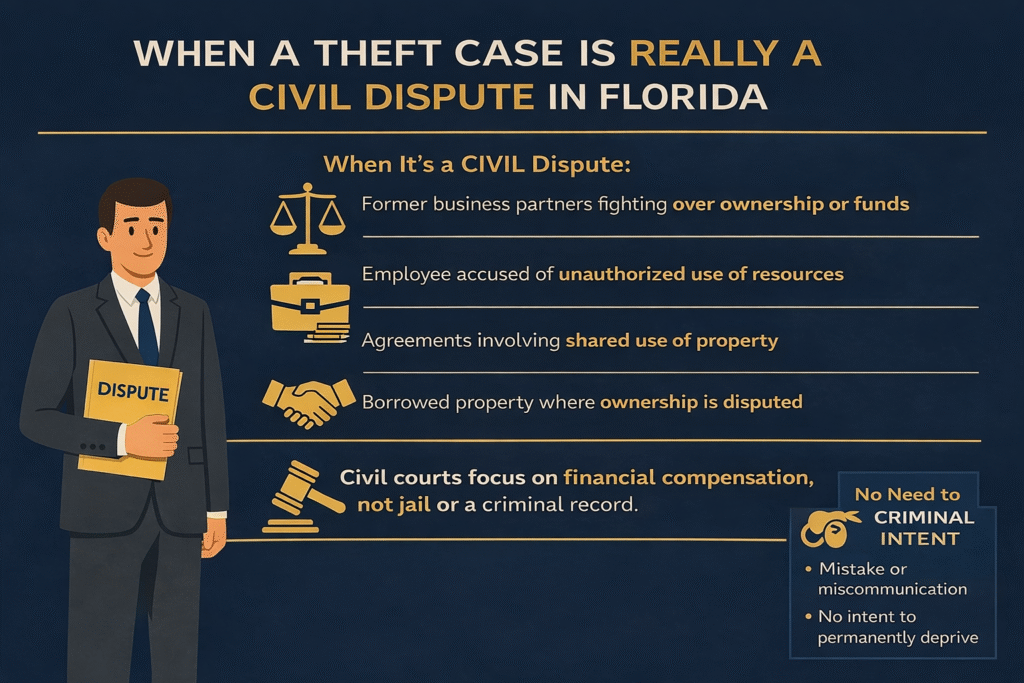
🧩 Examples of “Civil Dispute” Scenarios That Get Reported as Theft
These are common South Florida situations that frequently start as civil conflicts:
-
Former business partners fighting over funds or ownership
-
Employee accused of unauthorized use of company resources
-
Shared property agreements (tools, electronics, vehicles)
-
Borrowed property where the owner later claims it was “stolen”
-
Property kept during a breakup or move-out dispute
A key point: civil court focuses on compensation (money, return of property), while criminal court focuses on punishment (jail, probation, a record).
🚫 Why “Civil Dispute” Doesn’t Mean You’re Safe
Even when the underlying issue is civil, police can still:
-
write an arrest affidavit based on one-sided statements
-
seize property
-
file charges that force you to defend yourself in criminal court
Once the case enters the system, it often moves forward unless challenged early with the full context. And after charges are filed, the system tends to move forward unless your defense team intervenes early.
🛡️ How We Defend These Cases
When a “theft” accusation is really a civil dispute, the defense often focuses on:
-
lack of criminal intent (permission, misunderstanding, business disagreement) — This is one of the most common defenses in these cases—see how lack of intent defense in Florida theft cases applies.
-
ownership disputes (no clear owner, competing claims)
-
credibility issues (motive to retaliate, timing after conflict)
-
documentary proof (texts, emails, agreements, prior payments)
-
probable cause challenges (arrest based on incomplete facts)
These cases are often won by reframing the situation early—before prosecutors adopt a one-sided version of events. In many cases, early presentation of records and context can prevent filing—or position the case for dismissal.
If you’re under investigation, don’t wait for an arrest. Your best window to control the narrative is before charges are filed.
What happens in the early stages often determines whether the case is treated as a criminal offense or resolved as a civil matter.
📍 What To Do If You’re Accused
-
Do not “explain it” to police—statements often get framed as intent.
-
Preserve communications (texts, emails, receipts, agreements).
-
Don’t contact the accuser—that can create new allegations.
-
Have counsel intervene early to frame the dispute correctly.
📞 Fort Lauderdale Theft & Fraud Defense
If a civil dispute is being treated like a theft case in Fort Lauderdale or Broward County, the consequences can be immediate—and severe.
At Michael White, P.A., we step in early to challenge probable cause, expose civil context, and push to stop criminal charges before they become a permanent record.
❓ FAQs
Can someone be charged criminally and sued civilly for the same theft?
Yes. Civil claims and criminal charges can proceed separately, with different standards and consequences.
Does a criminal dismissal prevent a civil lawsuit?
Not necessarily. Civil cases can proceed even if the criminal case is dismissed, depending on the claim.
Can police arrest someone over a civil dispute?
They can—but arrests based on incomplete facts or disputed ownership are often challengeable as lacking probable cause.
What’s the biggest red flag that it’s a civil dispute?
Disputed ownership/permission plus a report made right after a relationship, employment, or business breakup.
What should I do first if I’m accused?
Stay silent, preserve records, and involve a lawyer early—before the story hardens into charges.