
Last updated March 2026
Drug possession charges are among the most common — and most misunderstood — criminal offenses in Florida. People are often arrested for possession even when drugs were not in their pocket, were not theirs, or were never knowingly controlled.
Under Florida law, possession cases turn on knowledge, control, and legality of the search — not assumptions or proximity. Understanding how Florida defines possession, and how these cases are challenged, is critical to protecting your freedom and your record.
For a broader overview of Florida drug offenses and defense strategy, see our Drug Crimes Defense page.
⚖️ How Florida Defines Drug Possession
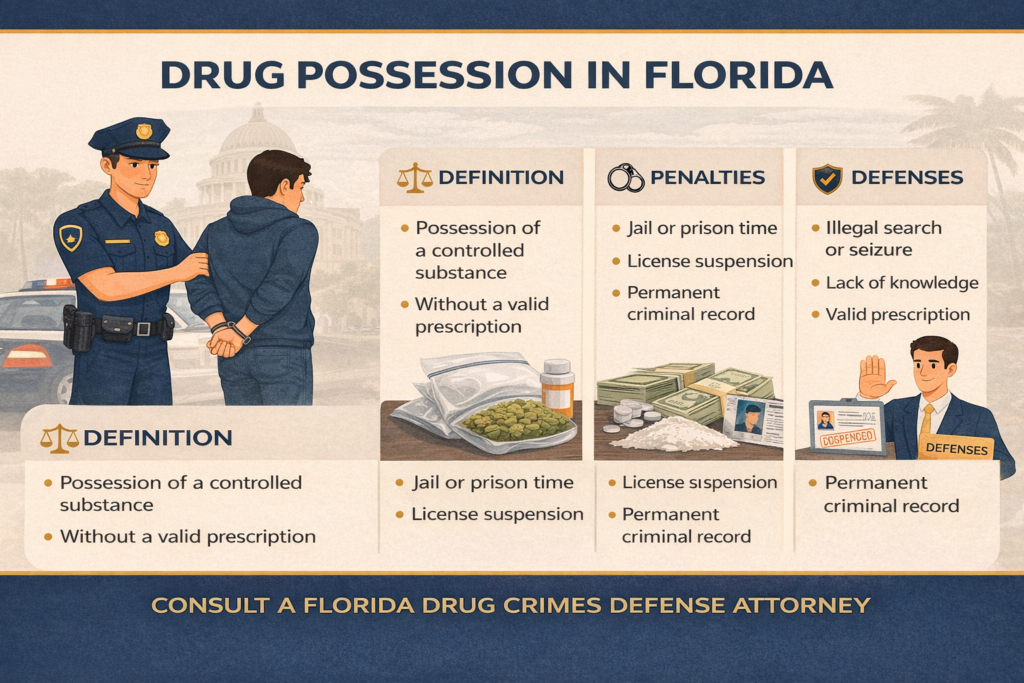
Florida law prohibits the knowing possession of a controlled substance unless the person has a valid prescription or other lawful authorization.
To convict someone of possession, the State must prove:
The substance was a controlled substance
The defendant knew of its presence
The defendant knew of its illicit nature
The defendant exercised control over it
Drugs do not need to be found in your pocket for charges to be filed.
Florida recognizes two forms of possession:
Actual possession
Constructive possession
Understanding the difference is critical.
🧍 Actual vs. Constructive Possession
📌 Actual Possession
Actual possession means the substance was found:
In your hand
In your pocket
In a container you were holding
In a bag you were carrying
Even in these cases, the State must still prove knowledge of the substance and its illegal character.
🧠 Constructive Possession
Constructive possession is far more common — and far more defensible.
The State must prove that you:
Knew the drugs were present, and
Had the ability to exercise control over them
Constructive possession cases often arise when drugs are found in:
Vehicles with multiple occupants
Shared homes or apartments
Backpacks, purses, or containers owned by someone else
Hidden compartments or common areas
These cases often turn on whether prosecutors can prove knowledge and control, which is explained in more detail under constructive possession in Florida drug cases.
📦 Substance-Specific Drug Possession Charges in Florida
Possession penalties vary dramatically depending on the substance involved. Even small amounts of certain drugs trigger felony charges.
Below are detailed guides addressing the most frequently charged substances:
Powder & Opioid Possession
Party & Synthetic Drugs
Marijuana Possession
First-Time & Threshold Issues
🚨 Felony vs. Misdemeanor Drug Possession
Some possession charges are misdemeanors, while others are felonies.
In general:
Marijuana (small amounts) may be charged as a misdemeanor
Most other controlled substances are charged as felonies — even in tiny amounts
Prescription drugs without a valid prescription are typically felonies
Felony possession convictions can result in:
Prison or jail time
Probation
Driver’s license suspension
Loss of civil rights
A permanent criminal record
🔍 How Drug Possession Charges Commonly Arise
Many possession arrests stem from:
Traffic stops
Searches of vehicles or residences
Passenger arrests
Probation or parole searches
Searches incident to arrest
K-9 sniffs or consent searches
In many cases, the legality of the stop, search, or seizure determines whether the case survives.
🛡️ Common Defenses in Florida Drug Possession Cases
🚓 Illegal Stop or Search
If police lacked reasonable suspicion, probable cause, or a valid warrant, evidence may be suppressed.
👉 Suppression of evidence can lead to dismissal of possession charges entirely.
🧍 Lack of Knowledge
The State must prove you knew the drugs were present and knew their illegal nature.
Knowledge is often disputed when drugs are:
Hidden
Left by someone else
Found in shared spaces
🧠 No Dominion or Control
Even if drugs were present, prosecutors must show you had the ability to control them.
Mere proximity is not enough.
💊 Valid Prescription Defense
Prescription medications may be lawfully possessed only by the person for whom they were prescribed.
Borrowed or shared prescriptions often lead to felony charges — but defenses may still exist.
Possession of prescription pills without a valid prescription is treated differently under Florida law and is explained further in our guide on prescription pill possession in Florida.
⚖️ Insufficient Evidence
Possession cases often rely on assumptions, weak circumstantial evidence, or unreliable testimony.
When evidence is thin, charges can be reduced or dismissed.
🔗 How Possession Differs From Trafficking or Sale
Drug possession is distinct from:
Drug trafficking, which is based primarily on weight thresholds
Sale or delivery, which involves distribution conduct
Possession cases often involve probation-eligible outcomes, unlike trafficking cases that carry mandatory minimum prison sentences.
👉 For weight-based offenses, see Drug Trafficking in Florida
📞 Speak With a Florida Drug Possession Defense Lawyer
A drug possession charge can follow you for life — even when the case involves a small amount, a misunderstanding, or someone else’s drugs.
Early legal intervention can make the difference between:
Dismissal and conviction
Probation and prison
A sealed record and a permanent felony
📲 Call Michael White, P.A. at (954) 270-0769
💬 Or request a confidential consultation online.
❓ FAQs — Drug Possession in Florida
Q1: Can I be charged with possession if the drugs weren’t on me?
Yes. Florida allows constructive possession charges, but the State must prove knowledge and control.
Q2: Is drug possession always a felony in Florida?
No. Some marijuana offenses are misdemeanors, but most other substances are charged as felonies.
Q3: What if the drugs belonged to someone else?
Ownership is not required, but lack of knowledge or control is a strong defense.
Q4: Can possession charges be reduced or dismissed?
Yes. Illegal searches, weak evidence, or successful motions to suppress often result in reductions or dismissals.
Q5: Should I talk to police if I’m accused of possession?
No. You should speak with a defense attorney before answering questions.