
Last updated February 2026
Fentanyl possession charges in Florida are treated extremely seriously. Because fentanyl is a powerful synthetic opioid linked to overdose deaths, prosecutors often pursue harsh penalties — even in cases involving very small amounts.
If you’ve been arrested for fentanyl possession in Fort Lauderdale or anywhere in South Florida, it’s critical to understand how these cases are charged, what the State must prove, and how they can be defended.
For a broader overview of how Florida defines drug possession — including actual vs. constructive possession and common defenses — see Drug Possession in Florida.
How Florida Defines Fentanyl Possession
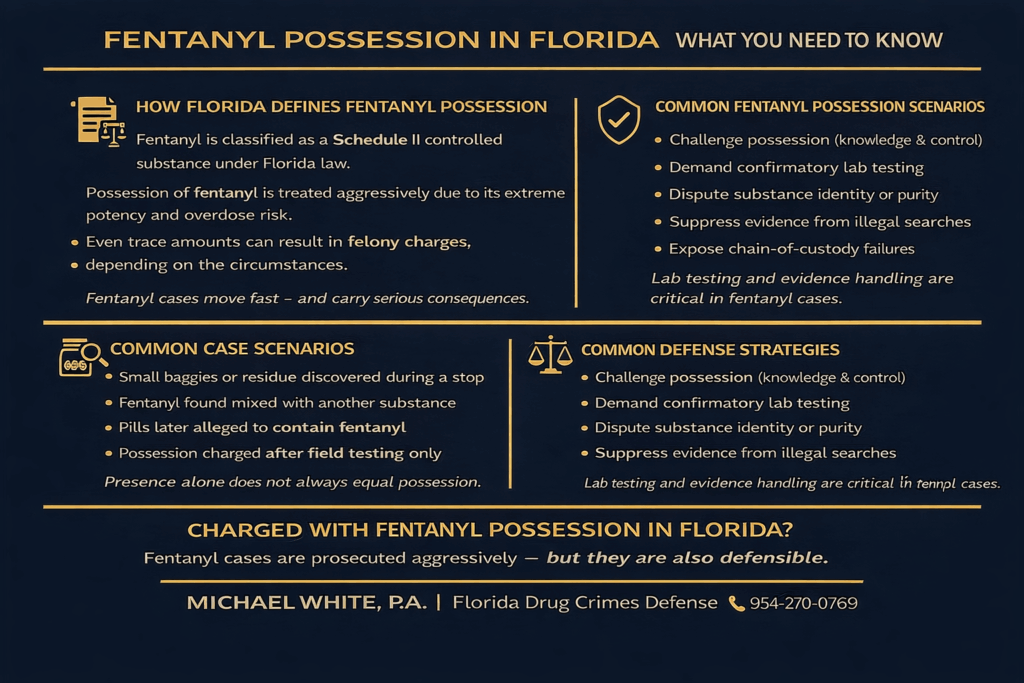
Under Florida law, fentanyl is classified as a Schedule II controlled substance.
This means:
Possession is a criminal offense
Penalties escalate quickly
Prosecutors often assume heightened danger
Unlike some lower-schedule substances, fentanyl cases are rarely treated as minor or low-risk by the State.
Even trace amounts or residue may support felony charges, depending on how the case is built.
Why Fentanyl Cases Are Prosecuted Aggressively
Fentanyl possession cases carry unique risks because:
Fentanyl is extremely potent
Small quantities can be lethal
It is often mixed with other drugs without a person’s knowledge
Prosecutors emphasize public safety concerns
As a result, fentanyl possession charges often move faster and are prosecuted more aggressively than other drug cases.
Common Fentanyl Possession Scenarios
Fentanyl possession charges frequently arise from situations such as:
Small baggies or residue discovered during a traffic stop
Fentanyl allegedly mixed with heroin, cocaine, or pills
Pills later claimed to contain fentanyl
Charges based on field testing only
Drugs found in shared vehicles or residences
Importantly, presence alone does not always equal possession. The State must still prove knowledge and control.
Common Defense Strategies in Fentanyl Cases
Fentanyl possession cases are defensible — especially when the evidence is challenged early.
Defense strategies may include:
Challenging whether the accused knowingly possessed fentanyl
Demanding confirmatory laboratory testing
Disputing substance identity or purity
Suppressing evidence from unlawful searches
Exposing chain-of-custody failures
Because fentanyl cases rely heavily on lab testing and evidence handling, weaknesses in those areas can dramatically change the case.
Potential Penalties for Fentanyl Possession in Florida
A fentanyl conviction can result in:
Felony charges
Prison or probation exposure
A permanent criminal record
Loss of employment or housing
Immigration consequences for non-citizens
Penalties depend on the facts of the case, the amount involved, and prior history — but outcomes often hinge on how aggressively the defense challenges the evidence.
📍 Charged With Fentanyl Possession in Florida?
Fentanyl cases are prosecuted aggressively — but they are also defensible.
Police mistakes, testing failures, and proof problems matter. Early defense action can expose weaknesses before the State’s case hardens.
At Michael White, P.A., we fight fentanyl possession charges by challenging evidence, testing, and constitutional violations.
👉 Schedule a free consultation to discuss your fentanyl possession case and your defense options.
🙋♂️ FREQUENTLY ASKED QUESTIONS
Is fentanyl possession always a felony in Florida?
Fentanyl possession is often charged as a felony, even for small amounts, but the exact charge depends on the facts and how the evidence is handled.
Can I be charged if I didn’t know fentanyl was present?
The State must prove knowledge and control. Lack of knowledge can be a critical defense in mixed-substance cases.
Are field drug tests reliable for fentanyl?
Field tests are frequently challenged. Confirmatory lab testing is often necessary to prove fentanyl possession.
Does fentanyl possession lead to mandatory prison?
Not always. Outcomes vary widely and depend on the evidence, the charge level, and prior history.
Should I hire a lawyer right away?
Yes. Early legal intervention is especially important in fentanyl cases due to the severity of the charges.