
Last updated April 2026
Aggravated battery in Florida is not just another battery charge — it’s a violent felony that can send you to prison and permanently change your life. Unlike simple battery, aggravated battery is a serious felony that can lead to lengthy prison exposure, mandatory sentencing consequences, and a permanent violent-felony record.
Aggravated battery allegations can arise from disputed injury claims, weapon accusations, or escalated confrontations. Below, we break down the specific legal issues that commonly determine whether the State can sustain a felony charge.
But aggravated battery is also frequently overcharged — based on disputed injuries, unclear weapon allegations, or one-sided accounts in chaotic situations. The details matter, and the State still has to prove every required element beyond a reasonable doubt.
Aggravated battery is prosecuted as one of Florida’s most serious violent felony offenses. For a broader overview of how violent crimes are classified and defended in South Florida, see our guide to Violent Crimes in Florida.
Let’s break down what aggravated battery in Florida really means, what prosecutors must prove, and how a defense lawyer can fight for your future.
⚖️ What Is Aggravated Battery in Florida?
Battery charges in Florida (§ 784.03) can be charged for minimal unwanted contact or minor injury. For a full breakdown of how Florida defines and prosecutes battery offenses, see our guide to Battery Charges in Florida.
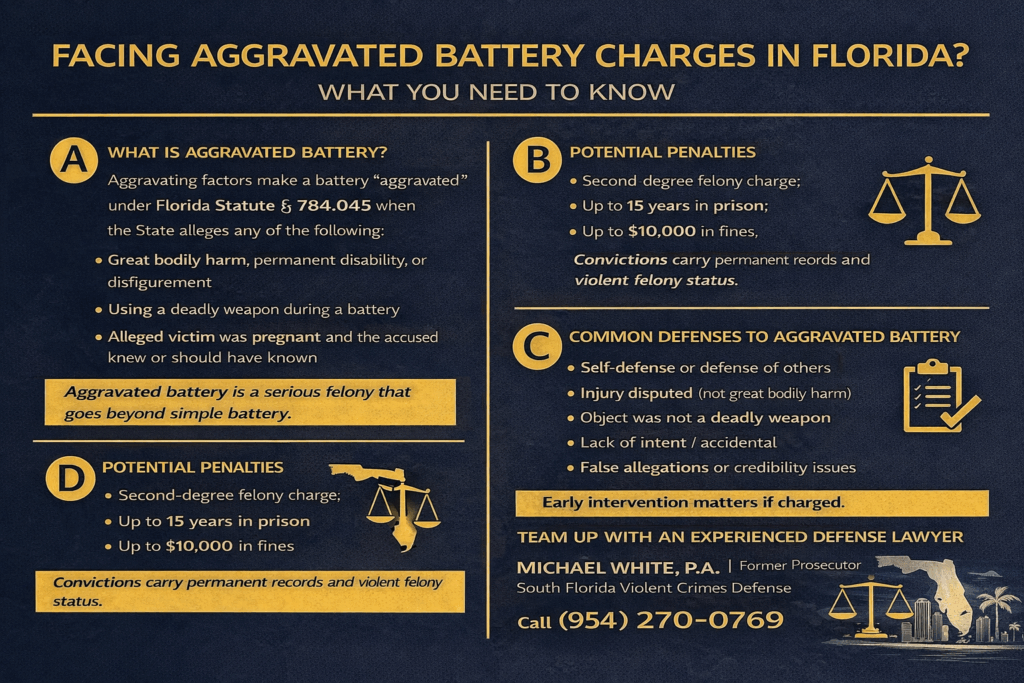
For aggravated battery, the State must allege one of the following:
Great bodily harm, permanent disability, or permanent disfigurement, or
Use of a deadly weapon, or
The victim was pregnant, and the defendant knew or should have known of the pregnancy.
Pregnancy-based aggravated battery allegations carry unique legal issues and proof requirements. Learn how these cases are analyzed in Florida when pregnancy is alleged as an aggravating factor.
Aggravated battery is often charged even when the injury is disputed, the “weapon” allegation is stretched, or the circumstances support self-defense.
🔨 What Counts as a Deadly Weapon in Aggravated Battery Cases?
Florida prosecutors and courts interpret “deadly weapon” broadly. Depending on the facts, alleged deadly weapons may include:
Firearms
Knives or blades
Baseball bats
A vehicle used to strike or threaten
A bottle, tool, or heavy object
A “deadly weapon” allegation is frequently contested. Law enforcement may label everyday objects as weapons, but not every item legally qualifies when the facts and intent are examined closely.Whether an object legally qualifies depends on how it was used and whether it was likely to cause death or great bodily harm.
See how courts analyze this issue in our guide to what qualifies as a deadly weapon in Florida aggravated battery cases.
🔪 Common Examples of Aggravated Battery in Florida
Aggravated battery charges commonly arise from situations like:
A fight where the State alleges serious injury (fracture, stitches, concussion, hospitalization)
An altercation where an object is alleged to have been used as a deadly weapon
A domestic incident where the State claims strangulation, serious injury, or weapon involvement
A confrontation where the victim is alleged to be pregnant and the State claims the defendant knew it
A bar, parking lot, or neighbor dispute that escalates and results in injuries
In many cases, the real issue is not what “could have” happened — it’s what actually happened, what injuries can be proven, and whether the defendant acted lawfully.
🔪 Common Examples of Aggravated Battery in Florida
Not all aggravated battery cases are the same. In many situations, the charge becomes more serious based on how the incident occurred or who was involved.
Some cases turn on firearm allegations and potential mandatory minimum sentencing. Others involve law enforcement officers, pregnant individuals, or protected emergency personnel such as EMTs and firefighters. In every case, the outcome often depends on what prosecutors can actually prove.
We break down these scenarios in more detail:
🧑⚖️ Penalties for Aggravated Battery in Florida
Aggravated battery is generally a second-degree felony, punishable by:
Up to 15 years in prison
Up to 15 years of probation
Up to a $10,000 fine
Beyond the statutory maximum, aggravated battery convictions carry severe collateral consequences, including loss of civil rights and a permanent violent-felony record.
Importantly, aggravated battery convictions are not eligible for sealing or expungement under Florida law, making the long-term consequences especially serious.
🔒 Is There a Minimum Sentence for Aggravated Battery in Florida?
Aggravated battery does not automatically carry a mandatory minimum sentence in every case. However, mandatory prison exposure can arise when:
The State alleges firearm enhancements or other statutory enhancements
The case is scored on Florida’s sentencing guidelines in a way that produces a prison recommendation
The prosecution refuses to offer non-prison resolutions based on the alleged injury facts
Early defense intervention matters because it can prevent enhancements from attaching, challenge the injury narrative, and create leverage before the case hardens.
🔫 Aggravated Battery Involving a Firearm in Florida
When aggravated battery involves a firearm, the stakes increase dramatically. Firearm allegations can trigger sentencing enhancements and mandatory minimum prison terms under Florida’s firearm laws, making early defense strategy critical.
Important:
• The State’s firearm enhancement theory matters.
• Whether an enhancement applies is often a prosecutorial decision.
• Early advocacy can sometimes prevent mandatory minimum exposure from attaching.
We examine these issues in more detail in our guide to Aggravated Battery with a Firearm in Florida.
🩺 How Medical Evidence Is Challenged in Aggravated Battery Cases
Aggravated battery charges often depend on whether injuries qualify as “great bodily harm,” permanent disability, or disfigurement. These terms have specific legal meanings and are frequently contested.
Florida courts apply specific legal standards to determine whether an injury qualifies as “great bodily harm” in Florida aggravated battery cases, including how fractures, stitches, and hospitalizations are analyzed under § 784.045.
Medical records, photographs, timelines, and expert review often reveal inconsistencies between initial police descriptions and actual clinical findings. Challenging medical evidence is a central defense strategy in many aggravated battery cases.
🔍 How Prosecutors Try to Prove Aggravated Battery
To convict someone of aggravated battery, prosecutors generally must prove:
An intentional touching or striking (battery)
The contact was against the alleged victim’s will, or caused bodily harm
Aggravating factor(s) beyond simple battery, such as:
Great bodily harm / permanent disability / permanent disfigurement, or
Use of a deadly weapon, or
Pregnancy knowledge element (where applicable)
Aggravated battery cases often turn on medical evidence, the credibility of witnesses, and whether the State can prove the “aggravating” factor beyond a reasonable doubt.
🔍 Aggravated Battery vs. Battery in Florida
Battery (§ 784.03) can be charged for minimal unwanted contact or minor injury.
Aggravated Battery (§ 784.045) requires the State to prove a serious aggravating factor — such as great bodily harm, a deadly weapon, or qualifying pregnancy allegations.
This distinction matters because prosecutors often attempt to escalate simple battery cases into aggravated battery based on disputed injury descriptions or questionable weapon theories.
If you’re unsure whether your case qualifies as aggravated battery or felony battery, the distinction can dramatically affect sentencing exposure.
🛡️ Legal Defenses to Aggravated Battery
Aggravated battery cases often hinge on details the State struggles to prove. A strong defense focuses on injury proof, intent, context, and justification.
Common defenses include:
✔ Self-Defense / Defense of Others
If you acted to prevent imminent harm, Florida’s justifiable use-of-force laws may apply. In some aggravated battery cases, defendants may seek dismissal through lawful self-defense or Stand Your Ground immunity before trial.
✔ Injury Is Disputed or Not “Great Bodily Harm”
Not every injury qualifies as great bodily harm, permanent disability, or disfigurement. Medical records and expert review can be decisive.
✔ Object Was Not a Deadly Weapon
Law enforcement may label objects as weapons, but legal classification depends on the facts and use.
✔ Lack of Intent / Accident
Accidental contact or unintended injury can defeat required elements.
✔ False Accusations / Credibility Problems
Aggravated battery allegations commonly arise in emotional disputes, intoxicated encounters, and domestic conflict. Inconsistent statements matter.
✔ Insufficient or Unreliable Evidence
Missing video, unclear witness accounts, weak medical proof, or contradictory reports can undermine the State’s case.
In many cases, aggravated battery charges are reduced to lesser offenses when the defense challenges injury claims, weapon allegations, or credibility early.
If you’re wondering whether your case qualifies for a downgrade or negotiated resolution, we explain common reduction pathways in our article on Whether Aggravated Battery Charges Can be Reduced in Florida.
⚖️ Pre-Charge Intervention in Fort Lauderdale Aggravated Battery Cases
In some aggravated battery investigations, law enforcement arrests first and the State Attorney’s Office makes final filing decisions later. That early window can be critical.
When possible, we intervene before formal charges are finalized by presenting exculpatory evidence such as:
Video footage contradicting the allegation
Witness statements undermining the State’s narrative
Medical records inconsistent with “great bodily harm” claims
Proof that self-defense applies
Early intervention can lead to reductions, diversion-eligible resolutions in appropriate cases, or decisions not to file the most serious charge.
⚖️ Jury Perception and Overcharging in Aggravated Battery Cases
Prosecutors often charge aggravated battery aggressively to control negotiations or leverage plea offers. But juries scrutinize these cases closely — especially when alleged injuries appear inconsistent with the charge.
When the facts do not match the severity of the accusation, overcharging can backfire. Effective defense strategy focuses on aligning the charge with the actual evidence, not worst-case narratives.
📍 Arrested for Aggravated Battery in Fort Lauderdale or South Florida?
Aggravated battery allegations often fall within a broader category of serious violent offenses.
Learn more about how an experienced Fort Lauderdale Violent Crimes Defense Lawyer can challenge the State’s case, pursue early intervention, and fight for charge reductions or dismissal.
A violent-felony accusation doesn’t have to destroy your life. With the right strategy and experienced representation, you may be able to:
Get charges reduced or dropped
Challenge exaggerated injury or weapon claims
Avoid unnecessary prison exposure
Protect your record and future opportunities
At Michael White, P.A., we bring former prosecutor insight to violent-crimes cases across South Florida. We know how the State builds aggravated battery cases — and how to break them down.
🟡 Call today at (954) 270-0769, or schedule your free consultation.
🟢 Protect your rights before charges become convictions.
❓ FAQs
Q1: Is aggravated battery a felony in Florida?
A: Yes. Aggravated battery is generally a second-degree felony and can carry up to 15 years in prison, along with severe long-term consequences.
Q2: What makes a battery “aggravated” in Florida?
A: A battery becomes aggravated if the State alleges great bodily harm, permanent disability or disfigurement, use of a deadly weapon, or certain pregnancy-related allegations under § 784.045.
Q3: Does aggravated battery require serious injury?
A: Not always. The charge can also be based on an alleged deadly weapon or pregnancy allegations. But when the State relies on injury, the defense can challenge whether the injury meets the legal standard.
Q4: Can aggravated battery charges be reduced?
A: Yes. Reductions are common when injury claims are exaggerated, weapon allegations are disputed, self-defense applies, or evidence is weak.
Q5: Can aggravated battery be sealed or expunged in Florida?
A: Not after a conviction. Eligibility typically requires a dismissal, non-conviction outcome, or reduction to an eligible offense.