
Last updated April 2026
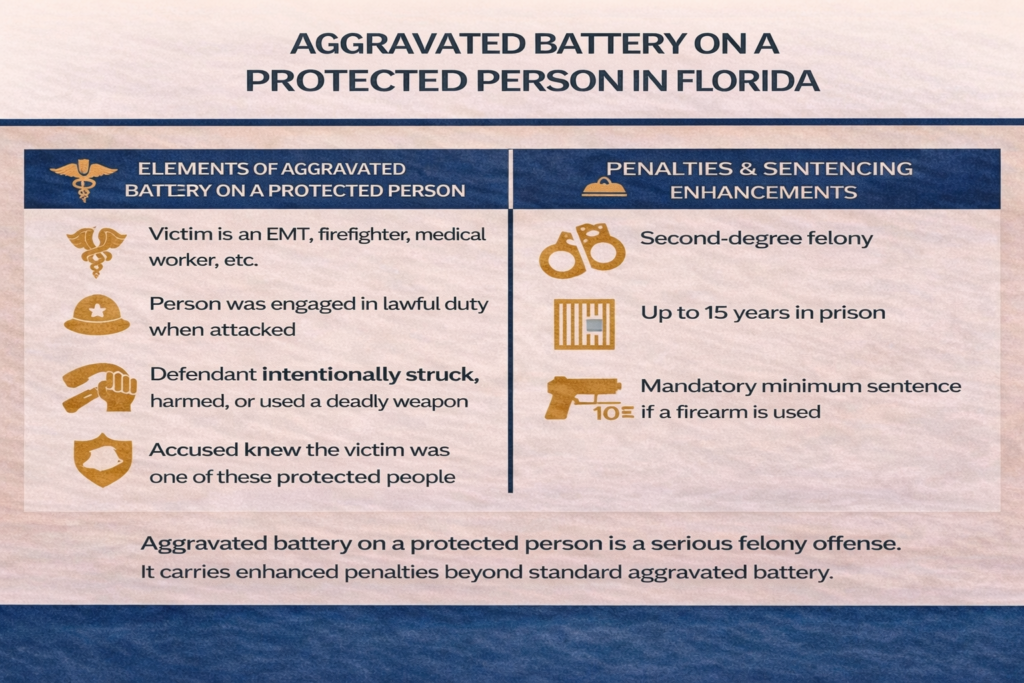
Aggravated battery on a protected person in Florida is a serious felony charge that applies when certain individuals—such as EMTs, firefighters, and other designated personnel—are involved in an alleged battery.
These cases are often charged aggressively, especially when they arise during emergency response situations or chaotic scenes.
For a broader overview of how aggravated battery cases are charged and defended, see our guide to Aggravated Battery Charges in Florida.
⚖️ Who Qualifies as a “Protected Person”?
Florida law enhances battery charges when the alleged victim falls within specific protected categories.
These may include:
• Emergency medical technicians (EMTs)
• Paramedics
• Firefighters
• Certain medical or public safety personnel
The exact classification depends on the statute and the circumstances of the incident.
🔍 What Prosecutors Must Prove
To sustain this charge, the State must prove:
• Intentional touching or striking
• Against the alleged victim’s will
• The victim qualifies as a protected person
• The defendant knew or should have known that status
• An aggravating factor (such as injury or weapon, where applicable)
We break down these elements in our guide to What Prosecutors Must Prove to Convict Aggravated Battery in Florida.
🧠 Knowledge of Protected Status
Just like other enhanced battery charges, knowledge is a key issue.
The State must prove that the accused:
• Knew the person was a firefighter, EMT, or protected individual, or
• Should have known based on the circumstances
This can become contested in:
• chaotic emergency scenes
• low visibility environments
• situations involving multiple responders
• unclear identification
If knowledge cannot be proven, the enhanced charge may not stand.
🔨 Aggravating Factors Still Matter
Even with a protected person, prosecutors may still rely on:
• great bodily harm
• use of a deadly weapon
• other aggravating circumstances
We explain how courts evaluate these issues in our guide to Great Bodily Harm in Florida Aggravated Battery Cases.
⚖️ Related Aggravated Battery Charges
Florida law includes several enhanced battery charges based on the status of the alleged victim.
These include:
• law enforcement officers
• pregnant individuals
See Our Guide to Aggravated Battery on a Law Enforcement Officer in Florida for a breakdown of officer-related cases.
See Our Guide to Aggravated Battery on a Pregnant Woman in Florida for how pregnancy-based charges differ.
Each charge has distinct legal elements and proof requirements.
🛡️ Common Defense Strategies
These cases often depend heavily on what actually happened during a fast-moving situation.
Common defenses include:
✔ Lack of Knowledge of Protected Status
✔ No Intentional Contact
✔ Self-Defense or Defense of Others
✔ Officer or Responder Conduct Was Improper
✔ Conflicting or Unreliable Evidence
Body camera footage, witness testimony, and scene conditions are often critical.
🔍 Evidence and Credibility Issues
Protected-person cases frequently involve:
• multiple witnesses
• conflicting accounts
• chaotic environments
• incomplete or inconsistent reporting
Credibility becomes central.
Even when a protected person is involved, the State must still prove every element.
📉 Can These Charges Be Reduced?
Yes. Reductions are common when:
• knowledge of protected status is unclear
• injury evidence is weak
• intent is disputed
• facts are overstated or mischaracterized
See Our Guide to How Aggravated Battery Charges Can Be Reduced in Florida for how these cases are resolved.
📍 Facing Charges in Broward County or South Florida?
Aggravated battery on a protected person is a serious allegation—but it is not automatic.
These cases often turn on:
• what the defendant knew
• how the incident unfolded
• whether the State can prove each element
Early legal analysis can significantly affect the outcome.
📞 Call (954) 270-0769 or request a confidential consultation.
❓ FAQs
Who is considered a protected person in Florida battery cases?
Protected persons may include EMTs, firefighters, paramedics, and other designated emergency or public safety personnel.
Does the defendant have to know the person is protected?
Yes. The State must prove the defendant knew or should have known the victim’s status.
Does this charge require serious injury?
Not always. However, injury or weapon use may still be used to support the aggravated charge.
Can aggravated battery on a protected person be reduced?
Yes. These cases are often reduced when knowledge, intent, or evidence is disputed.