
Last updated March 2026
Aggravated battery is one of Florida’s most serious violent felony charges — often carrying years in prison and permanent consequences. Because of that exposure, one of the first questions defendants ask is:
“Can this charge be reduced?”
The answer is yes — in many cases.
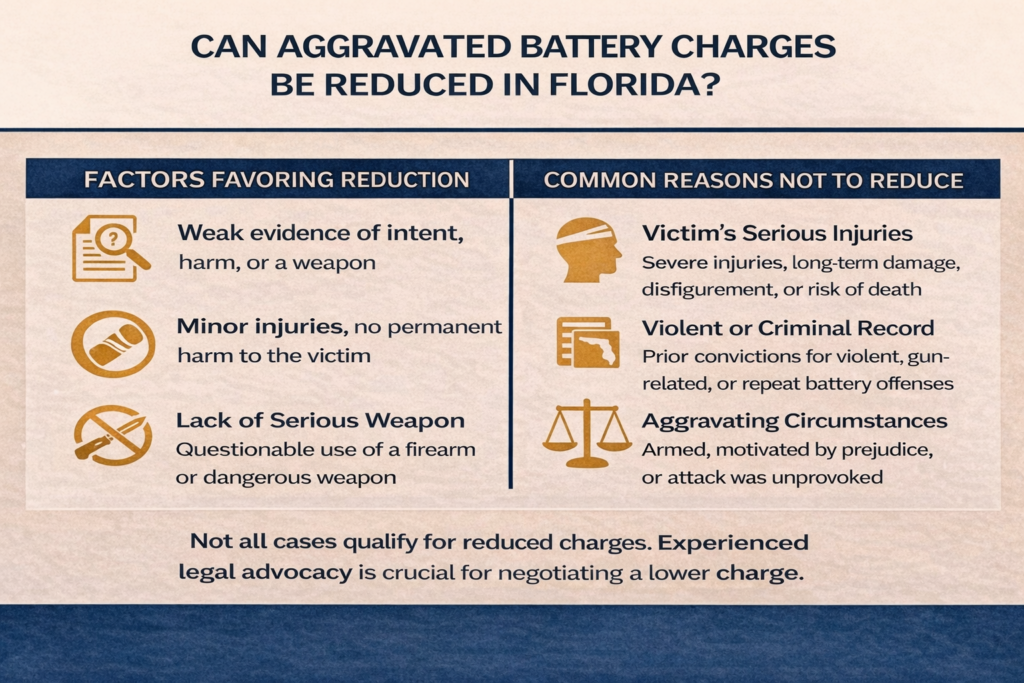
Aggravated battery charges are frequently reduced when the facts, evidence, or injuries do not support the level of severity prosecutors initially allege.
For a full explanation of aggravated battery charges — including penalties, defenses, and how cases escalate —
see our guide to Aggravated Battery in Florida charges in Florida.
Here’s how charge reductions happen, what factors matter most, and when reductions are less likely.
⚖️ The Short Answer
Yes. Aggravated battery charges in Florida can be reduced, often to:
felony battery (see our comparison of Aggravated Battery vs. Felony Battery in Florida)
simple battery
or, in some cases, dismissed entirely
Reductions depend on injury evidence, intent, credibility, and early defense strategy.
📜 What Makes Battery “Aggravated” Under Florida Law
Under Florida Statute § 784.045, battery becomes aggravated when prosecutors allege:
great bodily harm,
permanent disability,
permanent disfigurement, or
use of a deadly weapon.
If the State cannot prove one of these elements beyond a reasonable doubt, the aggravated charge may not stand.
🔍 Common Reasons Aggravated Battery Charges Are Reduced
✔ Injuries That Do Not Qualify as “Great Bodily Harm”
Many cases are overcharged based on:
bruising or swelling
superficial cuts
temporary pain
injuries that resolved quickly
If medical records do not support severe or lasting injury, reductions are common.
We explain how courts evaluate these injury claims in our guide to Great Bodily Harm in Florida Aggravated Battery Cases.
✔ Weapon Allegations Are Weak or Overstated
Everyday objects are often labeled “deadly weapons” in arrest reports.
If the object:
was not used to cause serious harm, or
was incapable of causing death or great injury as used,
the aggravated element may fail.
See how courts analyze this issue in our guide to What Qualifies as a Deadly Weapon in Florida Aggravated Battery Cases.
✔ Lack of Intent or Accidental Conduct
Aggravated battery requires intentional conduct.
Accidental contact, reflexive movement, or chaotic situations often undermine the charge.
✔ Credibility Problems or Conflicting Evidence
Reductions frequently occur when:
witness statements conflict
body-camera footage contradicts police reports
alleged victims exaggerate injuries
evidence is incomplete or inconsistent
✔ Self-Defense or Mutual Confrontation
If the defendant was acting to protect themselves or others, prosecutors may:
reduce the charge, or
decline to proceed entirely
Especially when the alleged victim was the initial aggressor.
🚨 When Reductions Are Less Likely
Charge reductions are harder when:
injuries are severe or permanent
firearms or knives are clearly involved
the defendant has a violent criminal history
the alleged victim is a protected person
the case involves domestic violence with strong evidence
Even then, early defense work can still influence outcomes.
🧭 The Importance of Early Intervention
Aggravated battery charges are often filed before:
full medical records are reviewed
all video is analyzed
witnesses are interviewed
Early defense involvement can:
present mitigating evidence
challenge injury classifications
prevent enhancements from attaching
shape prosecutorial discretion before positions harden
Timing matters.
🔍 What Prosecutors Must Still Prove
Even in aggravated battery cases, the State must prove:
Intentional contact or striking
Against the alleged victim’s will
A qualifying aggravating factor (injury or weapon)
No legal justification
Failure on any element opens the door to reduction or dismissal.
We break this down in detail in our guide to What Prosecutors Must Prove to Convict Aggravated Battery in Florida.
📍 Facing an Aggravated Battery Charge in Florida?
Not every aggravated battery case belongs at the felony level prosecutors initially file.
📞 Call (954) 270-0769 or request a confidential consultation today.
❓ Frequently Asked Questions
Can aggravated battery charges really be reduced in Florida?
Yes. Many cases are reduced when injuries are overstated, weapons are disputed, or evidence is weak.
Reduced to what?
Common reductions include felony battery, simple battery, or dismissal depending on the facts.
Does the alleged victim’s cooperation matter?
It can. Lack of cooperation often weakens aggravated allegations, especially where injuries are minor.
Is reduction more likely before trial?
Yes. Early intervention provides the best opportunity to influence charging decisions.
Does self-defense help reduce aggravated battery charges?
Yes. Credible self-defense evidence often leads to reductions or dismissal.