
Last updated April 2026
Not every object labeled a “weapon” in a police report legally qualifies as a deadly weapon under Florida aggravated battery law.
The difference matters.
A simple battery can become a second-degree felony — punishable by up to 15 years in prison — if the State proves the object used meets the legal definition of a deadly weapon.
Whether it does often becomes the central battleground in aggravated battery cases.
For a full overview of aggravated battery charges and penalties, see our guide to aggravated battery charges in Florida.
⚖️ Weapon vs. “Deadly Weapon” vs. Dangerous Object
In everyday language, many objects can be called “weapons.”
But Florida law does not treat every weapon as a deadly weapon.
There is an important distinction between:
• An object capable of causing harm
• An object used offensively
• An object legally proven to be a deadly weapon in that specific incident
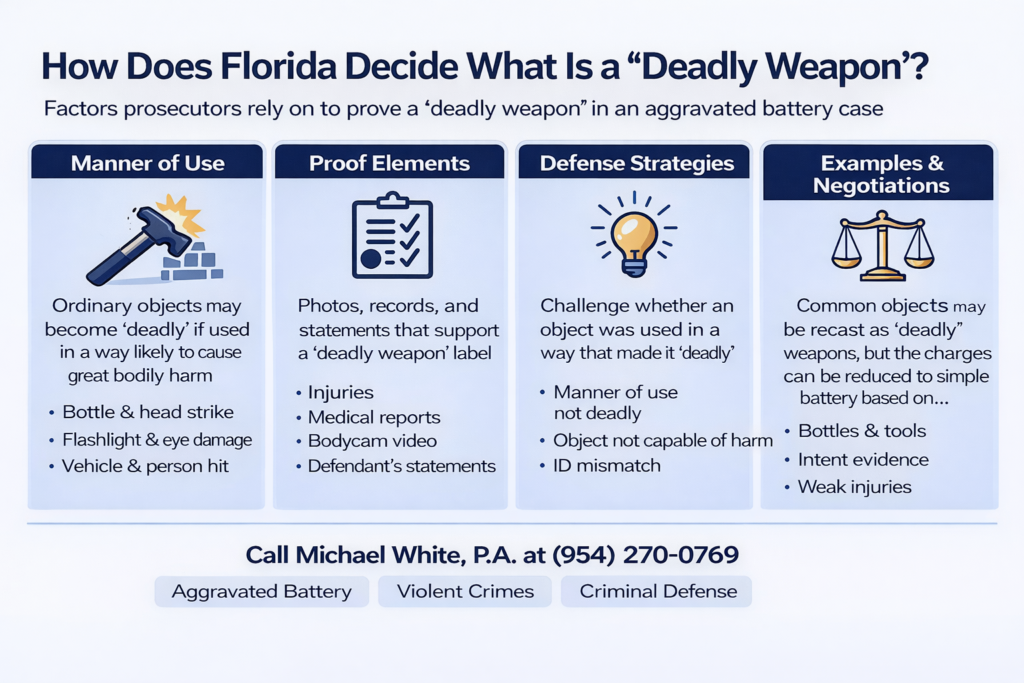
Florida courts generally focus on whether the object was used in a manner likely to cause death or great bodily harm.
The label alone does not control.
🎯 The “Manner of Use” Rule
This is the core legal principle:
The same object may or may not be a deadly weapon depending on how it was used.
Examples (with legal analysis, not just lists):
Bottle
A bottle sitting on a table is not a deadly weapon.
A bottle smashed and used to strike someone’s head at close range may qualify.
Flashlight
A flashlight carried during an argument is not automatically deadly.
A heavy metal flashlight swung at someone’s skull may be treated differently.
Car Keys
Keys in a pocket are not deadly.
Keys used to stab repeatedly at someone’s face or eyes may be argued as such.
Vehicle
A parked car is not a deadly weapon.
A vehicle intentionally driven toward a person at speed may qualify.
The question is always:
Was the object, as used in that moment, capable of causing death or great bodily harm?
Firearm allegations raise additional legal issues and potential sentencing exposure. We examine those cases in our guide to aggravated battery involving a firearm in Florida.
🔍 What Prosecutors Must Actually Prove
In aggravated battery weapon cases, the State must present specific evidence to support the charge. We break down these requirements in our guide to what prosecutors must prove to convict aggravated battery in Florida. The State must present evidence supporting:
1️⃣ Capability — that the object, as used, was likely to cause serious harm
2️⃣ Manner of use — how it was wielded or applied
3️⃣ Circumstances — distance, force, intent, proximity
4️⃣ Credible proof — not just assumptions
That proof often relies on:
• Photographs
• Medical records
• Body-worn camera footage
• Surveillance video
• Injury documentation
• Witness statements
• The defendant’s statements
• Physical recovery of the object
When that proof is weak, the “deadly weapon” allegation weakens with it.
🧠 Why This Becomes the Leverage Point in Negotiations
In many aggravated battery cases:
The injury may be minor
The object may not be recovered
The alleged use may be exaggerated
When the deadly weapon label collapses, the case often shifts from:
Second-degree felony
⬇
To simple battery or misdemeanor exposure
That shift dramatically changes sentencing risk and negotiation posture.
This is why defense strategy frequently focuses on dismantling the “deadly weapon” element first.
When the deadly weapon element is successfully challenged, cases are often reduced. See how this works in our guide to how aggravated battery charges can be reduced in Florida.
🚫 Common Defense Lanes in Deadly Weapon Allegations
Object Not Capable of GBH “As Used”
Even if dangerous in theory, the actual conduct may not support felony classification.
No Intent / Accidental Contact
Intent matters in aggravated battery analysis.
Inconsistent Weapon Descriptions
Witnesses often describe objects differently.
No Recovery of the Object
If the alleged weapon was never recovered, proof becomes credibility-driven.
Weak Injury Evidence
If injuries are inconsistent with deadly force, the allegation may be overstated.
Self-Defense Context
If force was legally justified, the deadly weapon element may be neutralized entirely.
For a broader explanation of justified force, see our overview of self-defense and Stand Your Ground in Florida.
⚖️ Jury Instructions Matter
At trial, jurors are often instructed that an object qualifies as a deadly weapon if:
It was used in a manner likely to cause death or great bodily harm.
That language is narrower than many police reports suggest.
The defense does not have to prove the object was harmless.
The State must prove beyond a reasonable doubt that it was legally deadly in that context.
🔁 Deadly Weapon vs. Great Bodily Harm
Aggravated battery may also be charged based on:
• Great bodily harm
• Permanent disability
• Permanent disfigurement
Sometimes prosecutors pursue both theories.
But when injury evidence is weak, they often lean heavily on the weapon theory instead.
Challenging that theory can reshape the case.
📍 Broward County Reality
In Broward County aggravated battery cases:
“Deadly weapon” language is often used broadly in arrest affidavits
Charging decisions may precede full evidence review
Weapon allegations are frequently used as leverage
Early investigation — including scene reconstruction and medical review — often determines whether the deadly weapon enhancement survives.
🛡️ Facing an Aggravated Battery Charge?
If your case hinges on whether an object qualifies as a “deadly weapon,” the outcome may depend less on the object — and more on how it was used and what the evidence actually shows.
Not every object labeled a weapon meets Florida’s aggravated battery standard.
Call Michael White, P.A. at (954) 270-0769 for a confidential consultation.