
Last updated March 2026
Aggravated battery is one of the most serious violent felony charges in Florida—but it is not automatic.
Prosecutors must prove every required element beyond a reasonable doubt, and these cases often turn on details the State cannot fully establish.
For a broader overview of how these cases are charged and defended, see our guide to Aggravated Battery Charges in Florida.
🔍 The Core Legal Elements
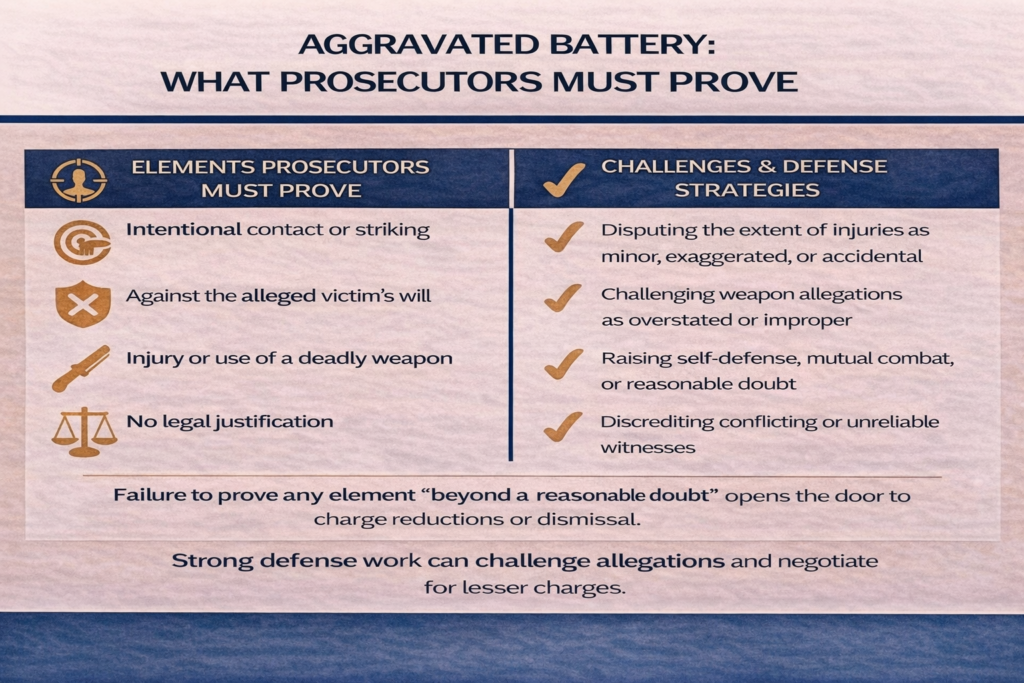
To convict someone of aggravated battery in Florida, the State must prove:
• An intentional touching or striking
• Against the alleged victim’s will
• A qualifying aggravating factor
• No legal justification
Failure on any one of these elements can result in reduction or dismissal.
🧠 Intent: More Than Just Contact
Aggravated battery requires intentional conduct.
The State must prove the defendant:
• intended to touch or strike, and
• did so knowingly
Accidental contact, reflexive movement, or chaotic encounters can undermine this element.
⚖️ Lack of Consent
The contact must be against the alleged victim’s will or result in harm.
In many cases, this element becomes contested when:
• both parties were involved in a confrontation
• the incident escalated quickly
• the alleged victim’s account changes
Credibility matters.
🔨 The Aggravating Factor (Where Most Cases Turn)
This is the key difference between simple battery and aggravated battery.
Prosecutors must prove at least one of the following:
• great bodily harm
• permanent disability or disfigurement
• use of a deadly weapon
• qualifying status-based enhancement
We explain how injury-based allegations are evaluated in our guide to Great Bodily Harm in Florida Aggravated Battery Cases.
We also break down weapon-related issues in our guide to What Qualifies as a Deadly Weapon in Florida Aggravated Battery Cases.
🧬 Status-Based Enhancements
Some aggravated battery charges are based on the status of the alleged victim.
These include cases involving:
• law enforcement officers
• pregnant individuals
• protected emergency personnel
See Our Guide to Aggravated Battery on a Law Enforcement Officer in Florida for officer-related cases.
🛡️ No Legal Justification
Even if all elements are alleged, the State must prove the absence of legal justification.
This includes self-defense.
If the defendant acted to prevent imminent harm, the charge may not stand.
🔍 Evidence and Proof Problems
In many aggravated battery cases, the State relies on:
• police reports
• witness statements
• photographs
• medical records
• video evidence
But these sources are often inconsistent or incomplete.
Common issues include:
• conflicting witness accounts
• exaggerated injury claims
• unclear weapon use
• missing or inconclusive video
These gaps can create reasonable doubt.
⚖️ Why Cases Are Often Reduced
Even when charges are filed as aggravated battery, the evidence may not support it.
Reductions often occur when:
• injury does not meet the legal threshold
• weapon allegations are weak
• intent is unclear
• credibility is compromised
See Our Guide to How Aggravated Battery Charges Can Be Reduced in Florida for how these cases are resolved.
📍 Facing Aggravated Battery Charges in Florida?
Aggravated battery cases are not decided by labels—they are decided by proof.
If the State cannot establish every required element, the charge may be challenged, reduced, or dismissed.
Early analysis of the evidence can make a critical difference.
📞 Call (954) 270-0769 or request a confidential consultation.
❓ FAQs
What must prosecutors prove for aggravated battery in Florida?
They must prove intentional contact, lack of consent, a qualifying aggravating factor, and no legal justification.
What is the hardest element for the State to prove?
Often the aggravating factor—especially great bodily harm or deadly weapon use.
Can aggravated battery be reduced if the evidence is weak?
Yes. Cases are often reduced when injury, intent, or evidence is disputed.
Does self-defense defeat aggravated battery charges?
Yes. Valid self-defense can prevent conviction or lead to dismissal.