
Last updated April 2026
Aggravated battery on a law enforcement officer in Florida is one of the most aggressively prosecuted violent felony charges. These cases often arise during arrests, traffic stops, or rapidly evolving encounters — and they carry serious legal consequences.
But like any aggravated battery charge, the State must still prove specific elements beyond a reasonable doubt.
Understanding what separates this charge from standard battery — and how it is challenged — is critical.
For a broader overview of how these cases are charged, defended, and prosecuted, see our guide to Aggravated Battery Charges in Florida.
⚖️ What Is Aggravated Battery on a Law Enforcement Officer?
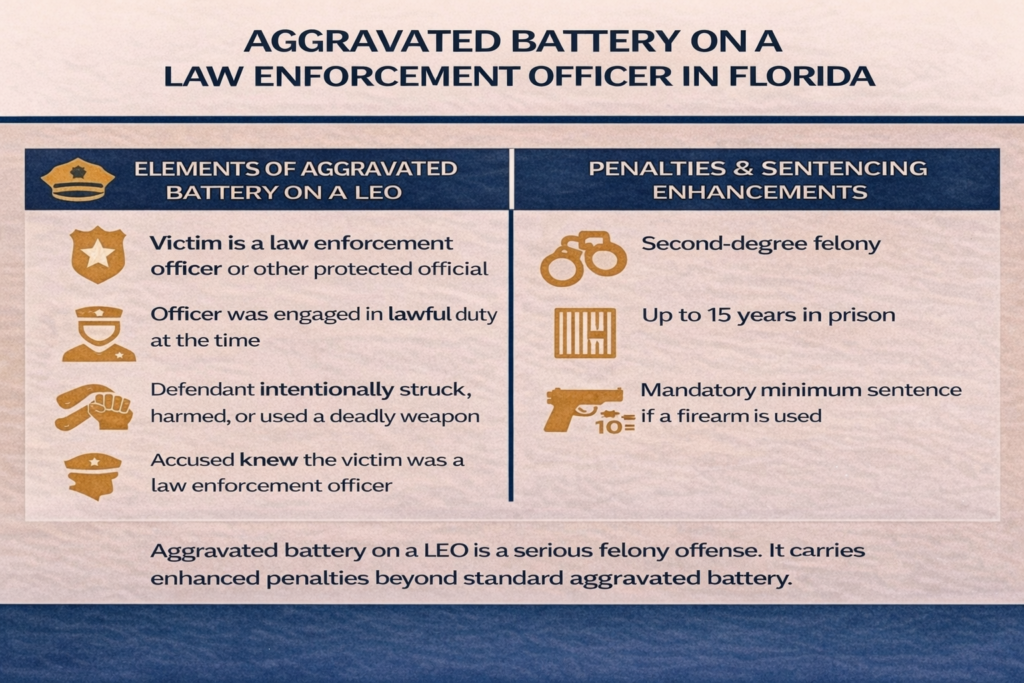
Under Florida law, aggravated battery becomes more serious when the alleged victim is a law enforcement officer engaged in lawful duties.
To sustain this charge, prosecutors must prove:
• The defendant intentionally touched or struck the officer
• The officer was engaged in lawful performance of duties
• The defendant knew (or should have known) the victim was an officer
• An aggravating factor existed (great bodily harm, deadly weapon, or qualifying circumstances)
This is not just a battery case — it combines status-based enhancement + aggravated battery elements.
🔍 Aggravated Battery vs. Battery on a Law Enforcement Officer
Not every case involving an officer is aggravated battery.
Florida law distinguishes between:
Simple or felony-level battery on an officer
Aggravated battery on an officer (which requires an additional aggravating factor)
For a full breakdown of how these charges differ, see our guide to Battery on a Law Enforcement Officer in Florida.
👉 This distinction matters because:
Battery on an officer may not require serious injury
Aggravated battery requires proof of an added element (injury or weapon)
🔨 What Makes the Charge “Aggravated”?
Prosecutors must prove one of the following:
• Great bodily harm, permanent disability, or disfigurement
• Use of a deadly weapon
• Other qualifying aggravating factors under Florida law
If the State cannot prove one of these elements, the aggravated charge may not stand.
🚨 The “Lawful Duty” Requirement
One of the most important — and often overlooked — elements is whether the officer was acting lawfully.
If the officer:
• Used excessive force
• Made an unlawful detention or arrest
• Acted outside the scope of legal authority
then this element may be challenged.
If the officer was not acting lawfully, the charge may be reduced or dismissed.
🧠 Knowledge of Officer Status
The State must also prove that the accused knew or should have known the victim was a law enforcement officer.
This becomes a key issue in:
• Plainclothes encounters
• Chaotic or fast-moving scenes
• Poor lighting or visibility
• Situations where identification was unclear
If knowledge cannot be proven, the enhanced charge may fail.
🔫 Firearm and Weapon Enhancements
If a firearm is alleged, the stakes increase significantly.
Firearm-related aggravated battery charges can trigger:
• Mandatory minimum sentences
• Enhanced prison exposure
• Additional sentencing considerations
🛡️ Common Defense Strategies
Aggravated battery on an officer cases are highly fact-specific. Common defenses include:
✔ Officer Was Not Acting Lawfully
✔ Self-Defense Against Excessive Force
✔ Lack of Intent
✔ No Great Bodily Harm
✔ Object Was Not a Deadly Weapon
✔ Lack of Knowledge of Officer Status
✔ Inconsistent or Unreliable Evidence
These cases often hinge on body camera footage, witness credibility, and use-of-force analysis.
🔍 What Prosecutors Must Prove
Even in officer-involved cases, the burden remains high.
The State must prove:
• Intentional contact
• Against the officer’s will
• Lawful duty status
• Knowledge of officer status
• A qualifying aggravating factor
• No legal justification
We explain this in detail in our guide to What Prosecutors Must Prove to Convict Aggravated Battery in Florida.
Failure on any one of these elements can result in reduction or dismissal.
📉 Can These Charges Be Reduced?
Yes — even serious charges like this can be reduced.
Reductions often occur when:
• Injury evidence is weak
• Use of force is disputed
• Body camera contradicts reports
• Officer conduct is questionable
• Evidence is inconsistent
We explain how this happens in our article on How Aggravated Battery Charges Can Be Reduced in Florida.
📍 Facing Charges in Broward County or South Florida?
Aggravated battery on a law enforcement officer is a serious charge — but it is not automatic.
These cases often depend on:
• What actually happened during the encounter
• Whether force was justified
• Whether the evidence supports the State’s version
Early analysis can make a critical difference.
📞 Call (954) 270-0769 or request a confidential consultation.
❓ FAQs
Is aggravated battery on a law enforcement officer a felony in Florida?
Yes. It is typically charged as a second-degree felony and carries significant prison exposure.
Does the officer have to be on duty?
Yes. The State must prove the officer was engaged in lawful duties at the time.
What if I didn’t know they were an officer?
Lack of knowledge can be a valid defense and may defeat the enhanced charge.
Can the charge be reduced?
Yes. Many cases are reduced when elements like injury, intent, or lawful duty are disputed.