
Last updated February 2026
Under Florida Statutes § 893.13(6)(a), possession of cocaine — regardless of the amount — is at a minimum a third-degree felony punishable by:
Up to 5 years in prison
Up to 5 years probation
Up to $5,000 in fines
Mandatory driver’s license suspension (minimum 6 months)
Unlike marijuana under 20 grams or drug paraphernalia, cocaine possession does not receive misdemeanor treatment under Florida law, even if it’s just residue.
This surprises many people — especially when the charge involves residue, a small baggie, or cocaine found in a shared space.
If you’ve been arrested for possession of cocaine in Fort Lauderdale or anywhere in South Florida, understanding how these cases are charged — and how they can be defended — is critical.
For a broader overview of how Florida defines drug possession, see our Drug Possession in Florida guide.
📜 How Florida Defines Cocaine Possession
Cocaine is classified as a Schedule II controlled substance under Florida law.
That means:
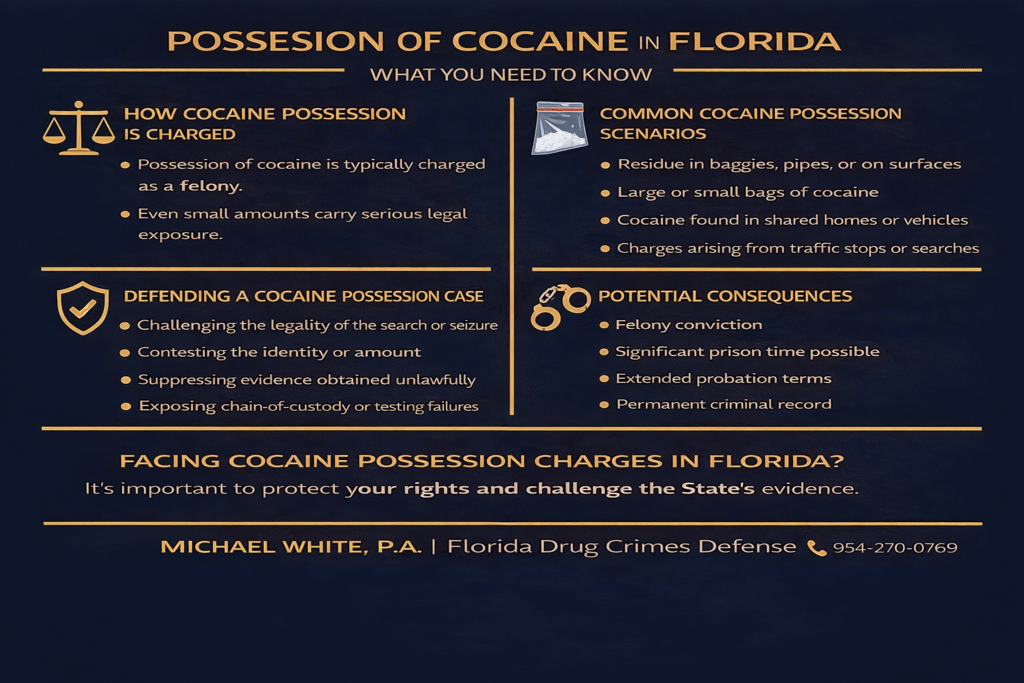
Possession is typically charged as a felony
The amount does not need to be large
Residue can still lead to charges if testing supports it
In practical terms, if the substance is cocaine and it’s not marijuana under 20 grams or paraphernalia, you are likely facing a felony charge.
📦 What Counts as “Possession”?
There are two types of possession under Florida law:
Actual possession – The cocaine was on your person (in your pocket, hand, sock, etc.)
Constructive possession – You had control over the place where it was found and knew it was there (e.g., under a car seat or inside a drawer at your residence)
If multiple people were present, prosecutors must prove beyond a reasonable doubt that you had knowledge and control, which isn’t always easy — and can be a major point for your defense.
⚠️ Why Cocaine Possession Is Treated So Harshly
Florida prosecutors treat cocaine possession aggressively because:
Cocaine is considered a serious controlled substance
Prior drug history is often used to justify harsher treatment
Law enforcement assumes distribution even without proof
Felony leverage is used to push quick resolutions
As a result, cocaine cases often escalate quickly — even when the facts are thin.
📦 Common Cocaine Possession Scenarios
Cocaine possession charges commonly arise from:
Residue found in baggies, pipes, or on surfaces
Small or large bags discovered during a traffic stop
Cocaine found in shared homes, vehicles, or hotel rooms
Charges following searches during unrelated investigations
Cases based on field testing only
🔑 Key point: Presence alone does not equal possession.
The State must still prove knowledge and control.
🛡️ Defending a Cocaine Possession Case
Cocaine possession cases are very defensible, especially when challenged early.
Common defense strategies include:
Challenging the legality of the search or seizure
Contesting whether the substance is actually cocaine
Demanding confirmatory laboratory testing
Suppressing evidence obtained unlawfully
Exposing chain-of-custody or testing failures
Many cocaine cases fall apart when the State’s evidence is examined closely.
⚖️ What’s at Stake With a Cocaine Possession Conviction
A cocaine possession conviction in Florida may result in:
A felony conviction
Prison or extended probation exposure
A permanent criminal record
Loss of employment or housing opportunities
Immigration consequences for non-citizens
Because the charge is a felony by default, early defense action matters.
📍 Charged With Cocaine Possession in Florida?
Cocaine possession charges are serious — but they are not automatic convictions.
Police mistakes, illegal searches, unreliable testing, and overcharging happen far more often than people expect.
At Michael White, P.A., we defend cocaine possession cases by challenging the evidence, the procedures, and the State’s assumptions.
👉 Schedule a free consultation to discuss your cocaine possession charge and your defense options.
🙋♂️ Frequently Asked Questions
Is possession of cocaine always a felony in Florida?
In most cases, yes. Cocaine possession is typically charged as a felony regardless of the amount.
Can residue lead to a cocaine possession charge?
Residue can lead to charges, but the State must still prove the substance is cocaine and that the accused knowingly possessed it.
Are field drug tests reliable for cocaine cases?
Field tests are frequently challenged. Confirmatory lab testing is often required to prove cocaine possession in court.
Does cocaine possession automatically mean prison?
Not always. Outcomes depend on the facts, prior history, and whether the defense successfully challenges the evidence.
Should I hire a lawyer immediately?
Yes. Because cocaine possession is usually a felony, early legal representation is critical.