
Last updated April 2026
In Florida, theft is not just about taking property — it’s about intent. Prosecutors must prove that a person intended to deprive the owner of their property, even temporarily. Without that intent, a theft charge should fail.
In many cases, challenging intent early can result in dismissal—learn when theft charges can be dropped in Florida.
Many theft accusations arise from mistakes, misunderstandings, permission disputes, or business conflicts — not criminal behavior. When intent is missing, the case often should never have been charged as theft.
In Broward County, we frequently see these cases originate from business disputes, loss prevention reports, or incomplete investigations rather than clear evidence of criminal intent.
This page explains how lack of intent works as a defense to theft charges in Florida and why it is one of the most powerful tools in criminal defense. It is often a central strategy in broader grand theft defense cases in Florida.
🔎 Why Intent Matters in Florida Theft Cases
Under Florida law, theft generally requires proof that a person knowingly obtained or used property with the intent to deprive the owner of it. That intent element is what separates criminal theft from:
-
Civil disputes
-
Accidental conduct
-
Contract or business disagreements
If the State cannot prove intent beyond a reasonable doubt, the charge should be dismissed or reduced.
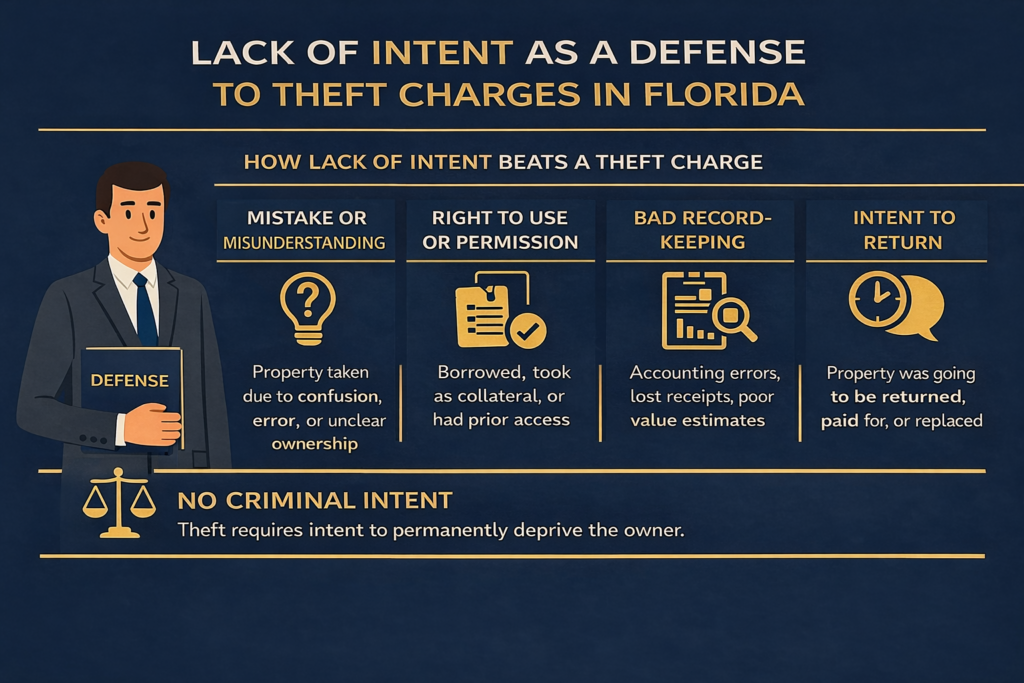
🧠 Common Situations Where Intent Is Missing
1️⃣ Mistake or Misunderstanding
People are frequently accused of theft when the situation was actually a misunderstanding, such as:
-
Confusion over ownership
-
Miscommunication about permission
-
Accidental removal of property
-
Self-checkout or billing errors
A mistake is not a crime — and without proof of intent, theft cannot stand.
2️⃣ Right to Use or Permission
If you believed you had permission to use, borrow, or possess the property, intent may be lacking.
This often arises in:
-
Family or roommate situations
-
Shared tools, vehicles, or electronics
-
Workplace access disputes
-
Prior patterns of consent
When permission is disputed, the issue is often civil, not criminal.
In these situations, the case may be more accurately treated as a civil dispute rather than a theft offense—learn more about when a theft case is really a civil dispute in Florida.
3️⃣ Bad Record-Keeping or Accounting Errors
Many theft cases stem from:
-
Poor inventory tracking
-
Lost receipts
-
Incomplete documentation
-
Disputed financial records
Accounting problems and sloppy records do not equal criminal theft — especially when there’s no proof someone intended to steal.
4️⃣ Intent to Return Property
If the evidence shows the property was:
-
Going to be returned
-
Paid for later
-
Replaced or exchanged
…then the required intent to deprive may be missing. Florida law focuses on what the person intended, not just what happened.
🚫 What Prosecutors Often Rely On to Prove Intent
Because intent is rarely direct, prosecutors often try to infer it from:
-
Statements made to police or loss prevention
-
Attempts to conceal property
-
Lack of documentation
-
After-the-fact explanations
In many cases, this results in intent being assumed based on limited facts rather than proven through clear evidence.
This is why remaining silent and involving counsel early is critical.
🛡️ How Defense Lawyers Use Lack of Intent
In practice, these cases are often won by reframing the narrative early—before prosecutors lock into a one-sided version of events.
A strong theft defense often focuses on:
-
Showing alternative explanations for the conduct
-
Introducing communications that show permission or confusion
-
Challenging one-sided police narratives
-
Attacking probable cause for arrest
-
Framing the case as a civil dispute, not a crime
In many cases, once intent is challenged, the prosecution’s case collapses.
📍 What to Do If You’re Accused of Theft
If you’re accused of theft and believe intent is missing:
-
Do not explain the situation to police
-
Preserve texts, emails, receipts, and agreements
-
Avoid contacting the accuser directly
-
Have a lawyer intervene early
The earlier intent is challenged, the better your chances of avoiding charges or securing dismissal.
Early intervention can prevent charges from being filed at all or significantly improve the outcome.
📞 Fort Lauderdale Theft & Fraud Defense
If you’ve been accused of theft and believe intent is missing, learn how our Fort Lauderdale theft and fraud defense team challenges charges that should never have been filed.
At Michael White, P.A., we regularly defend theft cases involving intent disputes, permission issues, and civil disagreements… that never should have been charged — because the intent element is missing.
Using experience as a former prosecutor, we know how theft cases are built — and how to dismantle them before they become permanent records.
❓ Frequently Asked Questions
Is lack of intent a defense to theft in Florida?
Yes. Theft requires proof of criminal intent. Without it, a conviction should not stand.
Can a mistake still lead to a theft charge?
It can lead to an accusation, but mistake or misunderstanding often defeats the charge when intent cannot be proven.
Does returning the property automatically dismiss the case?
Not automatically — but intent to return can significantly weaken the prosecution’s case.
What if I thought I had permission?
Permission or a reasonable belief of permission is a strong defense to theft.
When should I contact a lawyer?
Immediately. Early intervention is often the difference between dismissal and charges.