
Last updated February 2026
Updated for 2026 — Former Prosecutor. Local Strategy. Proven Results.
Former Prosecutor. Local Strategy. Proven Results.
Florida consistently ranks among the top states for identity theft, fraud, and felony theft investigations. In Broward County, prosecutors pursue these cases aggressively — even when the facts involve misunderstandings, workplace disputes, or accounting errors rather than criminal intent.
According to recent Florida Attorney General and law-enforcement data:
Identity theft complaints continue to rise statewide
Fraud investigations increasingly involve digital records and financial audits
Retail and employee-theft prosecutions are expanding across South Florida
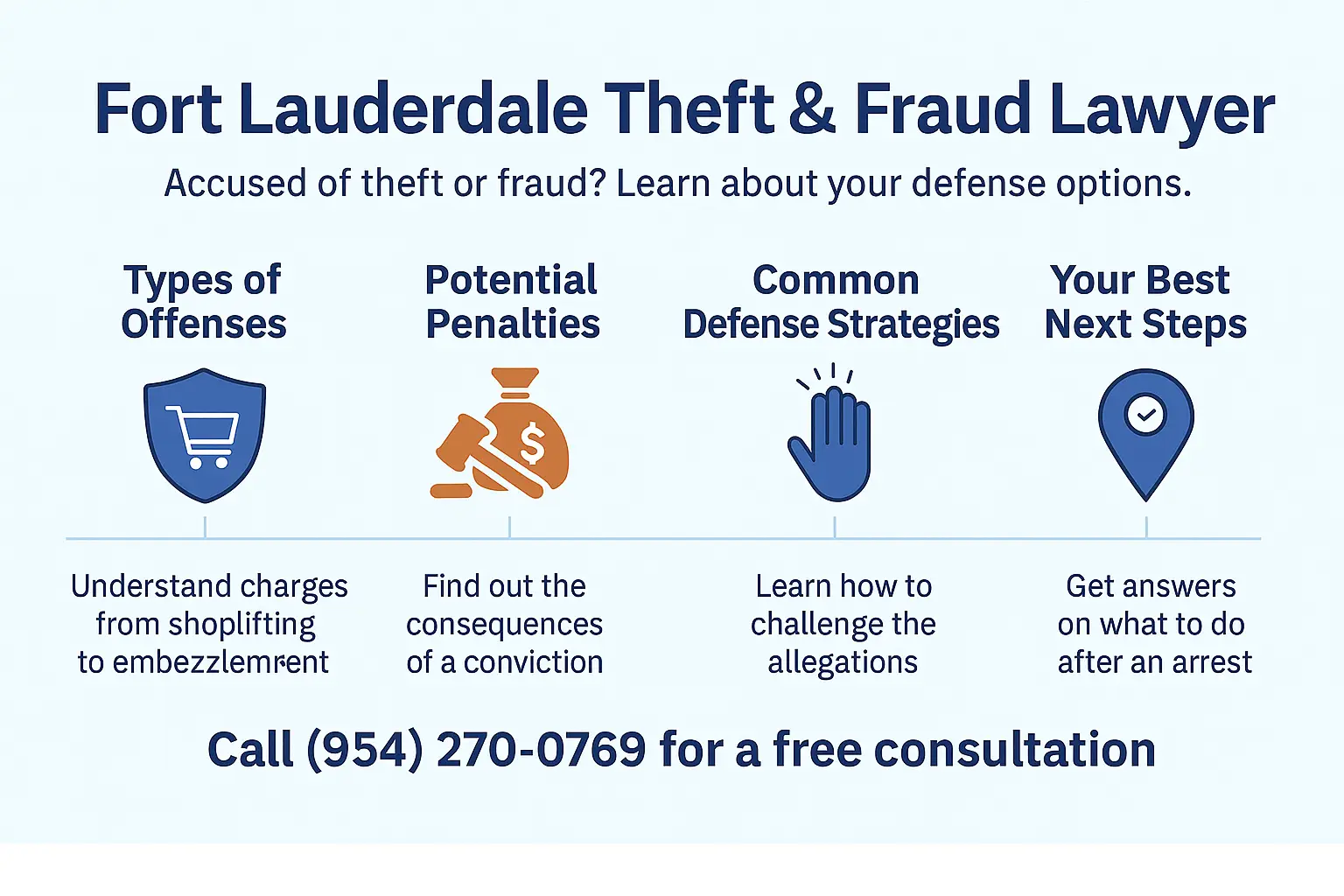
If you’re accused of theft or fraud in Fort Lauderdale, Hollywood, Plantation, Pembroke Pines, or anywhere in Broward County, the consequences can be severe — prison exposure, professional damage, and a permanent criminal record.
That’s where Michael White, P.A. steps in.
⚖️ Theft & Fraud Charges in Florida: What You Need to Know
Under Florida law, theft and fraud charges are built around intent, value, and conduct — not just accusations.
For example, Florida Statute § 812.014 defines theft as knowingly obtaining or using another person’s property with the intent to deprive them of it, permanently or temporarily. Fraud statutes focus on deception, misrepresentation, and financial gain.
Prosecutors evaluate factors such as:
💰 The value of the alleged loss
📜 Your prior criminal history
🔫 Whether the property is specially protected (firearms, vehicles, controlled substances, emergency equipment)
🏪 Whether the allegation involves a business, employer, or financial institution
Possible penalties can include:
State prison sentences (up to 30 years in first-degree felony cases)
Substantial fines and restitution
Probation or community control
Long-term consequences for employment, licensing, housing, and immigration
To understand how these offenses are defined and grouped under Florida law, start here:
🔑 Theft Charges in Florida: Felony vs. Misdemeanor
One of the most common — and most misunderstood — questions is whether a theft charge is a misdemeanor or a felony.
In many cases, the distinction turns on value, but not always.
When Theft Is a Misdemeanor
Theft is typically charged as petit theft when the property involved is valued under $750 and does not fall into a specially protected category. Petit theft is usually a misdemeanor, though repeat offenses can still carry jail time and permanent records.
When Theft Becomes a Felony
Theft becomes grand theft — a felony — when:
The value of the property is $750 or more, or
The item is specially protected under Florida law, regardless of value
Examples include firearms, motor vehicles, controlled substances, emergency equipment, and certain government or infrastructure property.
Because valuation and item classification are frequently disputed, many felony theft arrests are defensible — or reducible — with early legal intervention.
For a side-by-side breakdown, see:
📦 Grand Theft in Florida: Degrees and Exposure
Florida divides grand theft into three felony degrees, based primarily on value:
Third-Degree Grand Theft – $750 to $19,999, or protected items
Second-Degree Grand Theft – $20,000 to $99,999
First-Degree Grand Theft – $100,000+, or certain aggravated circumstances
Some categories — such as firearm theft or motor-vehicle theft — automatically trigger felony treatment regardless of value.
For a full breakdown of felony levels and sentencing exposure, see:
👉 Grand Theft Felony Penalties in Florida
🧭 Can Theft or Fraud Charges Be Dropped or Reduced?
Not every theft or fraud case should proceed to trial — or even survive filing.
Depending on the evidence, many cases are resolved through dismissal, reduction, or diversion when:
Intent cannot be proven
Value is inflated or unsupported
Ownership or permission is disputed
Evidence was obtained unlawfully
The defendant qualifies for pretrial intervention
Learn more about outcome-focused strategies here:
🧭 Charged or Under Investigation? What to Do Next
Early defense strategies often include:
Challenging whether you intended to steal or deceive
Disputing ownership, authorization, or misunderstanding
Contesting valuation methods used by loss-prevention or auditors
Examining surveillance footage, transaction logs, and digital records
Filing motions to suppress unlawfully obtained evidence
Exploring Pretrial Intervention (PTI) for eligible first-time offenders
Many cases are won — or stopped entirely — before formal charges ever stick.
🕵️♂️ Broward-Specific Insights Most People Don’t Know
Broward County has one of Florida’s most aggressive retail-theft units
Loss-prevention reports often exaggerate value or intent
Video evidence frequently contradicts written affidavits
Early contact with the State Attorney’s Office can prevent filing
As a former Broward prosecutor, Michael White understands how these cases are built — and where they break.
📞 Call a Fort Lauderdale Theft & Fraud Lawyer Today
You don’t have to face theft or fraud charges alone.
At Michael White, P.A., we move fast to protect your freedom, reputation, and future — using insider knowledge of how prosecutors evaluate, charge, and negotiate these cases.
📍 Serving Fort Lauderdale, Hollywood, Plantation, Pembroke Pines, and all of Broward County
📞 Call (954) 270-0769 or schedule your confidential case review online