
Last updated April 2026
Manslaughter is one of the most serious homicide charges under Florida law. It is often filed when prosecutors believe a death was caused unlawfully, but they cannot prove premeditation or intent required for murder. A conviction can carry years — or decades — in prison and lifelong consequences.
But manslaughter cases are also frequently overcharged. These cases often turn on intent, causation, medical evidence, and whether the death was truly criminal rather than accidental or justified.
This page explains how manslaughter charges work in Florida, what the State must prove, and how early, strategic defense can change the outcome.
📜 What Is Manslaughter Under Florida Law?
Under Florida Statute § 782.07, manslaughter is defined as the unlawful killing of another human being without premeditation. Unlike murder, manslaughter does not require an intent to kill.
Manslaughter is one category of homicide under Florida law. For a broader explanation of how Florida classifies homicide charges, see our overview of Florida Homicide Charges.
Florida manslaughter charges generally fall into two categories:
🔹 Voluntary Manslaughter
An intentional act that results in death, committed during a sudden quarrel or in the “heat of passion,” but without premeditation.
🔹 Involuntary Manslaughter (Culpable Negligence)
An unintentional killing caused by reckless or grossly negligent conduct that shows a disregard for human life.
In both cases, the focus is not simply that a death occurred — but how it occurred and whether the conduct was criminal.
🔍 Manslaughter vs. Murder in Florida
The key distinction between manslaughter and murder is intent.
Murder requires intent, premeditation, or conduct showing a depraved mind with no regard for human life.
Manslaughter involves unlawful killing without premeditation, often based on recklessness, negligence, or provocation.
Prosecutors frequently begin homicide cases with the most serious charge possible and later reduce or amend charges as evidence develops. Early defense intervention can influence this decision-making process.
For a deeper breakdown of how Florida distinguishes between different types of murder charges, see our guides to First-Degree Murder and Second-Degree Murder in Florida.
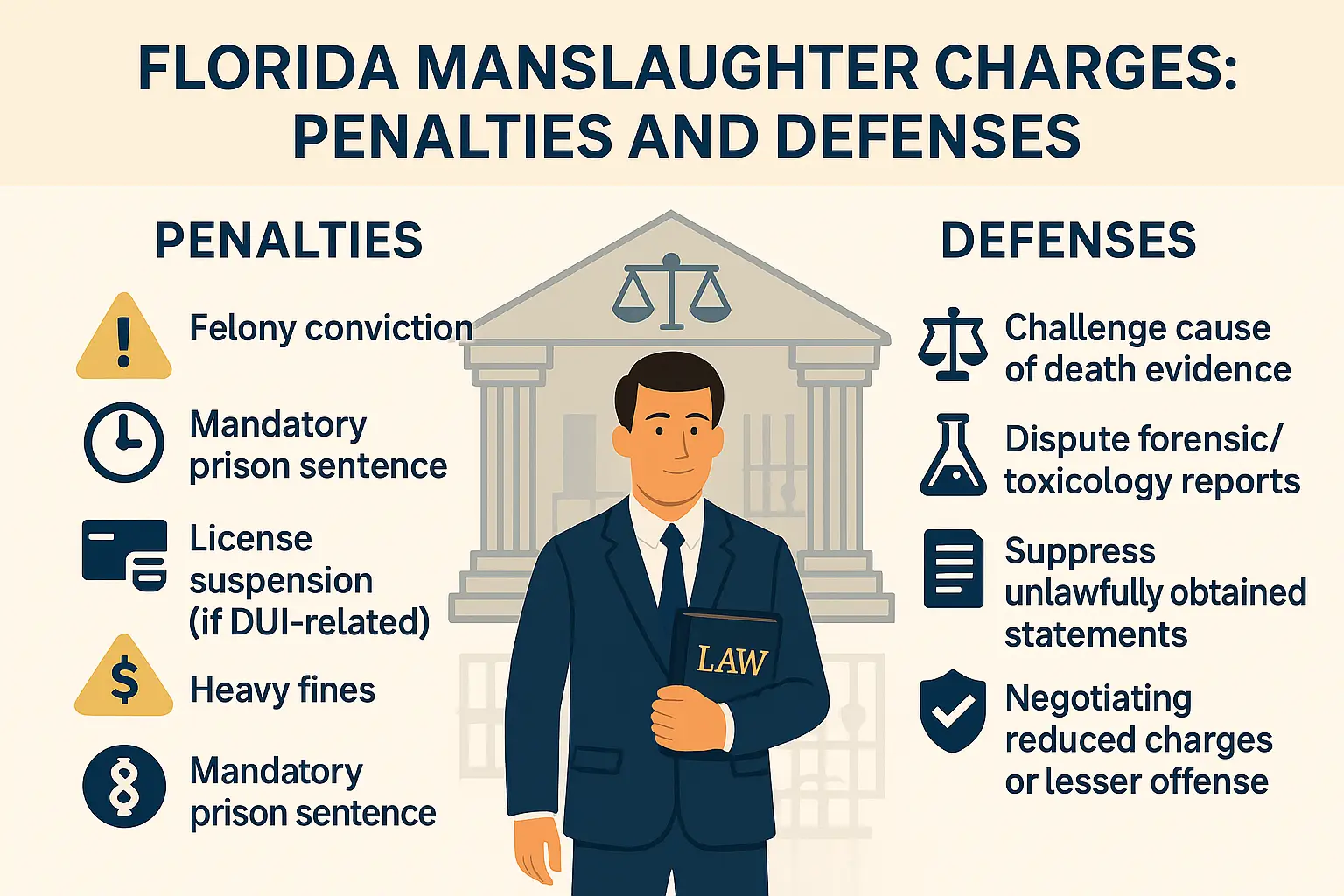
⚖️ Penalties for Manslaughter in Florida
Manslaughter is typically charged as a second-degree felony, punishable by:
Up to 15 years in prison
Up to 15 years of probation
Up to $10,000 in fines
🔺 Enhanced Penalties
Penalties may increase if aggravating factors are alleged, such as:
The victim was a child, elderly, disabled, or law enforcement officer
A firearm or deadly weapon was involved
Sentencing guideline scores produce prison recommendations
While the statutory maximum is severe, not all manslaughter cases result in maximum sentences. Sentencing depends on Florida’s Criminal Punishment Code, prior record, and the strength of mitigation.
🧾 Manslaughter vs. Vehicular and DUI Manslaughter
Not all homicide-related charges fall under § 782.07.
Vehicular homicide involves reckless operation of a motor vehicle and is charged under a separate statute.
DUI manslaughter applies when a death results from driving under the influence and carries mandatory minimum prison exposure.
These are distinct offenses with different elements and defenses. Manslaughter charges should not be confused with DUI or vehicular homicide cases.
In cases involving vulnerable victims, Florida law may instead apply aggravated manslaughter charges, which carry enhanced penalties.
🔍 What Prosecutors Must Prove in a Manslaughter Case
To secure a manslaughter conviction, the State must prove beyond a reasonable doubt that:
A death occurred
The defendant’s act or negligence caused the death
The killing was neither excusable nor justified
Each element is heavily litigated. The absence of intent, intervening medical causes, or evidence of lawful conduct can defeat the charge.
🩺 Medical Causation and Forensic Challenges
Manslaughter cases often hinge on medical and forensic evidence. Prosecutors must prove that the defendant’s conduct — not another cause — resulted in death.
Defense strategies frequently involve:
Challenging cause of death determinations
Identifying intervening medical events
Highlighting inconsistencies between police reports and clinical findings
Using forensic pathologists or medical experts to dispute conclusions
Causation is one of the most common weak points in manslaughter prosecutions.
🛡️ Common Defenses to Manslaughter Charges
Effective manslaughter defenses depend on facts, but often include:
✔ Lack of Criminal Intent
Accidents, ordinary negligence, or lawful conduct do not meet the standard for culpable negligence.
✔ Accident or Misadventure
Not every tragic outcome is criminal. The defense may show the death resulted from an unforeseeable or unavoidable accident.
✔ Self-Defense or Justifiable Use of Force
If the death occurred while lawfully defending oneself or others, the charge may be barred under Florida’s self-defense laws.
✔ Lack of Causation
The State must prove the defendant’s conduct actually caused the death — not another factor.
✔ Constitutional Violations
Illegal searches, unlawful interrogations, or Miranda violations can result in suppression of key evidence.
⚖️ Early Intervention in Florida Manslaughter Cases
Manslaughter cases are often reviewed by specialized homicide or major crimes units. Early defense involvement can affect:
Charging decisions
Whether enhancements are applied
Pretrial detention and bond
Preservation of surveillance, body-cam, and forensic evidence
In many cases, prosecutors reassess charges only after defense counsel presents evidence contradicting the initial narrative.
📍 Facing Manslaughter Charges in Florida?
A manslaughter accusation is life-altering — but it does not automatically mean conviction or maximum punishment. It is treated as one of the most serious violent offenses in Florida.
Learn more about how an experienced violent crimes defense attorney approaches homicide cases and early defense strategy.
With experienced representation, charges may be reduced, dismissed, or resolved without catastrophic outcomes.
📞 Call (954) 270-0769 or request a confidential consultation today.
❓ Frequently Asked Questions
Is manslaughter a felony in Florida?
Yes. Manslaughter is generally charged as a second-degree felony punishable by up to 15 years in prison.
Does manslaughter require intent to kill?
No. Manslaughter does not require intent to kill. It may be based on reckless conduct, culpable negligence, or an intentional act without premeditation.
Can manslaughter charges be reduced or dismissed?
Yes. Strong challenges to causation, intent, medical evidence, or legality of the investigation can lead to reductions or dismissal.
Can self-defense apply in manslaughter cases?
Yes. If the death occurred during lawful self-defense, the charge may be barred under Florida law.
Will a manslaughter conviction stay on my record forever?
A conviction cannot be sealed or expunged. Outcomes early in the case often determine long-term record consequences.