
Last updated April 2026
Understanding Aggravated Manslaughter Charges in Florida
Aggravated manslaughter is a serious felony under Florida law that applies when a person’s reckless or negligent conduct results in the death of a particularly vulnerable victim, such as a child, an elderly person, or a disabled adult.
These cases are prosecuted aggressively because the alleged victims are considered especially vulnerable under the law. Convictions can result in lengthy prison sentences and permanent felony records.
For a broader overview of homicide-related offenses under Florida law, see our guide to Florida Homicide Charges.
Florida Law on Aggravated Manslaughter
Aggravated manslaughter is defined under Florida Statute § 782.07.
Under Florida law, aggravated manslaughter typically occurs when a person’s culpable negligence causes the death of:
• a child
• an elderly person
• a disabled adult
“Culpable negligence” generally refers to conduct that shows reckless disregard for human life or the safety of others.
Unlike murder charges, aggravated manslaughter does not require proof that the defendant intended to cause death. Instead, prosecutors must show that the defendant’s conduct was so careless or reckless that it resulted in a fatal outcome.
Types of Aggravated Manslaughter in Florida
Florida law recognizes several forms of aggravated manslaughter depending on the victim involved.
Aggravated Manslaughter of a Child
This charge may arise when a person’s reckless conduct causes the death of a child under the age of 18.
These cases sometimes involve allegations of child neglect, unsafe living conditions, or dangerous conduct involving minors.
Aggravated Manslaughter of an Elderly Person
Florida law also provides enhanced penalties when a person’s culpable negligence causes the death of an elderly victim.
The statute recognizes that elderly individuals may be more vulnerable to harm due to age or health conditions.
Aggravated Manslaughter of a Disabled Adult
Similar protections apply when a disabled adult dies as a result of another person’s reckless or negligent conduct.
These cases sometimes involve allegations related to caretakers, guardians, or individuals responsible for the care of vulnerable adults.
What Prosecutors Must Prove
To obtain a conviction for aggravated manslaughter, prosecutors must prove several elements beyond a reasonable doubt.
Generally, the State must establish that:
• the victim is deceased
• the defendant’s conduct caused the death
• the conduct amounted to culpable negligence
• the victim was a child, elderly person, or disabled adult
Because these cases often involve complicated factual circumstances, disputes frequently arise about causation and the level of negligence involved.
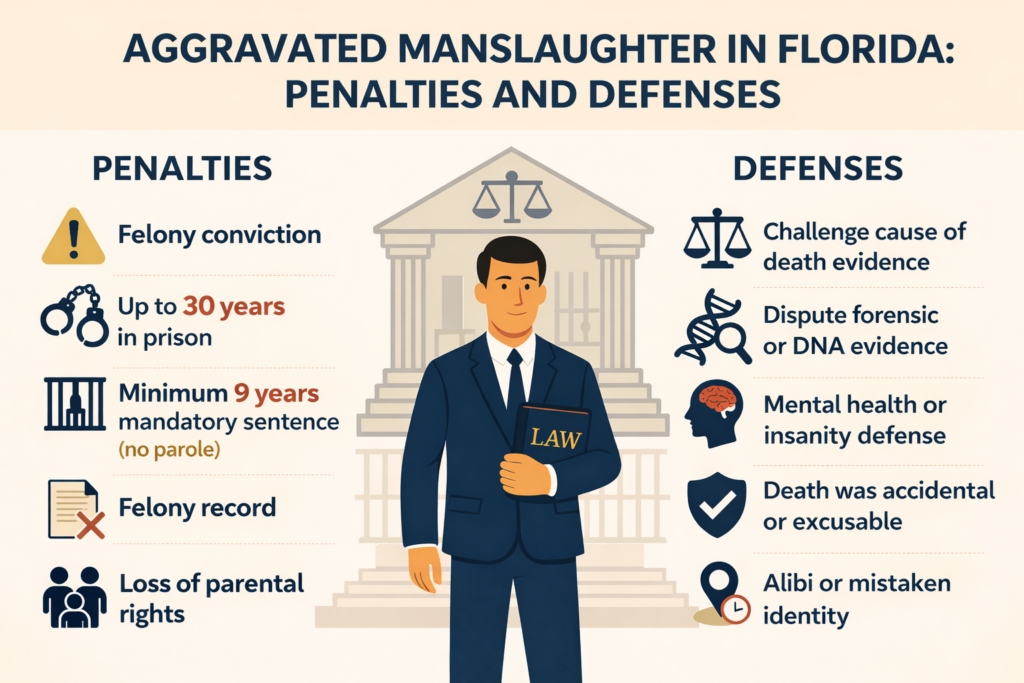
Penalties for Aggravated Manslaughter in Florida
Aggravated manslaughter is typically prosecuted as a first-degree felony under Florida law.
Possible penalties include:
Up to 30 Years in Prison
A conviction may result in a sentence of up to 30 years in state prison.
Probation and Fines
Courts may impose probation, fines, and other penalties depending on the circumstances of the case.
Permanent Felony Record
A conviction results in a permanent criminal record that cannot be sealed or expunged under Florida law.
Aggravated Manslaughter vs Murder
Aggravated manslaughter differs significantly from murder charges.
For a broader explanation of how standard manslaughter charges are defined and prosecuted, see our guide to Manslaughter Charges in Florida.
Murder charges generally require proof that the defendant either intended to cause death or engaged in conduct demonstrating extreme disregard for human life.
Aggravated manslaughter focuses instead on culpable negligence resulting in the death of a vulnerable victim.
For example, you can learn more about homicide offenses involving intent to kill in our guide to Second-Degree Murder in Florida.
Common Defense Strategies in Aggravated Manslaughter Cases
Each homicide case depends on the unique facts and evidence involved. However, several defense strategies commonly arise in aggravated manslaughter prosecutions.
Self-Defense and Stand Your Ground
Florida law recognizes the right to use force — including deadly force — in certain circumstances when a person reasonably believes it is necessary to prevent death, great bodily harm, or the commission of a forcible felony.
Under Florida’s Stand Your Ground law, a person who is lawfully present in a location may not have a duty to retreat before using defensive force if the legal requirements are met.
In homicide and attempted homicide cases, a successful self-defense argument may completely justify the use of force and result in the dismissal of charges.
Learn more about these legal protections in our guide to Self-Defense and Stand Your Ground in Florida.
Challenging Culpable Negligence
The defense may argue that the defendant’s conduct does not meet the legal standard of culpable negligence required under Florida law.
Disputing Causation
In some cases, the defense may argue that the alleged conduct did not actually cause the victim’s death.
Medical evidence and expert testimony may play a critical role in these cases.
Causation disputes are also common in fatal crash cases, where multiple factors may contribute to a death. For more, see Vehicular Homicide in Florida.
Challenging Evidence or Witness Testimony
As with other serious felony prosecutions, the defense may challenge the reliability of witness testimony, forensic evidence, or investigative conclusions.
Mistaken Identity or Lack of Responsibility
In certain cases, the defense may argue that the accused person was not responsible for the conduct that allegedly caused the death.
Why Early Legal Representation Matters
Aggravated manslaughter investigations often involve complex evidence, including medical records, forensic reports, and witness statements.
Early legal representation can help protect constitutional rights and ensure that important evidence is preserved during the investigation.
Individuals facing homicide-related allegations should seek experienced legal counsel as soon as possible.
FREQUENTLY ASKED QUESTIONS ABOUT AGGRAVATED MANSLAUGHTER IN FLORIDA
What is aggravated manslaughter in Florida?
Aggravated manslaughter occurs when a person’s culpable negligence causes the death of a vulnerable victim such as a child, elderly person, or disabled adult.
What is the penalty for aggravated manslaughter in Florida?
Aggravated manslaughter is typically a first-degree felony punishable by up to 30 years in prison.
What does culpable negligence mean?
Culpable negligence refers to conduct that shows reckless disregard for human life or the safety of others.
What is the difference between manslaughter and aggravated manslaughter?
Aggravated manslaughter involves the death of a vulnerable victim such as a child, elderly person, or disabled adult, which results in enhanced penalties.
Can aggravated manslaughter charges be reduced?
Depending on the evidence, aggravated manslaughter charges may sometimes be reduced if prosecutors cannot prove culpable negligence or causation.