
Last updated April 2026
Understanding First-Degree Murder Charges in Florida
First-degree murder is the most serious homicide offense under Florida law. A conviction can result in life imprisonment without parole or the death penalty, making it one of the highest-stakes criminal charges in the justice system.
Under Florida law, first-degree murder generally involves either premeditated killing or a death that occurs during the commission of certain dangerous felonies.
Prosecutors devote enormous resources to homicide investigations. Cases often involve forensic analysis, witness testimony, digital evidence, and extensive investigative work by law enforcement.
Because the penalties are so severe, the defense strategy in a murder case must be carefully developed from the earliest stages of the investigation.
For a broader overview of homicide charges, see our guide to Homicide Charges in Florida.
Florida Law on First-Degree Murder
First-degree murder is defined under Florida Statute §782.04.
The law recognizes two primary categories of first-degree murder:
Premeditated Murder
Premeditated murder occurs when a person intentionally kills another person after forming a conscious plan or design to kill.
Premeditation does not require weeks or months of planning. Under Florida law, it can occur in a relatively short period of time if prosecutors can show that the defendant formed the intent to kill before the act occurred.
Evidence prosecutors often rely on to prove premeditation includes:
• prior threats
• planning behavior
• weapon acquisition
• statements made before the killing
• actions showing deliberation
However, proving premeditation beyond a reasonable doubt can be complex, and the defense often focuses heavily on challenging this element.
Felony Murder
Florida also recognizes the felony murder rule, which allows prosecutors to charge first-degree murder when a death occurs during certain dangerous felonies.
In these situations, the prosecution does not necessarily need to prove the defendant intended to kill anyone.
Instead, the focus is on whether the death occurred during the commission or attempted commission of a qualifying felony.
Common felonies associated with felony murder charges include:
• robbery
• burglary
• kidnapping
• sexual battery
• arson
• drug trafficking
• carjacking
Even individuals who did not personally cause the death may face murder charges if they were participating in the underlying felony.
You can learn more about this doctrine in our guide to the Felony Murder Rule in Florida.
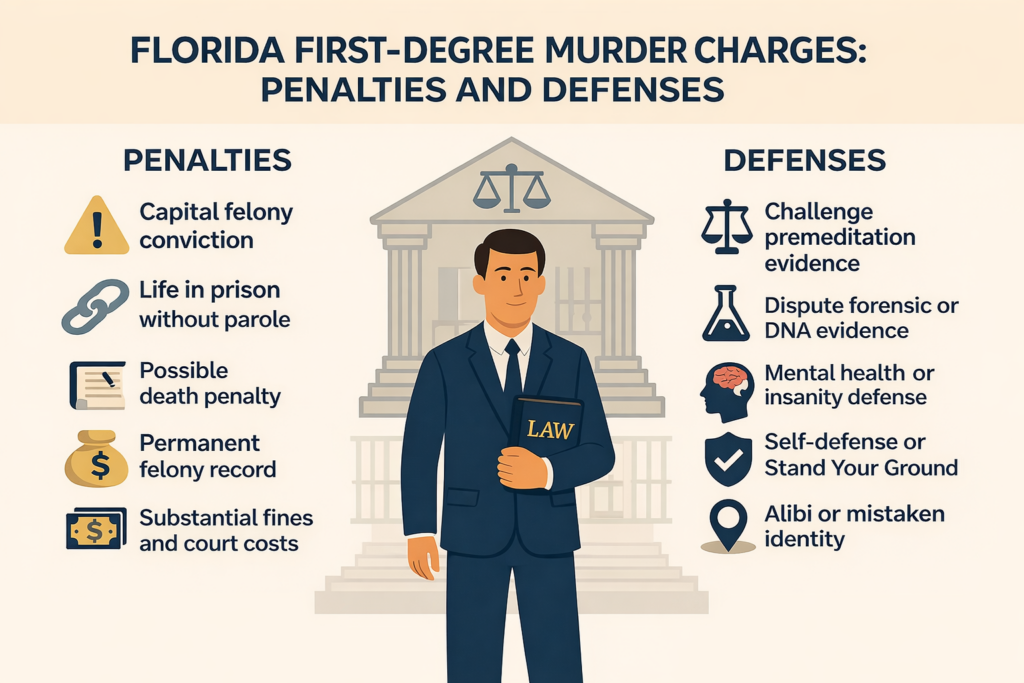
Penalties for First-Degree Murder in Florida
First-degree murder is classified as a capital felony under Florida law.
Possible penalties include:
Life Imprisonment Without Parole
In many cases, a conviction results in life imprisonment without the possibility of parole.
This means the defendant will spend the remainder of their life in state prison.
Death Penalty
Florida law allows the death penalty in certain first-degree murder cases if specific aggravating factors are present and a jury recommends the sentence.
Capital sentencing proceedings are complex and involve a separate penalty phase after a conviction.
Permanent Felony Record
A murder conviction results in a permanent criminal record that cannot be sealed or expunged.
How Prosecutors Attempt to Prove First-Degree Murder
To obtain a conviction, prosecutors must prove every element of the offense beyond a reasonable doubt.
In premeditated murder cases, the prosecution must establish:
• the victim is deceased
• the death was caused by the defendant
• the killing was intentional
• the act was premeditated
Evidence used in murder prosecutions may include:
• forensic evidence
• medical examiner testimony
• digital or phone data
• surveillance footage
• eyewitness testimony
• statements made by the accused
Because homicide cases often rely heavily on circumstantial evidence, the defense frequently focuses on exposing weaknesses in the prosecution’s theory.
These same issues often arise in attempted murder cases, where prosecutors must prove intent to kill even when the victim survives.
Common Defense Strategies in First-Degree Murder Cases
Every homicide case is unique, and the appropriate defense depends on the specific facts and evidence involved.
However, several strategies frequently arise in murder cases.
Challenging Premeditation
In many cases, the defense argues that prosecutors cannot prove the defendant formed a deliberate intent to kill.
If premeditation cannot be proven, the charge may be reduced to a lesser offense such as second-degree murder or manslaughter.
Self-Defense and Stand Your Ground
Florida law recognizes the right to use force — including deadly force — in certain circumstances when a person reasonably believes it is necessary to prevent death, great bodily harm, or the commission of a forcible felony.
Under Florida’s Stand Your Ground law, a person who is lawfully present in a location may not have a duty to retreat before using defensive force if the legal requirements are met.
In homicide and attempted homicide cases, a successful self-defense argument may completely justify the use of force and result in the dismissal of charges.
Learn more about these legal protections in our guide to Self-Defense and Stand Your Ground in Florida.
Challenging Forensic Evidence
Homicide cases frequently rely on forensic analysis such as DNA testing, ballistics, or blood-pattern interpretation.
Defense attorneys often consult independent experts to evaluate whether forensic conclusions are scientifically reliable.
Mistaken Identity or Alibi
In some cases, the defense may present evidence that the accused was not present at the scene of the crime.
Witness misidentification and unreliable testimony can play a significant role in wrongful convictions.
The Importance of Early Legal Representation
First-degree murder investigations often begin long before charges are formally filed.
Early involvement by a defense attorney can be critical to:
• protecting constitutional rights
• challenging unlawful searches or interrogations
• preserving favorable evidence
• developing a strategic defense
Individuals under investigation for homicide should seek legal counsel immediately.
Frequently Asked Questions About First-Degree Murder in Florida
What is first-degree murder in Florida?
First-degree murder typically involves a premeditated killing or a death that occurs during the commission of certain dangerous felonies.
What is the penalty for first-degree murder in Florida?
A conviction can result in life imprisonment without parole or the death penalty, depending on the circumstances of the case.
What is the felony murder rule?
The felony murder rule allows prosecutors to charge murder when a death occurs during certain serious felonies, even if the defendant did not intend to kill anyone.
Can first-degree murder charges be reduced?
Yes. Depending on the evidence, a charge may be reduced to second-degree murder or manslaughter if prosecutors cannot prove premeditation.
What defenses exist for first-degree murder?
Possible defenses include self-defense, lack of premeditation, mistaken identity, or challenges to forensic evidence.