
Last updated April 2026
What Is the Felony Murder Rule in Florida?
The felony murder rule allows prosecutors to charge someone with murder when a death occurs during the commission of certain serious felonies—even if the defendant did not intend to kill anyone.
Under Florida law, a person participating in a dangerous felony can be held legally responsible for a death that occurs during that crime. In some cases, individuals who did not personally cause the death may still face a murder charge if prosecutors believe they were involved in the underlying felony.
This rule can significantly increase the potential penalties in a criminal case and often becomes a central issue in homicide prosecutions.
For a broader overview of homicide offenses, see our guide to Florida homicide charges.
Florida Law on Felony Murder
Florida recognizes felony murder under Florida Statute §782.04. Felony murder is one of the ways prosecutors may pursue
First-Degree Murder Charges in Florida.
The law allows prosecutors to charge murder when a death occurs during the commission or attempted commission of certain dangerous felonies.
These cases do not require proof that the defendant intended to kill someone. Instead, the prosecution focuses on whether the death occurred while the defendant was participating in a qualifying felony.
Felonies That Can Trigger the Felony Murder Rule
A felony murder charge may arise when a death occurs during crimes such as:
• robbery
• burglary
• kidnapping
• carjacking
• sexual battery
• arson
• drug trafficking
• aggravated child abuse
Even if another participant—or in some situations a victim or police officer—caused the death, participants in the underlying felony may still face murder charges.
First-Degree vs Second-Degree Felony Murder
Florida law distinguishes between first-degree felony murder and second-degree felony murder depending on the circumstances.
First-Degree Felony Murder
A person may be charged with first-degree murder if a death occurs during certain specified felonies.
This is considered a capital felony and carries the most severe penalties under Florida law.
Second-Degree Felony Murder
Second-degree felony murder generally applies when a death occurs during a felony committed by someone other than the defendant, but the defendant was still participating in the criminal activity.
Although it is a lesser charge than first-degree murder, it still carries severe penalties. For a broader explanation of how second-degree murder is defined under Florida law, see our guide to Second-Degree Murder in Florida.
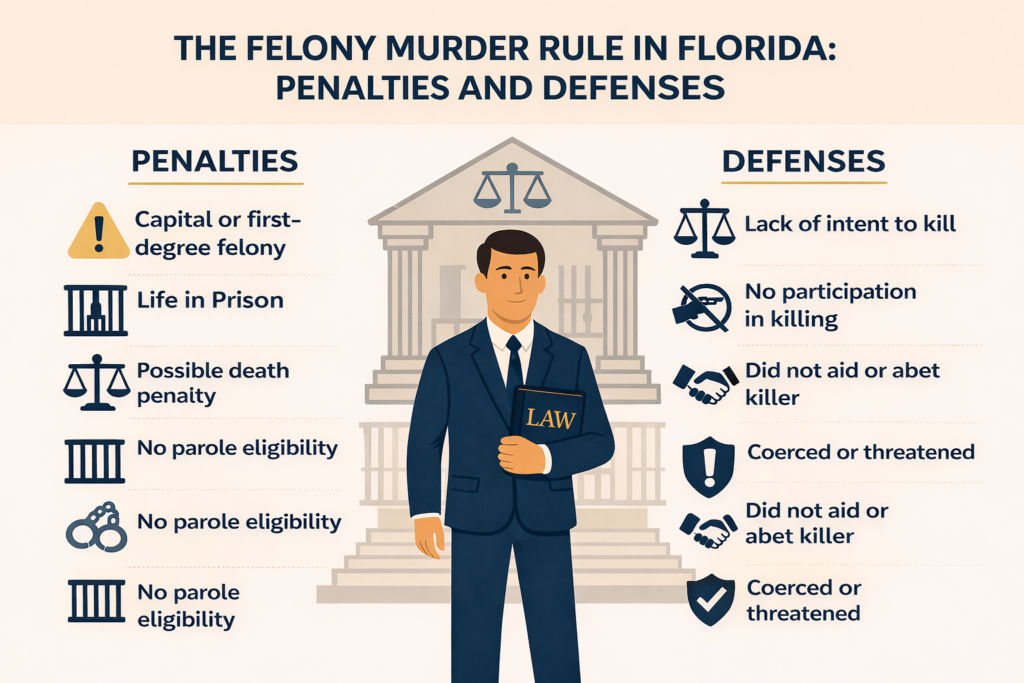
Penalties for Felony Murder in Florida
Because felony murder is often charged as first-degree murder, the penalties can be extremely severe.
Possible consequences include:
Life in Prison Without Parole
Many felony murder convictions result in life imprisonment without the possibility of parole.
Death Penalty
In certain cases involving aggravating circumstances, prosecutors may seek the death penalty.
Permanent Felony Record
A conviction results in a permanent criminal record and cannot be sealed or expunged.
In some cases, the facts of the incident may support lesser homicide charges such as Manslaughter.
Common Defense Strategies in Felony Murder Cases
Felony murder cases are often complex and fact-intensive. The defense strategy typically focuses on challenging the prosecution’s theory of participation in the underlying felony.
Common defenses may include:
Lack of Participation in the Felony
If the defendant was not actively involved in the underlying felony, prosecutors may not be able to prove felony murder liability.
Withdrawal From the Crime
In some situations, a defendant may argue they withdrew from the criminal activity before the death occurred.
Challenging the Cause of Death
The defense may dispute whether the death actually resulted from the felony or whether another independent event caused it.
Constitutional Violations
Illegal searches, unlawful interrogations, or improperly obtained evidence may also become key issues in homicide prosecutions.
Why Felony Murder Charges Are Often Contested
Felony murder cases frequently involve complicated factual questions about:
• who participated in the felony
• when the death occurred
• whether the felony directly caused the death
• whether the defendant had withdrawn from the crime
Because these cases can involve multiple participants and conflicting evidence, the prosecution must still prove every element beyond a reasonable doubt.
Frequently Asked Questions About the Felony Murder Rule in Florida
What is the felony murder rule in Florida?
The felony murder rule allows prosecutors to charge murder when a death occurs during certain dangerous felonies, even if the defendant did not intend to kill anyone.
Can someone be charged with felony murder if they didn’t cause the death?
Yes. Participants in the underlying felony may still face murder charges even if another person caused the death.
What crimes can lead to felony murder charges?
Crimes such as robbery, burglary, kidnapping, sexual battery, and arson can trigger felony murder liability if a death occurs during the crime.
What is the penalty for felony murder in Florida?
Felony murder is often prosecuted as first-degree murder and may result in life imprisonment without parole or, in some cases, the death penalty.
Can felony murder charges be reduced?
Depending on the circumstances, felony murder charges may be challenged or reduced if prosecutors cannot prove participation in the underlying felony.