
Last updated April 2026
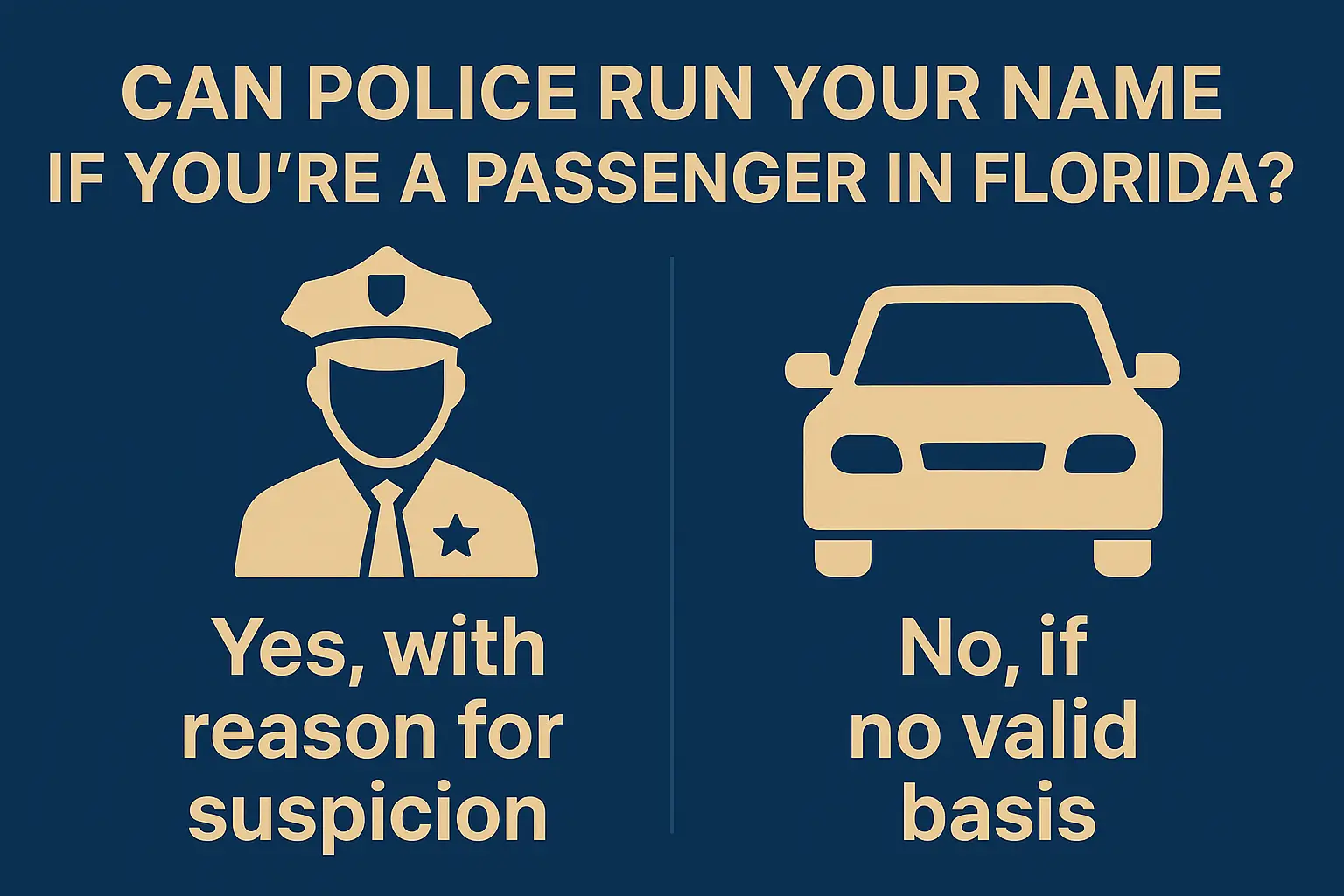
If you’re riding as a passenger during a traffic stop in Fort Lauderdale or anywhere in Broward County, you might wonder: “Can the police run my name even though I’m not the driver?”
For a broader overview of how these encounters can lead to resisting or obstruction charges, see our guide to <a Resisting Arrest & Obstruction Charges in Florida.
Many people assume passengers must hand over ID or submit to background checks during a stop. But under Florida law, officers can’t automatically demand identification—or run your name—without a lawful basis. Understanding these limits can protect you from unnecessary detentions, searches, or arrest situations based on unrelated warrants.
Here’s what the law really says.
⚖️ When Police Can Run a Passenger’s Name
Officers may legally run your name as a passenger only when:
-
They have independent reasonable suspicion that you committed a crime
-
They are issuing you a civil citation
-
They are conducting a lawful investigation involving you
-
You voluntarily provide ID during a consensual encounter
For a broader explanation of identification rules, see Do You Have to Show ID in Florida If You’re Not Driving?.
Passengers are not automatically detained during a traffic stop. The detention applies to the driver—unless the officer develops additional suspicion tied specifically to the passenger.
This distinction is often misunderstood, even by law enforcement.
A critical part of this analysis is that the officer must have a lawful basis to extend the stop or investigate the passenger. Without individualized suspicion, running a passenger’s name may violate the Fourth Amendment.
🚫 When Police Cannot Run Your Name
In most situations, officers cannot:
-
Demand your ID simply because you’re a passenger (See also Refusing to Show ID in Florida)
-
Run your name to “see if you have warrants”
-
Extend the stop beyond the time needed for the driver’s citation
-
Detain you solely because you choose not to provide ID
If the officer lacks individualized suspicion toward the passenger, forcing an ID check or running a name through FCIC/NCIC may violate the Fourth Amendment.
In fact, unrelated warrant hunting is one of the most common overreaches during Florida traffic stops.
⚠️ When Passenger Encounters Become a Legal Issue
Not every interaction between a passenger and police leads to a lawful detention or investigation.
In many cases, the key issue is whether the officer developed independent reasonable suspicion specific to the passenger — not just the driver.
Situations that often fall into a gray area include:
- officers asking for ID without clearly stating you are detained
- passengers unsure whether they are free to leave
- hesitation or refusal to provide information
- encounters that escalate without clear justification
In these situations, what may appear to be noncompliance is often a misunderstanding about whether the passenger was legally required to cooperate.
These distinctions are often critical in determining whether an officer’s actions were lawful.
🚨 How a Simple Passenger Stop Can Escalate
When police escalate a passenger encounter beyond its lawful scope, it is often framed as obstruction — allegations that can be challenged if the officer lacked individualized suspicion or unlawfully extended the stop.
In practice, many of these cases turn on whether the officer can justify extending the stop beyond the driver’s citation — not simply whether a passenger refused to cooperate.
Learn how these charges are applied in Resisting Without Violence in Florida.
These situations often lead to:
-
Resistance/obstruction charges
-
Arrests on old warrants
-
Vehicle searches that may be illegal
If you believe your rights were violated, body-worn camera footage from BSO or local agencies usually reveals the truth.
📘 Florida Law: What Courts Have Said
Courts in Florida and around the country consistently hold:
-
Passengers are not required to identify themselves unless reasonable suspicion exists
-
Passengers are seized only for the duration of the stop, not beyond it
-
Running a passenger’s name for warrant checks requires a lawful purpose
An officer’s “curiosity” alone is never a lawful basis.
🛡️ Why Legal Representation Matters
If your name was run illegally, we can challenge:
-
The legality of the traffic stop
-
The extension of the stop
-
The basis for the ID request
-
Any evidence found after an unlawful detention
These cases often turn on seconds of bodycam footage and specific statements made by officers—details most people don’t even realize matter.
🚓 Charged After a Passenger ID Encounter? Get Help Now
If a simple traffic stop turned into a detention, warrant arrest, or criminal charge because an officer ran your name without lawful cause, you may have powerful defenses.
Contact Michael White, P.A. today and get a former prosecutor on your side.
❓ FAQs — Passenger ID & Name Checks in Florida
1. Do passengers have to show ID during a traffic stop in Florida?
No. Passengers are not required to show ID unless officers have independent reasonable suspicion or are issuing the passenger a citation.
2. Can police run a passenger’s name just to look for warrants?
No. A warrant check without legal basis is unlawful and may invalidate any later search or arrest.
3. Are passengers considered detained during a traffic stop?
Passengers are detained only for the duration of the stop—but this doesn’t give officers automatic authority to demand ID.
4. Can refusing ID as a passenger lead to arrest?
Not legally. Officers often threaten obstruction, but refusal alone doesn’t meet the statute for obstruction in Florida.
5. What should I do if an officer tries to run my name without cause?
Ask calmly, “Am I being detained, or am I free to go?” If you are not detained, you may decline to provide ID. If you believe the stop was unlawfully extended or your name was run without cause, document the encounter and contact a defense lawyer as soon as possible.