
Last updated April 2026
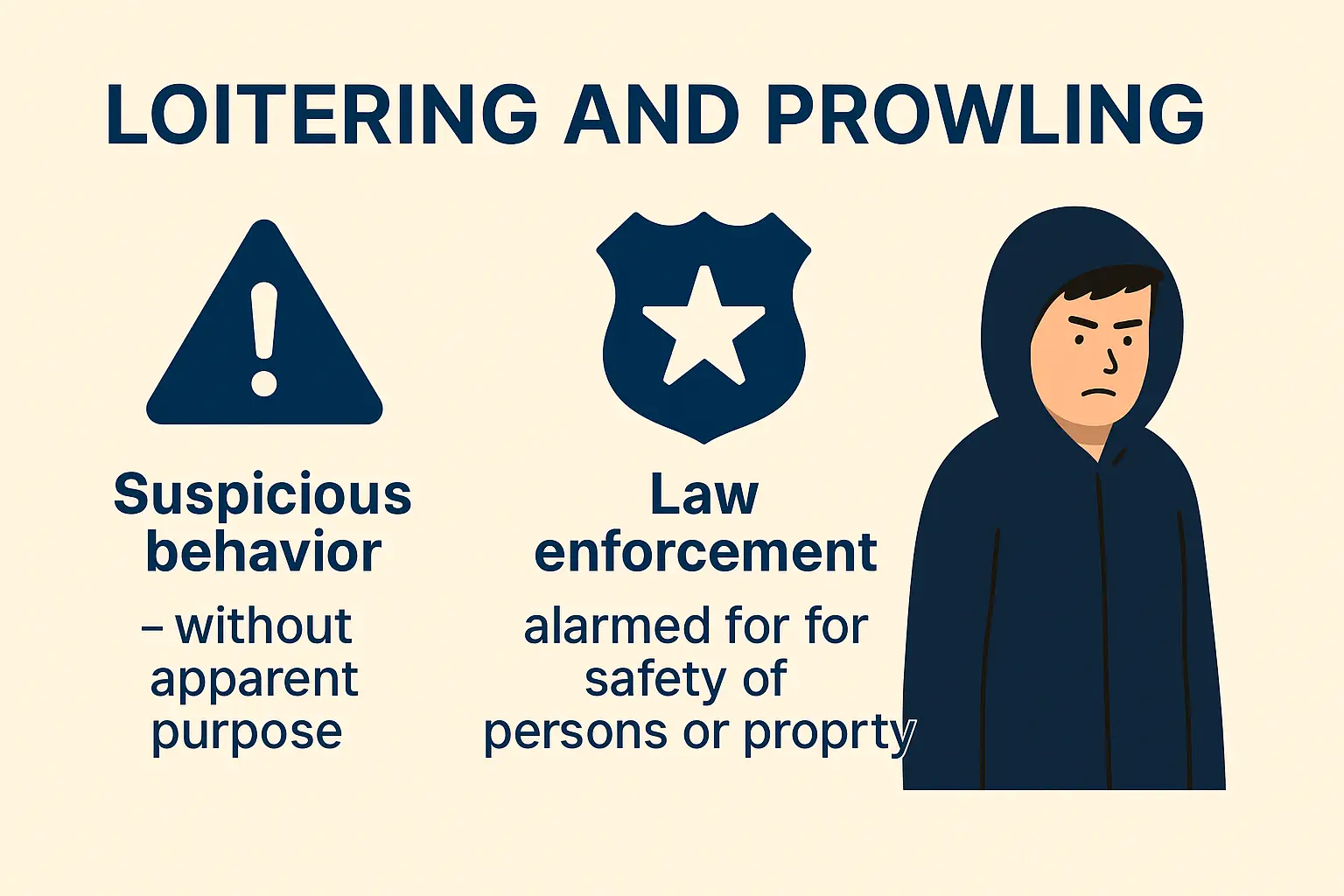
Loitering and prowling under Fla. Stat. § 856.021 is one of the most misused criminal charges in Florida.
Police often file it based solely on “suspicious behavior” — even when the person isn’t committing a crime.
The problem?
The statute has strict requirements, and many arrests fall apart when challenged. In Broward County, these cases are frequently dismissed once a defense attorney highlights gaps in the officer’s probable-cause narrative.
For a broader overview of related charges, see our guide to Disorderly Conduct & Public Order Offenses in Florida.
Here’s what Florida law actually requires — and how to fight a loitering & prowling charge.
⚖️ What Police Must Prove for Loitering & Prowling
To convict someone, prosecutors must prove two elements:
1️⃣ The behavior was unusual or suspicious
Examples officers cite include:
-
Walking around homes late at night
-
Standing near parked cars
-
Looking into windows
-
Hiding or acting evasively
-
Wearing dark clothing in low-light areas
BUT suspicious behavior is not enough.
2️⃣ The behavior caused immediate concern for public safety
The State must show the conduct posed:
-
A threat to persons or property,
-
That danger was imminent, and
-
A reasonable person would be alarmed.
Courts dismiss these cases routinely when officers only describe “odd” or “unusual” conduct without actual danger — the same evidentiary weakness we expose in motion to dismiss and probable-cause challenges.
Similar issues arise in Disorderly Conduct in Florida, where behavior alone is often mistaken for criminal conduct.
⚠️ When Does “Suspicious Behavior” Become a Crime?
Not every unusual or suspicious action is illegal.
In many cases, the key issue is whether the conduct created an imminent threat to people or property — not simply whether it appeared suspicious to an officer.
Situations that often fall into a gray area include:
- being present in a neighborhood at night
- walking slowly or changing direction
- waiting outside a residence or business
- avoiding interaction with police
- appearing nervous or evasive
In these situations, what police describe as “suspicious behavior” may not meet the legal standard required for a conviction.
These distinctions are often central to getting the charge dismissed.
🚨 Police Must Give You a Chance to Explain
Florida law requires officers to give a reasonable opportunity to identify yourself and explain your behavior before making an arrest.
If they don’t, the charge is usually defective.
This is very similar to the issues seen in:
-
Can police run your name if you’re a passenger?
-
ID-refusal posts
-
Unlawful seizure and investigative-stop cases
Failure to provide an opportunity to dispel alarm is one of the strongest defenses.
🛑 Common Scenarios in South Florida
Loitering & prowling arrests often occur when:
-
Someone is waiting outside an apartment
-
A person sits in a parked car for an extended period
-
A pedestrian walks through a neighborhood late at night
-
Police respond to vague “suspicious person” calls
-
Homeless individuals occupy public spaces
-
Minor trespass-like conduct is not supported by actual trespass law
In practice, these cases often turn on body camera footage — particularly whether the behavior created an actual threat or simply appeared unusual.
Many of these situations lack the imminent threat element entirely, making the charge extremely defendable.
In other cases, intoxication-related behavior may lead to separate charges. See Disorderly Intoxication in Florida.
🛡️ Defenses to Loitering & Prowling in Florida
At Michael White, P.A., we frequently challenge these cases using:
✔ No Imminent Threat
Police often describe behavior, not danger — a fatal flaw for the State.
✔ Failure to Allow Explanation
If officers didn’t ask questions, demand ID, or allow clarification before arrest, the charge is invalid.
✔ Lawful Purpose
Waiting for a ride, talking on your phone, or entering your own building is not a crime.
✔ Insufficient Evidence
Body-worn camera often shows calm, nonthreatening behavior.
✔ Illegal Detention
If the stop itself was unlawful, a motion to suppress may eliminate the case.
✔ Mistaken Identity
A common issue in neighborhood patrol cases — and a strong defense highlighted in your mistaken identity cluster.
🚨 Speak With a Fort Lauderdale Criminal Defense Lawyer Today
Loitering & prowling charges are often based on assumptions — not evidence.
If you were stopped or arrested for “suspicious behavior,” you may have a strong defense.
Contact Michael White, P.A. today to protect your record and challenge the State’s case.
❓ FAQs — Loitering & Prowling in Florida
1. Is loitering and prowling a crime in Florida?
Yes — it’s a second-degree misdemeanor under § 856.021.
2. Can police arrest me just for looking suspicious?
Not legally. Suspicion alone isn’t enough for probable cause.
3. Do police have to ask me questions first?
Yes. Officers must give you a chance to explain your behavior before arresting you.
4. Can this charge be dropped?
Often — especially when the State cannot prove imminent danger.
5. Can I be convicted without video evidence?
Yes, but bodycam often reveals inconsistencies that lead to dismissal.