
Last updated April 2026
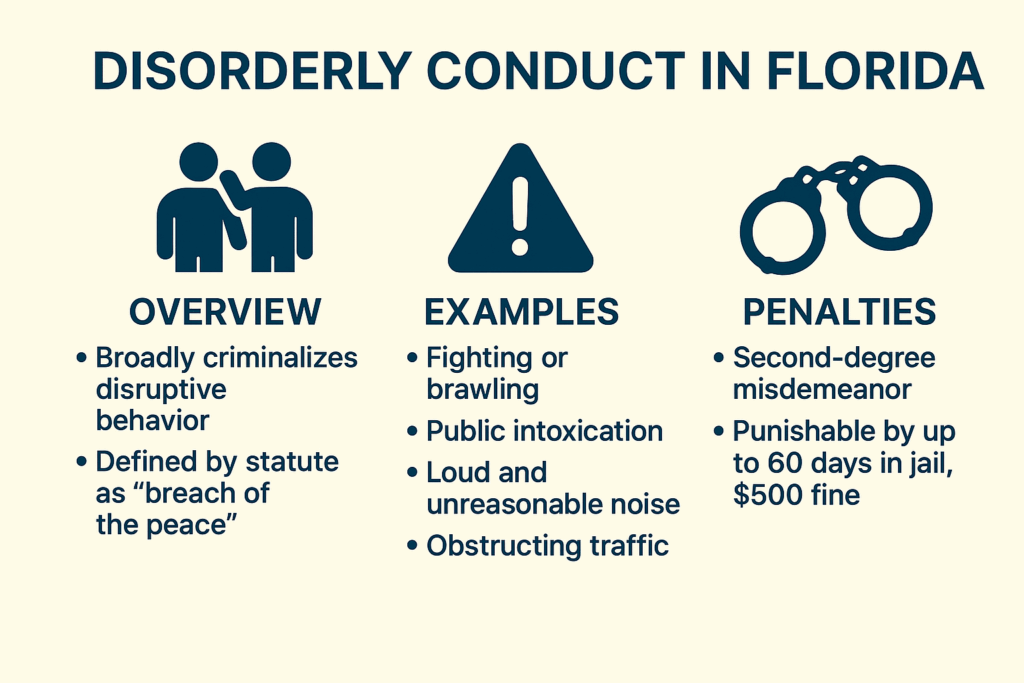
Florida’s disorderly conduct statute — also called breach of the peace — is one of the most overused charges in the state.
Under Fla. Stat. § 877.03, disorderly conduct occurs when someone:
-
Acts in a manner that corrupts public morals,
-
Outrages public decency, or
-
Creates a public disturbance or breach of the peace.
But the law is narrower than many officers think. Courts have repeatedly held that mere loudness, profanity, or rudeness is NOT a crime.
For a broader overview of related charges, see our guide to Disorderly Conduct & Public Order Offenses in Florida.
Here’s what the State must prove — and how we challenge these cases.
⚖️ What Actually Counts as Disorderly Conduct?
To convict someone of disorderly conduct, the State must show more than annoying or unpleasant behavior.
Qualifying conduct may include:
-
Fighting in public
-
Violent or threatening conduct
-
Behavior that causes crowds to gather
-
Creating a clear safety hazard
-
Obstructing traffic or emergency personnel
But courts have repeatedly thrown out cases where the conduct was simply:
-
Yelling
-
Swearing
-
Being disrespectful
-
Arguing with officers
-
Recording police activity
These protections mirror the First Amendment principles we rely on in motion-to-dismiss litigation and investigative-stop challenges.
⚠️ When Does Behavior Cross the Line?
Not every loud, offensive, or uncomfortable situation is a crime.
In many cases, the key issue is whether the behavior created a real public disturbance or safety risk — not simply whether it annoyed an officer or bystander.
Situations that often fall into a gray area include:
- loud arguments without threats or violence
- profanity directed at officers
- emotional or heated confrontations
- filming or questioning police
- intoxication without dangerous conduct
In these scenarios, what police interpret as disorderly conduct may actually be protected speech or non-criminal behavior.
These distinctions are often central to getting the charge dismissed.
🚫 Behavior That Is NOT Disorderly Conduct
Florida courts have held the following IS NOT enough:
-
Raising your voice
-
“Talking back” to an officer
-
Being intoxicated but not dangerous (see Disorderly Intoxication in Florida)
-
Filming police
-
Expressing anger or frustration
-
Loud or emotional speech
Police often misuse disorderly conduct as a catch-all charge to arrest someone they view as uncooperative — particularly when they cannot justify a lawful detention or another criminal offense.
Because disorderly conduct is frequently used to escalate police encounters, it often overlaps with obstruction and resisting allegations — especially when officers lack a lawful basis for detention.
🚓 Common Scenarios Leading to Disorderly Conduct Arrests
Most arrests come from:
-
Bar or nightlife districts
-
Beach and tourist areas
-
House parties
-
Public arguments
-
Protests or demonstrations
-
“Failure to obey” or “being loud” during police encounters
-
Crowd-control situations
Sometimes police arrest for disorderly conduct when they cannot justify another charge, which is why these cases are often dismissed early.
🛡️ Defenses to Disorderly Conduct in Florida
At Michael White, P.A., the strongest defenses include:
✔ First Amendment Protection
Speech — even loud or offensive speech — is protected unless it creates a clear danger.
✔ No Actual Breach of Peace
If no bystanders complained or no crowd formed, the charge fails.
✔ No Threatening Conduct
Disorderly conduct requires dangerous or publicly disruptive behavior.
✔ Illegal Detention / Arrest
If police escalated without reasonable suspicion, we challenge everything through a motion to suppress.
✔ Misuse of Catch-All Arrest Authority
Bodycam often shows behavior that does NOT meet the statutory standard — similar to Loitering and Prowling in Florida and other behavior-based offenses
✔ Inconsistent Officer Statements
Your victim credibility and inconsistent statements silos are especially useful here.
⚖️ Why Disorderly Conduct Charges Are Often Dropped
In Broward County and throughout Florida, disorderly conduct cases are frequently dismissed once prosecutors review the evidence.
In practice, these cases often turn on body camera footage — particularly whether the conduct created an actual disturbance or simply reflected protected speech.
These charges are often filed quickly during chaotic encounters — but they rarely hold up under scrutiny. After body-worn camera footage and witness accounts are examined, prosecutors commonly see that the alleged conduct does not meet the narrow legal definition of a breach of the peace.
Early dismissal is especially common when:
- The alleged conduct involved only speech or argument
- No crowd gathered and no safety risk existed
- The officer failed to issue a lawful warning before arrest
- Bodycam footage contradicts the arrest report
- The charge was used as a fallback when no other offense applied
Because §877.03 is vague and constitutionally limited, disorderly conduct arrests are closely scrutinized by courts and prosecutors alike.
🏛️ How Disorderly Conduct Cases Are Handled in Broward County
Disorderly conduct charges arising in Fort Lauderdale, Hollywood, Pembroke Pines, and surrounding cities are handled in the Broward County Central Courthouse. Local defense counsel familiar with the county’s misdemeanor divisions know which motions and timing often lead to early dismissal — particularly in cases involving protected speech or questionable arrests.
🚨 Speak With a Fort Lauderdale Criminal Defense Lawyer Today
Disorderly conduct cases often arise from misunderstandings, emotional moments, or overreactions by police.
Contact Michael White, P.A. today to challenge the charge and protect your record.
❓ FAQs — Disorderly Conduct in Florida
1. Is disorderly conduct the same as disorderly intoxication?
No. Disorderly conduct involves disturbance or breach of peace — not alcohol.
2. Can police arrest me for yelling in public?
Not legally, unless the yelling created a real danger or disturbance.
3. What are the penalties?
It’s a second-degree misdemeanor: up to 60 days in jail.
4. Can I fight a disorderly conduct charge?
Yes — many cases get dismissed due to First Amendment protections.
5. Will this stay on my record?
Yes, unless dismissed or resolved with a withhold.